



The argument everyone had
There was always someone who started it.
All it took was a magazine lying open on a table, a screenshot that looked too good to be true, a cartridge plugged into a friend’s Mega Drive, a Super Nintendo running Super Mario World, or an Amiga floppy loading while the room was already arguing about who owned the better machine. In the early 1990s, the comparison between Amiga, Mega Drive and Super Nintendo was not something for hardware historians. It belonged to bedrooms, game shops, schoolyards, afternoons spent watching someone else play.
On one side there were the 16-bit consoles. Closed, immediate machines built around the simplest possible ritual: cartridge, pad, television, game. The Mega Drive, known as Genesis in North America, ran with SEGA’s typical aggression, between Sonic, home arcade energy and a muscular idea of videogames. The Super Nintendo answered with control, colour, refinement, a pad full of possibilities and that Nintendo polish that made even deeply designed things feel natural.
On the other side there was the Amiga. Or perhaps it would be more accurate to say: somewhere else.
Because the Amiga 500 was not a console with a keyboard. It was not a more complicated Mega Drive. It was not a Super Nintendo with floppy disks. It was a home computer that many people used mainly for games, of course, but that also opened doors to graphics, music, demos, software, copied disks, expansions, Workbench, trackers, drawings, intros, cracktros and experiments. It entered the home as a gaming machine and often became a small digital workshop.
The problem, if we want to call it that, is that in the early 1990s nobody really wanted to make such careful distinctions. We looked at the games. We watched Sonic run, Street Fighter II move better on Super Nintendo, Aladdin look like a cartoon on Mega Drive, and then we went back to the Amiga wondering whether that computer could really stand in the same arena.
The short answer was: sometimes yes, sometimes no.
The interesting answer is much longer.
Closed consoles, open computer
Mega Drive and Super Nintendo were machines designed for one mission: running videogames on a television as immediately as possible. They did not have to manage a general-purpose operating environment. They did not have to host graphics software, music tools, productivity programs or animation packages. They were not expected to be expanded by the average user. They did not need to act as a bridge between gaming, creativity and domestic computing. They had to switch on, read a cartridge and take the player into a controlled experience.
That apparent limitation was also their strength.
A console developer worked with closed, stable hardware designed around sprites, tiles, scrolling, pads and cartridges. The player did not have to configure anything. There were no long loading times to negotiate, no disk swapping, no doubts about extra memory, no question of whether a version had been designed for a different model. The game was a compact, expensive but solid object, built around one clear promise: insert me and play.
The Amiga was different. It was a computer, which meant a more open and more ambiguous system. It used cheap and widely available floppy disks, had a keyboard and mouse, could be connected to a monitor or television, and could run games as well as creative programs, utilities, music software, graphics tools and animation packages. On Amiga, the videogame was not isolated from everything else: it lived alongside Deluxe Paint, modules, Workbench, demos, magazines with cover disks and a much broader idea of domestic use.
If Mega Drive and Super Nintendo were instruments tuned to play a precise score, the Amiga felt more like a rehearsal room at home: less immediate, messier, but also more open. You could play, certainly. But you could also wonder how that music had been made, how that sprite had been drawn, how a screen had been built, how those effects had been programmed.
For many users, that was the real difference: the console showed the game, while the Amiga revealed the workshop behind the game.
That did not erase its limits. When the comparison moved onto the ground of pure action, fast platformers, fighting games and arcade conversions, the consoles often started with a structural advantage. Not because the Amiga was weak in absolute terms, but because it had not been designed around the same grammar.
Floppy disks versus cartridges: two different cultures
The physical medium was not a detail. It was a philosophy.
The cartridge was expensive, rigid, industrial. But for action games it was extraordinary: fast data access, instant start-up, no disk swapping, no constant loading, a clean experience. A Mega Drive or Super Nintendo cartridge was part of the console promise itself. The game lived inside it as a closed, finished, polished product, sold at a high price but perceived as a premium object.
The Amiga floppy disk told a completely different story. It was cheaper, more flexible, more domestic. It allowed an enormous circulation of games, both legal and less legal, feeding collections, swaps, copies, handwritten labels and boxes full of disks. It was also the medium of demos, intros, programs, save disks and experiments. Technically, however, it imposed clear compromises: loading times, disk swapping, compression, space limitations and the need to adapt the rhythm of a game to a much less immediate medium.
For an adventure, a strategy game, a management title or a slower experience, the floppy disk could be acceptable. For a platform game trying to imitate the continuous flow of a console cartridge, things became more complicated. The same was true of arcade conversions: what was immediate, continuous and aggressive in the arcade could become fragmented on floppy, broken by loading and compromise.
And yet the floppy disk was also the material support of a culture. On Amiga, the disk was not only a limitation: it was the object passed from hand to hand, containing games, demos, music, utilities, intros and trainers. The cartridge protected the product. The floppy spread the ecosystem.
That is one reason why the comparison between Amiga and consoles immediately becomes more complex than a simple spec sheet. The consoles were better at delivering the game. The Amiga was more fertile at spreading a culture.
The one-button joystick and the problem of hands
Before graphics, before the CPU, there was the body.
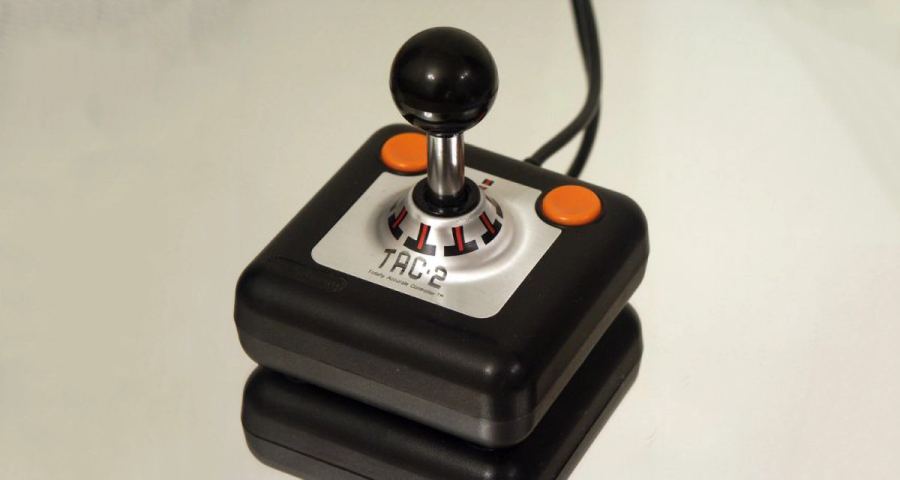
Anyone who played for years on Amiga knows the feeling: joystick in hand, one button, jumping often assigned to pushing the stick upward, constant compromises in games that clearly wanted more actions. It was a legacy of the Atari-style ecosystem, perfectly understandable in the 1980s, but increasingly problematic as console design refined the language of control.
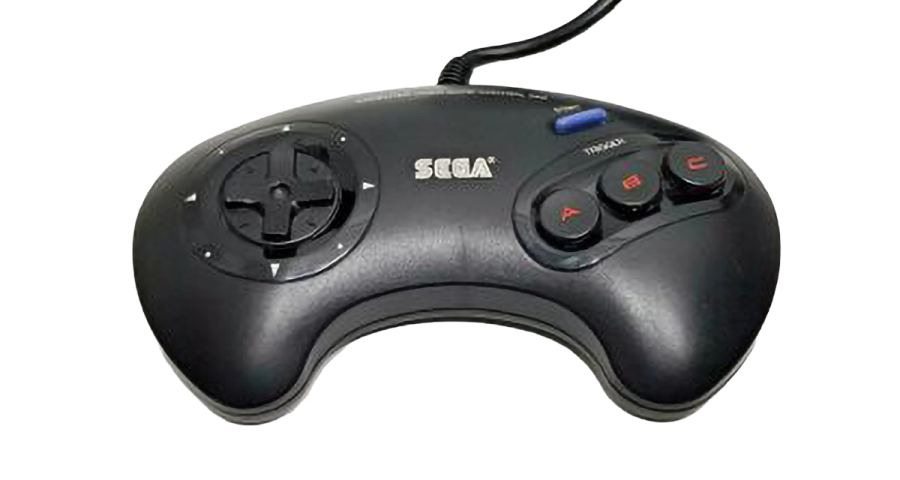
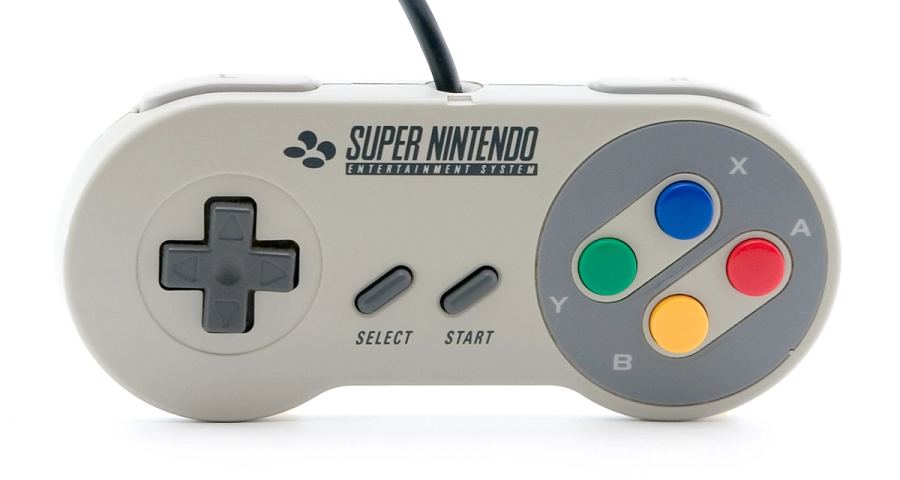
The Mega Drive started with a three-button pad, later expanded to six buttons to better support fighting games. The Super Nintendo offered four face buttons, two shoulder buttons and an excellent directional pad. These were not simply “more buttons”. They represented a different way of thinking about games. Jump, attack, run, block, special moves, weapon switching, grab, kick, punch: everything could be distributed across the hands more naturally.
This difference mattered enormously in fighting games. Street Fighter II on Super Nintendo was not important only because it brought Capcom’s arcade phenomenon home. It was important because the SNES pad offered a credible domestic translation of a six-attack arcade language. On Amiga, every conversion of that kind had to face a less favourable reality. It was not enough to reduce the graphics or adapt the audio. The whole control system had to be translated physically from a language born elsewhere.
The same applied to platform games. Jumping by pushing the stick upward was common, but not always ideal. In fast, precise games built around timing and control, a dedicated jump button changed everything. Sonic and Mario were not just characters: they were extensions of a pad, of responsiveness, of a relationship between hand and screen. Many Amiga platformers, even good ones, carried the weight of an interface that felt less modern for that kind of grammar.
Superfrog, for example, remains a beloved and polished Team17 production, but it also lives within that tension: the desire to give the Amiga a mascot in a world where Sonic and Mario had already defined the console platformer language. Zool pushed even harder toward speed and commercial visibility, but for that very reason it showed how difficult it was to chase Japanese mascots on their own ground.
It was not only a matter of power. It was a matter of hands.
Sprites, tiles, bitmap graphics and scrolling
When people talk about 16-bit graphics, the risk is turning everything into a ranking: how many colours, how many sprites, how much speed, how many parallax layers. But these machines did not draw the world in the same way.
Mega Drive and Super Nintendo were designed to handle tile-based backgrounds, hardware sprites and scrolling naturally. They were architectures built around a precise idea of videogame: characters moving through side-scrolling levels, objects on screen, moving backgrounds, parallax, bosses, repeated elements manipulated efficiently. Their hardware was not omnipotent, and each system had real limits and important differences, but both spoke the language of console action very well.
The Amiga worked differently. Its bitmap and bitplane graphics, blitter, copper and Commodore custom chipset offered enormous flexibility, but often required different solutions. With talent, deep knowledge of the machine and intelligent compromises, spectacular results were possible. Without that care, however, some genres ended up showing less fluid scrolling, fewer objects, less immediacy and less of what players called “console feeling”.
This is where the most interesting differences appear.
Sonic the Hedgehog was not just a fast game. It was a complete system: hardware, cartridge, level design, inertia, scrolling, collisions, pad and SEGA identity stitched together. Replicating that feeling on Amiga did not simply mean making a character run from left to right. It meant rebuilding a grammar. Some games tried to chase that direction, but the result could rarely feel as natural as it did on Mega Drive.
Super Mario World, on the other hand, did not rely on pure speed, but on control, readability, rhythm, secrets, pad design and refinement. It was a game that seemed to waste nothing. Here too, the advantage was not only technical: it was productive, design-led, cultural. Nintendo built games around its own machine with a confidence that few European studios could afford.
Then you loaded Lionheart and understood why the Amiga could not be dismissed as an inferior console. Thalion’s game showed another path: not the direct imitation of the Japanese model, but European technical pride, attention to visual detail and the desire to push the machine beyond common perception. It was not Sonic. It was not Mario. It was Amiga in a very deep sense.
The same applies to Shadow of the Beast. As a game, it could be debated, even criticised in terms of design, but as an audiovisual event it was a manifesto. Parallax, atmosphere, cover art, the Psygnosis logo, music, a sense of wonder: all of it helped sell not only a game, but an image of the Amiga as a machine capable of amazement. Seeing Shadow of the Beast in a magazine or on a screen meant perceiving a promise.
And then there was Turrican. Manfred Trenz’s saga, with music by Chris Hülsbeck and Factor 5’s work, was perhaps one of the most convincing answers to the wrong question: “could the Amiga have its own action game?” Yes, but not by copying Sonic or Mario. Turrican spoke another language: more European, more metallic, more exploratory, more hybrid. It was action, but also maze, atmosphere, music and home-computer power.
The Amiga was often less convincing when it tried to disguise itself as a console. It was much stronger when it remembered it was Amiga.


Three different ways of sounding like the 1990s
Audio was part of the war too, or at least of the arguments.
Paula, the Amiga sound chip, had four PCM channels and a very strong identity. It was not simply “better” or “worse” than its rivals: it was different. It enabled samples, modules, tracker compositions and sounds that seemed to come from a scene both artisanal and free. Amiga music was not just accompaniment. It was often a culture of its own. You could listen to it, take it apart, recognise it, copy it, rework it.
The connection between games, the demoscene and modules made the Amiga sound something deeply generational.
The Mega Drive had its Yamaha FM sound, sharper, metallic, urban, aggressive. In the right hands it could be irresistible: synthetic basslines, hard timbres, arcade energy, a sound that felt perfect for chases, fighting games, racing, night cities and mascots with attitude. It did not have the same sampled immediacy as the Amiga, but it had enormous character.
The Super Nintendo took yet another path. Its sampled audio could sound softer, more orchestral, more atmospheric. It had memory and compression limits, but when used intelligently it produced warm, enveloping, recognisable soundtracks. It was less rough than the Mega Drive and less “tracker” than the Amiga, but perfect for Nintendo’s idea of cohesive, elegant, polished worlds.
Trying to decide which one was “best” often means missing the point. Paula, Yamaha and SNES audio represented three different sound aesthetics. The Amiga described music as domestic, modular construction. The Mega Drive described it as synthetic energy. The Super Nintendo described it as sampled and narrative colour.
Three different ways of remembering the 1990s.
When the consoles were right
Being honest means admitting it: in many cases, the consoles were right.
Street Fighter II is the simplest example. Capcom’s phenomenon was born in the arcade, but on Super Nintendo it found a historically important home conversion. Not perfect compared to the arcade, of course, but credible, immediate, playable, supported by a suitable pad and by an audience ready to turn the living room into a small competitive arena. On Amiga, games of that kind suffered much more.
Not because Commodore’s computer lacked quality, but because one-on-one fighting games, animation, input and arcade rhythm demanded conditions that a standard Amiga did not offer as naturally.
The same was true of many licensed action games and platformers. Aladdin on Mega Drive, tied to the work of Virgin Games and David Perry, showed how a console could become a stage for fluid animation, immediate control and Disney imagery turned into a high-impact commercial game. The Lion King, with all its rough edges, belonged to the same moment in which the 16-bit consoles had become deeply integrated into the family entertainment market.
Mortal Kombat benefited from the console context for similar reasons: pad, immediacy, audience, conversions designed to be consumed quickly and with little friction. Compromises existed there too, but the language was closer to the console living room than to a home computer with a one-button joystick.
Even when the Amiga received decent conversions, there was often a feeling that some games had been born elsewhere. They were translations, adaptations, attempts to bring a cartridge or arcade experience onto floppy disk. Sometimes they worked. Sometimes they did not. But they rarely erased the difference in origin.
There are genres where the Amiga did not lose because it lacked charm. It lost because it was playing on a field drawn by others.


When the Amiga remained only Amiga
Then there were the games that did not apologise.
Turrican, Lionheart, Shadow of the Beast, The Chaos Engine, Lotus, Superfrog, Jim Power, Chuck Rock II: very different titles, not all equally successful, not all perfect, but united by one thing. They expressed a European way of imagining the 16-bit videogame. Sometimes more technical than polished, sometimes more atmospheric than balanced, sometimes more ambitious than accessible. But recognisable.
The Chaos Engine by The Bitmap Brothers, for example, did not need to look Japanese. It was hard, mechanical, dark, cooperative, with that metallic and grimy British aesthetic that made the studio immediately identifiable. It was not chasing the mascot. It was chasing personality.
Lotus brought an elegant, fluid, musical form of home arcade racing to the Amiga. It was not OutRun, it was not F-Zero, it was not Super Monaco GP. It was something else: a floppy-disk racing ritual, especially in company.
Superfrog perhaps aimed more openly at the console mascot world, but it did so with Team17’s polish, memorable music and a level of care that still makes it one of the most remembered Amiga platformers. Jim Power, with music by Chris Hülsbeck, pushed audiovisual impact and difficulty. Chuck Rock II told another part of Core Design’s story, before that name became mainly associated with Tomb Raider.
And then there was Another World, which never truly belonged to any war. Éric Chahi’s masterpiece was not important because it was “better on Amiga” or “better on console”, but because it showed how videogames could become cinematic language, subtraction, animation and atmosphere. It was one of those titles capable of crossing platforms without losing its identity, which makes it perfect for reminding us that history is not always divided into teams.
The Amiga shone when it stopped asking how to beat the consoles and started doing what it did best: fusing game, technique, music, graphics and imagination into something less standardised.
Europe, Japan and the living room
The comparison between Amiga, Mega Drive and Super Nintendo was also a comparison between production cultures.
The 16-bit consoles represented the mature face of the Japanese videogame industry. SEGA and Nintendo offered two different ways of conquering the living room: the Mega Drive was more aggressive, arcade-driven and adolescent; the Super Nintendo was more colourful, controlled and family-oriented. Both, however, thought in terms of closed hardware, strong brands, franchises, distribution, licences, mascots and control of the experience.
The Amiga belonged to another geography. In perception, it was deeply European, especially in the way it was lived in countries such as the United Kingdom, Germany, Italy, France and Scandinavia. It was the machine of medium-sized software houses, bedroom coders, magazines, cover disks, shops full of illustrated boxes, demo groups and productions that often seemed born more from ambition than from industrial planning.
This difference explains a lot.
The consoles built closed and coherent worlds. The Amiga built possibilities. Not always orderly, not always polished, not always commercially competitive, but alive. This is why many users do not remember it only as a games machine. They remember it as a formative passage. With Amiga, you did not only play: you learned that behind the screen there could be something to create.
This does not make the consoles inferior. Mega Drive and Super Nintendo were extraordinary machines, probably more effective than the Amiga in many fundamental action genres of the 1990s. But the Amiga left a different mark. Less linear, harder to measure, but very deep.
Not a failed console
The most unfair way to describe the Amiga is to call it a failed console.
It is true that many people bought it to play games. It is true that Commodore, especially later, also tried to move closer to the console language, all the way to the CD32. It is true that in direct comparison with Mega Drive and Super Nintendo, the standard Amiga showed concrete limits: floppy disks, one-button joysticks, difficulty with arcade conversions and hardware that was not specialised in the same way for certain genres.
But the Amiga did not fail when it failed to be a console. The comparison failed only when we decided to reduce it to that.
Its strength was broader. It was in the constant passage between play and creation. It was in the possibility of listening to a music module and wondering how it had been composed. It was in seeing a demo and understanding that the machine could be pushed beyond what the manual promised. It was in drawing, copying, loading, modifying, exploring. It was in that very 1990s feeling that the computer at home was not just a device, but a door.
Mega Drive and Super Nintendo often won the battle of immediacy. They won many action-game fights. They won in control, cartridge use, pad design and clean experience. The Amiga won another battle, one that is harder to explain in a comparison screen: the battle of domestic creativity.
That is why the comparison is still interesting. Not because it needs to tell us who was right in 1993. Back then, very little was needed to start an argument, and perhaps that was part of the fun. Today we can afford something better: understanding why those machines spoke different languages.
The Mega Drive ran. The Super Nintendo refined. The Amiga imagined.
And in that difference, there is still a lot to tell.
Tell us your version
This series is also built from the memories and points of view of those who lived through those years, discovered them later or rediscovered them today. In the comments, you can add examples, games, corrections and different opinions. The goal is not to declare a winner, but to rebuild a piece of videogame culture together.
Discussion is welcome. Recreating the religious wars of 1993 is not. Tell us your experience, even if you disagree.
Which game made you feel that the Amiga could challenge Mega Drive and Super Nintendo, and which one felt truly out of reach on floppy disk and a one-button joystick?
Reader memories
Comments, memories and points of view stay here, beside the article.
Comment rulesLog in or register to leave a comment.
Leave a comment
Create your account
Loading comments...