


There are games you want to love because they seem to belong naturally to the happy memory of a machine. Superfrog is one of them. It is Team17, it is Amiga, it is colour, it is a frog with a cape in an era when every platform seemed to need its own cover hero. And yet, every time I tried to like it, something never quite worked.
This is not a bad game. Saying that would be unfair and, frankly, wrong. Superfrog is polished, smooth, clean and professionally made. It is a more than decent platformer, with solid production values and a beautiful presentation. The problem lies elsewhere: for years it was described, celebrated and remembered as something much bigger. Almost the definitive Amiga platformer. Almost Commodore’s answer to Mario and Sonic. Almost the mascot that would finally settle the argument.
That is where Superfrog begins to crack.
Team17 and the cult of perfect packaging
I have always had a complicated relationship with Team17. On Amiga, the studio was often celebrated almost automatically: every new release seemed to arrive with an aura of quality, technical elegance and membership of some kind of Commodore elite. Part of that reputation was deserved. Team17 knew how to package games, how to present them, how to give its products an immediately recognisable identity.
And yet, for me, they rarely warmed the heart. I loved Project-X, with all its excesses, and I had a lot of fun with Arcade Pool. But the technically solid Assassin always bored me, Body Blows felt forgettable, and even Alien Breed, as atmospheric and well made as it was, often left me colder than I wanted it to.
Superfrog is the perfect example of that feeling. It was a game carefully built to be desired by Amiga users. It arrived at a time when the Commodore audience needed a recognisable, colourful, fast character to place, at least symbolically, against the great heroes of Japanese consoles. Team17 offered exactly that image: a frog with a cape, a bright presentation, a promise.
The problem is that not every promise is fulfilled, and results are not always equal to expectations.
A genuinely beautiful presentation
The presentation is probably the best thing about the game. Bright, colourful and full of personality, it has the feel of a cartoon introduction promising a lively, modern adventure, almost console-like in tone. Superfrog presented itself wonderfully: it looked like the mascot the Amiga had been waiting for, a character able to enter the imagination without simply copying Mario or Sonic too openly.
In those opening moments, Superfrog works. It has identity, charm and rhythm. It suggests a light fairy-tale world, immediate and accessible. There is that feeling of “here we go”: Team17 seemed to understand what Amiga players wanted and appeared ready to give them the colourful, smooth and recognisable platformer that had been missing.
Then the actual game begins, and the magic starts to thin out.
Not because Superfrog is badly made. Quite the opposite. The problem is almost the reverse: everything is too orderly, too controlled, too clean. It feels like a game designed to make very few mistakes, but also one that never really manages to surprise.


Technically clean, not astonishing
Superfrog is often remembered as one of the most technically solid Amiga platformers, and to some extent it is. The scrolling is smooth, the play area is large, the general response is stable and the game never feels like it is struggling. But there is a long distance between that and calling it a real hardware showcase.
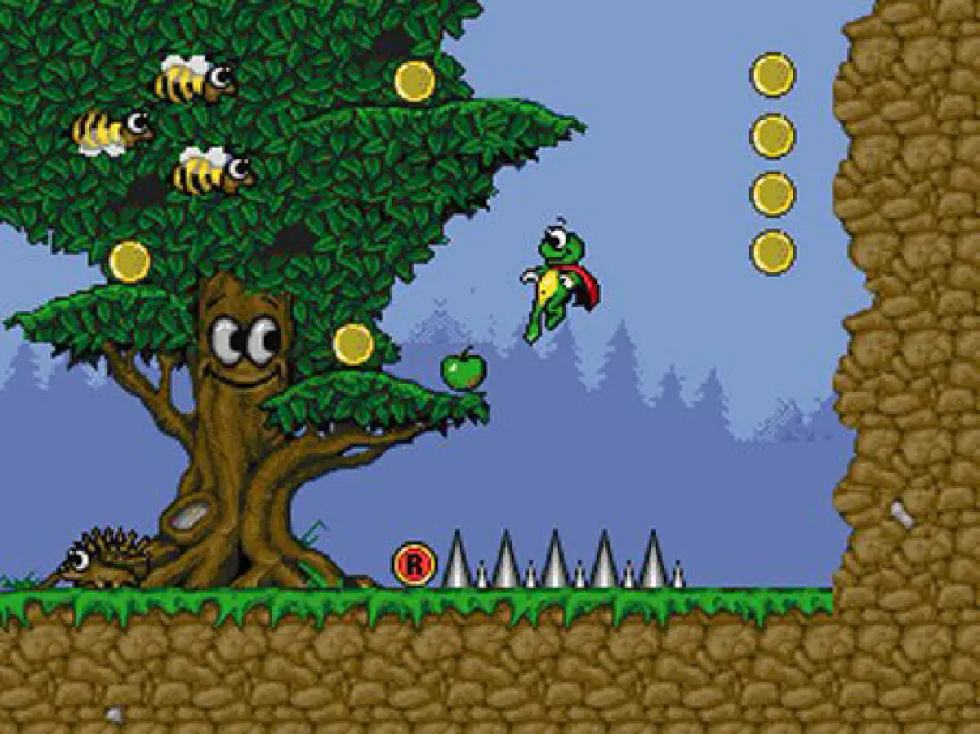
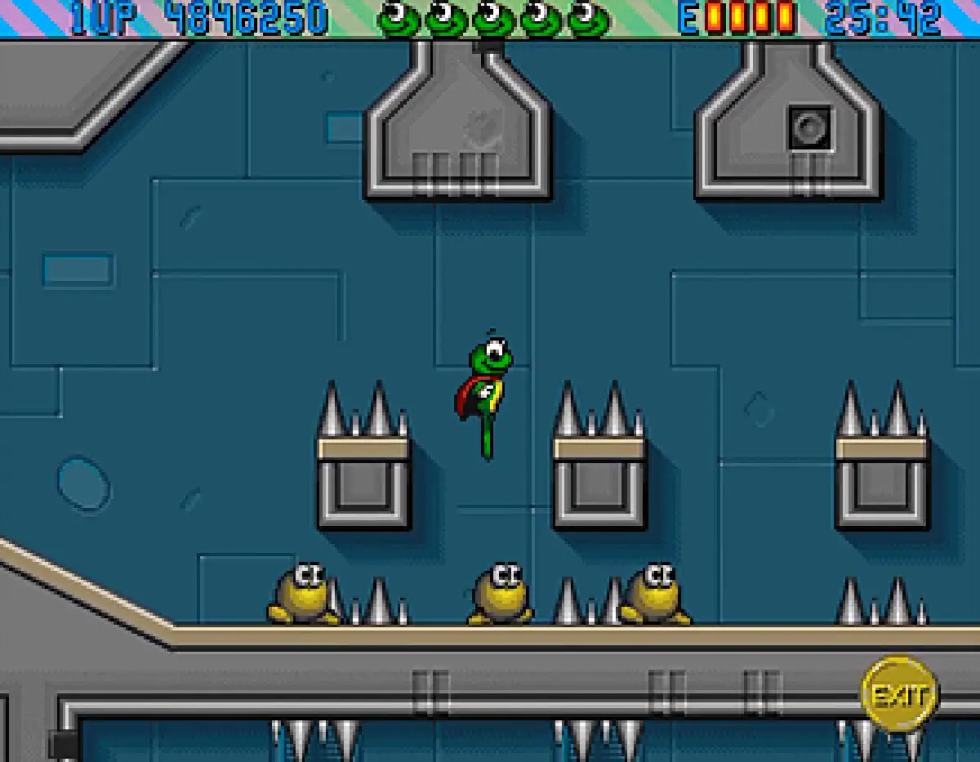
The colours are the standard colours of many Amiga productions, without any particularly surprising solution. There is no parallax scrolling, and the visual impact remains more orderly than spectacular. The main character is small, the enemies are often tiny, static and not especially charismatic. The screen is readable, certainly, but rarely alive.
Compared with other games on the same machine, Superfrog hardly looks like an absolute technical peak. Ruff ’n’ Tumble had a huge main sprite and a far stronger arcade impact. Kid Chaos genuinely chased speed. Fire & Ice had more atmosphere and more visual personality. Zool, for all its chaos and problems, at least had a more aggressive and recognisable pop identity. And if we widen the comparison to games such as Lionheart, Jim Power or Shadow of the Beast, the technical comparison becomes almost unfair.
Superfrog is clean. It is smooth. It is well packaged. But it is not astonishing.
It is a classic Team17 product: extremely polished on the surface, very careful in presentation, but less ambitious than the myth often suggested.


The rhythm never really takes off
The biggest limit of Superfrog, for me, is not technical. It is rhythm.
The game starts, moves well and seems ready to grow. You expect it to open up at any moment, for the levels to become more surprising, for ideas to arrive that can transform a correct platformer into something truly engaging. Instead, it remains where it is: linear, orderly, predictable.
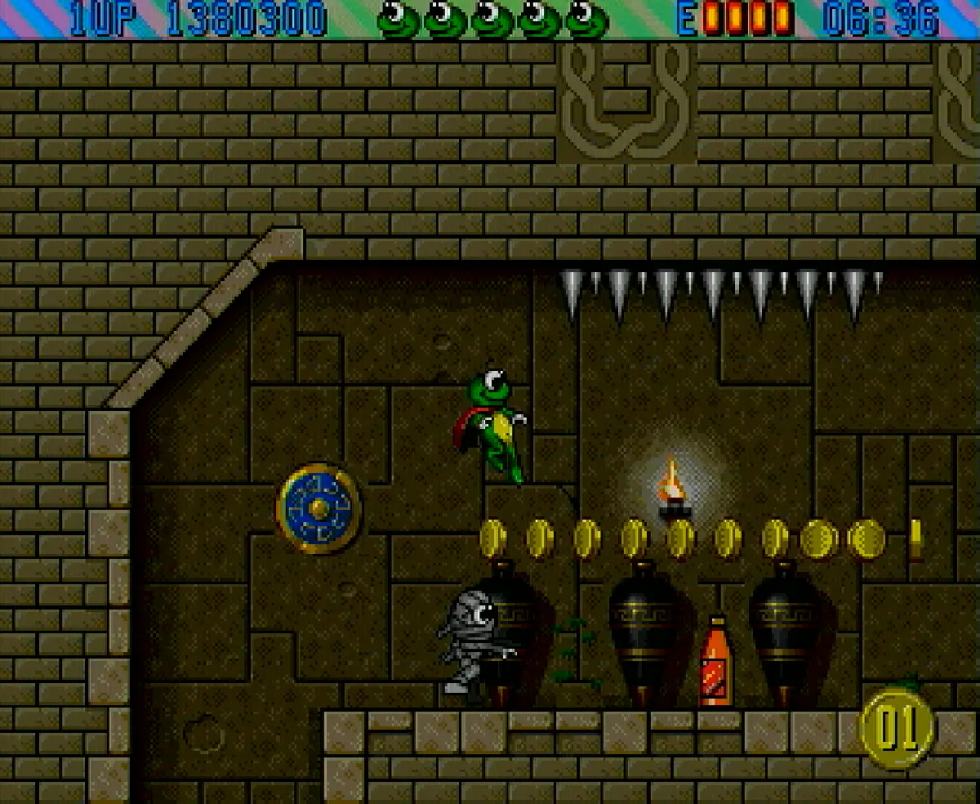
The levels are large, full of coins, bonuses, passages and things to collect, but they rarely build real tension. The structure works, yet over time exploration becomes more mechanical than exciting. You run, jump, collect, search for the exit, but the sense of escalation is missing. There is no real feeling of being pulled into a world that changes rhythm, raises the stakes or surprises you.
Above all, Superfrog lacks that beneficial chaos that makes many platformers memorable: recognisable enemies, sudden situations, jumps that stay in your hands, levels that change tone while you move through them, small moments of controlled madness. Superfrog is too composed. Too polite. It almost never stumbles, but it never truly takes off either.
It is a game that always seems about to become more fun than it is. Then it does not.
A mascot with little charisma inside the game
A mascot does not live only on the cover or in the introduction. It lives above all in the way it moves, reacts, occupies the screen and stays in the player’s memory.
From this point of view, Superfrog never convinced me. The character is likeable as an idea, but small and not very expressive during the actual game. He does not have Mario’s physical presence, Sonic’s iconic speed, or even the aggressive oddness that made Zool instantly recognisable. He is correct, functional, but not magnetic.
The enemies do not help much either. Bees, snails, hedgehogs, small animals and various obstacles fill the levels without becoming truly memorable presences. They often feel like elements placed where they need to be, more than creatures able to give personality to the game world.
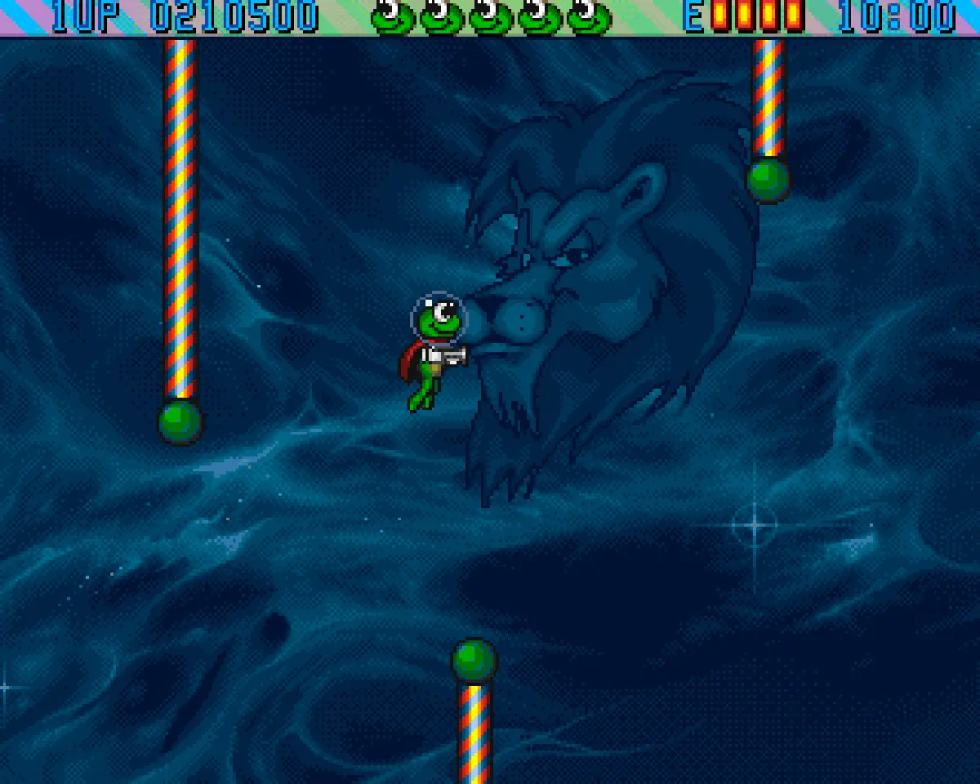
And then there is one element whose absence matters a lot in a mascot platformer: end-of-level bosses. This is not a minor detail. In this kind of game, a boss is not just a test of skill. It is a break in rhythm, an event, a moment of characterisation. It closes a world, gives weight to progression and makes the transition from one area to the next more memorable.
Superfrog almost completely gives up that dimension. It proceeds with its linearity, its order, its cleanliness. But that absence only reinforces the feeling of a platformer without real peaks, without moments capable of changing pace.
Even the sound stays in the background
Allister Brimble was, and is, a very talented musician. On Amiga he created clean, technically solid and often very polished soundtracks. But Superfrog, at least for me, is not one of his most memorable works.
The music accompanies the game well. It is cheerful, professional and consistent with the light fairy-tale tone of the adventure. But it rarely strikes hard. It does not have the melodic strength to remain in your head for days, nor the rhythmic drive that could have made a real difference in a mascot platformer.
Here again, the game feels refined more than inspired. There is nothing truly wrong, but there is no musical theme that makes you want to come back just to hear it again. The presentation promises personality; the game, even in its music, gives back much less.
The inevitable comparison with consoles
In 1993, Superfrog could not be judged only inside the Amiga catalogue. The platform genre had already been reshaped by Japanese consoles.
On Mega Drive, Sonic the Hedgehog had imposed a new idea of speed, rhythm and visual identity. On Super Nintendo, Super Mario World was still a lesson in control, level design and characterisation. On consoles there were already Disney games such as Castle of Illusion and World of Illusion, able to combine animation, atmosphere and immediacy with a naturalness rarely seen on Amiga.
There is no need to bring in later monsters such as Donkey Kong Country or Yoshi’s Island, because those belong to another production and creative planet. Mario, Sonic, Sega’s Disney platformers, Mega Man and much of the Japanese school of the period are already enough to show how high the standard was.
The point is not to say that the Amiga was an inferior machine overall. That would be absurd. The Amiga had charm, audio, creativity, demoscene culture, versatility and an identity all its own. But the mascot platformer required a very specific grammar: inertia, collisions, rhythm, spatial readability, character personality, level progression and control precision.
On that ground, Sega and Nintendo were years ahead.
Superfrog felt more like the attempt to finally have a presentable mascot than a true alternative to the console giants.


The British press and the weight of expectation
The Superfrog myth did not come out of nowhere. At the time, parts of the Amiga press welcomed it with enormous enthusiasm. One of the most useful British examples is Amiga Computing, which gave the game a very high 93%, describing it as one of Team17’s strongest releases of the period and praising its graphics, sound, playability and addictive quality.
That kind of enthusiasm says a lot about the relationship between Superfrog and its time. It was not just about reviewing a platformer. It was about finally celebrating a game that seemed to give the Amiga something it had been chasing for years: a clean, fast, colourful and defensible mascot. A title to show with pride, an argument to use in the symbolic war against consoles, a flag to plant on the most difficult ground for the Commodore machine.
The interesting thing is that not everyone was equally convinced. Amiga Power, for example, was much cooler and gave Superfrog 78% in its original 1993 review. That lower score feels almost more revealing today, because it shows that even at the time the game’s status was not completely untouchable.
The question, then, is not whether Superfrog was good. It was. The question is how much of that enthusiasm belonged to the game itself, and how much belonged to the desire to see the Amiga finally step into the ring of great console platformers with a presentable champion.
Looking back, some of that praise feels less like a balanced judgment and more like the reflection of a collective need.
A good game loaded with too much hope
This is where Superfrog becomes interesting, perhaps more as an Amiga phenomenon than as a platformer.
It did not become important only because of its qualities. It became important because it arrived when Amiga players needed to believe. They needed to say: we have a mascot too, we have a colourful, smooth, modern platformer too, something that can stand, at least ideally, beside the big console names.
Superfrog offered a visible answer to that desire. It had the right logo, the right presentation, the right character, the right timing. But the actual game was much more ordinary than the myth growing around it.
It was not the solution. It was something to hold on to.
Played today, far from the need to defend the Amiga at all costs, Superfrog appears for what it probably always was: a good Amiga platformer, not the great Amiga platformer. A decent, polished, smooth and pleasant game, but too linear, too composed and too lacking in charisma to carry all the symbolic weight placed upon it.
Conclusion
Superfrog is not rubbish. It is not even a bad platformer. It is a more than decent title, technically solid, well packaged and still respectable today. The problem is the distance between the real game and the myth that grew around it.
Taken for what it is, it remains a clean and enjoyable Team17 production, with a beautiful presentation and professional execution. Placed on the pedestal of the great Amiga platformer, the long-awaited mascot, the Commodore answer to Mario and Sonic, the picture changes completely.
There, Superfrog does not hold up.
Not because it is badly made, but because the great console platformers of the period were playing a different sport. They had more rhythm, more ideas, more personality, more precision, more character. Superfrog had packaging stronger than its content, a promise stronger than its result, a reputation larger than the game itself.
Perhaps that is exactly what it is: a good 7.5 game often remembered as if it were a 9. Not mediocre, not negligible, not without merit. But not unforgettable either.
Amiga users needed their own mascot and, for a while, Superfrog was good enough to fill that space. I tried several times. I respected it, understood it, recognised its care and polish.
But I never managed to love it.
Reader memories
Comments, memories and points of view stay here, beside the article.
Comment rulesLog in or register to leave a comment.
Leave a comment
Create your account
Loading comments...