




The last great miracle of the Commodore 64
By 1993, the Commodore 64 was already an old machine. The market had moved elsewhere: Amiga, Mega Drive, Super Nintendo and PC were shaping the imagination of players, while Commodore’s 8-bit computer seemed destined to survive mostly through memories, small budgets and increasingly modest conversions. And yet, right at that moment, Mayhem in Monsterland arrived: one of those games capable of making even those who thought they knew every limit of the C64 look twice.
Developed by Apex Computer Productions, the studio founded by brothers John and Steve Rowlands, already known for Creatures and Creatures II, Mayhem in Monsterland was not simply an excellent platform game. It was a technical statement, almost a challenge thrown at a market that had already filed the Commodore 64 away as yesterday’s machine. In an era when fast, colourful platformers had become the natural territory of 16-bit consoles, Apex tried to bring to the C64 an experience that felt bright, fluid and surprisingly modern.
The result is one of the last great commercial releases for Commodore’s machine, but also one of its most important. Not because it arrived late, but because it proved how much talent, hardware knowledge and craft could still extract unexpected results from a platform born more than ten years earlier.
A colourful, fast and unexpectedly ambitious platformer
Mayhem in Monsterland is, at first glance, a horizontally scrolling platform game with a fairly simple structure. Its hero, Mayhem, is a small cartoon creature somewhere between a dinosaur and a reptile, tasked with restoring happiness to a world that has been transformed into a dark and hostile place.
Each area is divided into two conceptual phases. First, you have to collect enough magic stars to awaken the level from its “sad” state. Then, in the happy version of that same world, you move toward its actual completion.
This idea gives the game a very clear identity. It is not just about reaching the end of a stage, but about transforming it. Colours change, the atmosphere becomes lighter and the level takes on a new personality. It is a simple but effective choice, one that supports the game’s central theme and allows Apex to show two sides of the same environment without overcomplicating the structure.
The progression remains linear, but the pace is high. Mayhem runs, jumps, bounces on enemies and crosses stages filled with platforms, hazards and secrets. The influence of console platformers is obvious, especially in the speed and in the desire to offer something more dynamic than many traditional C64 platform games. And yet Mayhem in Monsterland never feels like a poor imitation of Sonic or Mario. It is deeply Commodore 64: designed around the machine’s limits, but also around its possibilities.
Technically impressive
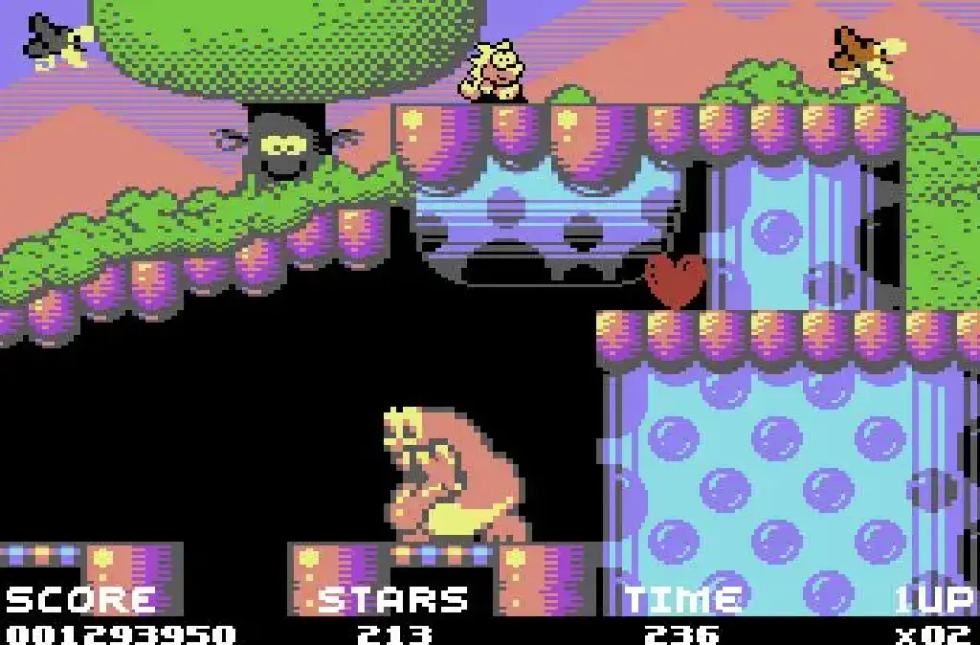
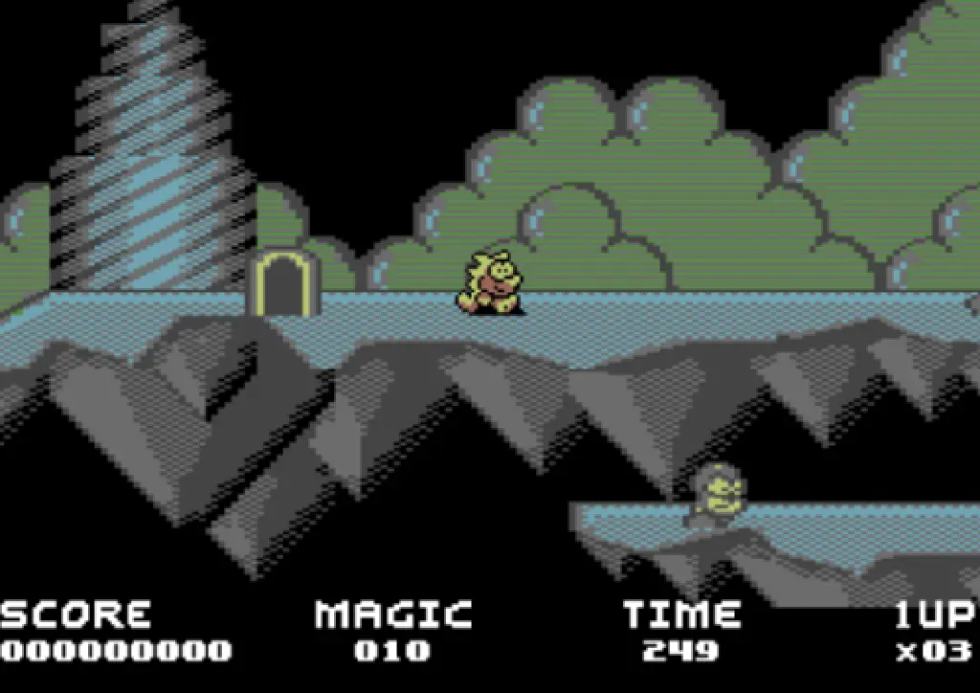
The first thing that stands out is the fluidity. Mayhem in Monsterland moves with a naturalness rarely seen on the C64, thanks to fast, clean and remarkably stable scrolling. It feels like a game trying to free itself from the stiffness often associated with 8-bit platformers, offering movement that is more elastic, almost console-like.
The visual work is just as remarkable. Backgrounds are colourful, readable and full of small details, while the main character has an immediate stage presence. Of course, this is not the colour richness of a 16-bit system, but Apex achieves a surprisingly strong visual impact through intelligent use of palette, sprites and level composition.
The C64 is not pushed blindly here: it is understood. Every choice seems to come from deep familiarity with the hardware. Sprites are large enough to feel expressive, animations are lively, the screen remains readable even in faster sections, and the whole game communicates a level of technical care far above the average.
Sound also plays an important role. Steve Rowlands’ music uses the SID with bright, immediate melodies that support the cheerful tone of the game without becoming intrusive. The audio fits perfectly with the cartoon setting and contributes to that “premium” feeling that Mayhem in Monsterland still manages to convey today.
Controls that are not always perfect
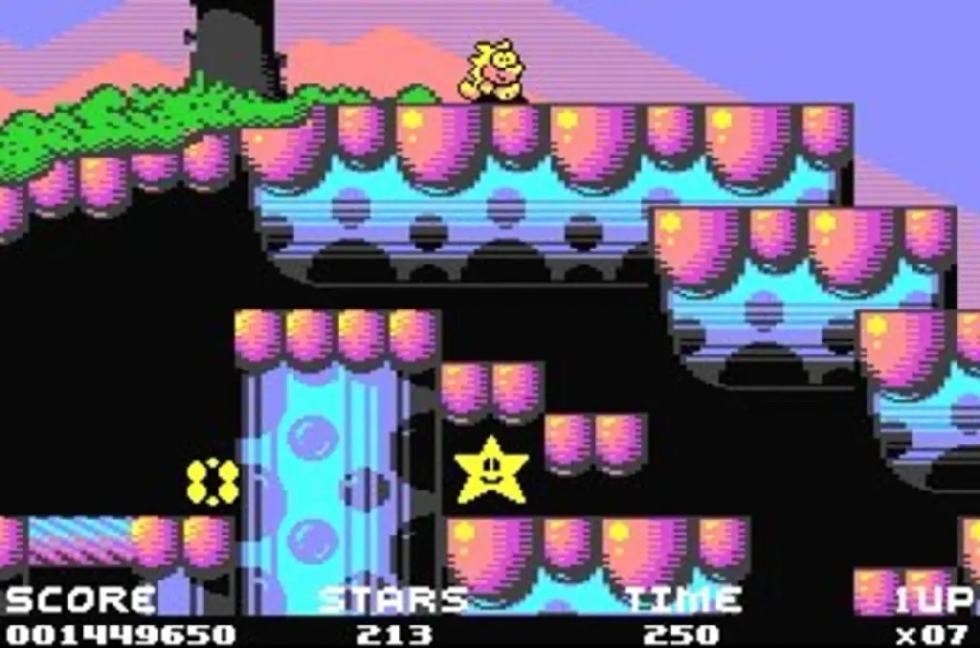
For all its technical brilliance, Mayhem in Monsterland is not without limits. Mayhem’s controls are quick and responsive, but they require some adaptation. The physics favour speed and momentum, and in some sections precision is not always as clean as one might expect from a modern platform game.
This does not ruin the experience, but it does make it slightly rougher. Mayhem does not have the surgical precision of Nintendo’s best platformers, nor the obsessively tuned inertia of Sonic. It is a game built to impress and entertain, not always to refine every contact to the millimetre.
The difficulty can also be demanding. Some levels require memory, attention and a fair amount of patience, especially when trying to collect everything or explore more carefully. The star-based structure works well, but it can sometimes slow the rhythm when you are stuck looking for the last objects needed to progress.
These are real flaws, but they should be understood in context. Mayhem in Monsterland is an extremely ambitious game running on a machine that was already living through its final commercial phase. A few rough edges were almost inevitable, and in a way they are part of its identity.
The charm of a game that arrived out of time
An important part of Mayhem in Monsterland’s appeal lies precisely in its timing. In 1993, a platformer like this on Commodore 64 felt both anachronistic and wonderful. It was like watching an old racing car pull off one last perfect lap when everyone thought it had already returned to the pits.
The game did not change the commercial fate of the C64, and it could not have done so. The market had moved on. But for those who were still following the Commodore scene, it felt like a final gift: proof that the hardware still had something to say when placed in the right hands.
Today, Mayhem in Monsterland is often remembered as one of the last masterpieces of the C64, and with good reason. It is not just a good platform game. It is an exclamation mark at the end of a very long story. After years of memorable games, questionable conversions, broken limits and creative compromises, the Commodore 64 said goodbye to its fans with a title that seemed to whisper: you have not seen everything yet.
A late classic, but an essential one
Played today, Mayhem in Monsterland retains much of its charm. Some aspects clearly reveal its age, and certain gameplay choices may feel less refined than the great console platformers of the same era. But its value remains enormous, especially when considered as a Commodore 64 game.
It is fast, colourful, technically bold and full of personality. It has a strong identity, above-average execution and that rare quality of games that arrive at exactly the right emotional moment to become legendary among fans, even while the mainstream market is looking somewhere else.
Mayhem in Monsterland is not only one of the best platformers ever released for Commodore 64. It is one of the clearest examples of how a machine can continue to surprise when someone decides not to treat it like a relic, but like a living instrument.

Reader memories
Comments, memories and points of view stay here, beside the article.
Comment rulesLog in or register to leave a comment.
Leave a comment
Create your account
Loading comments...