



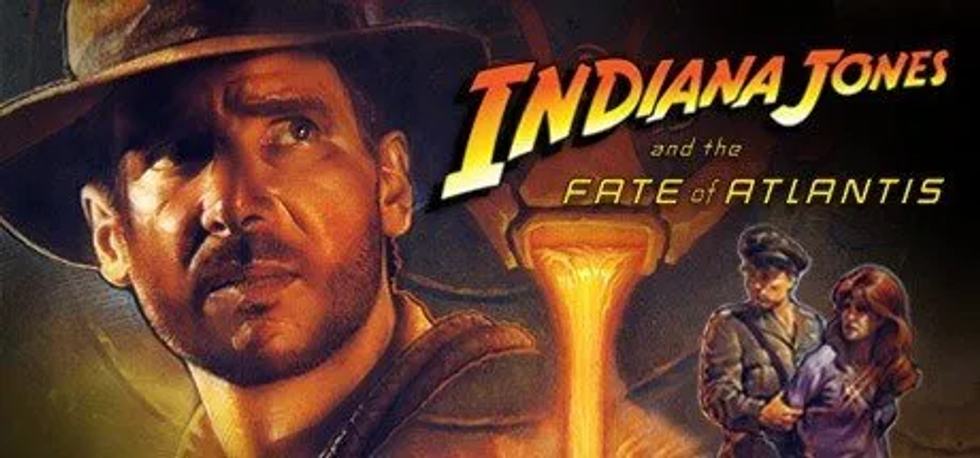
One year after the extraordinary Monkey Island 2, LucasArts returned in spectacular form with another absolute masterpiece of the point-and-click genre. And really, who else but the world’s most famous archaeologist could take centre stage?
Led by Hal Barwood, with Noah Falstein as co-designer, Indiana Jones and the Fate of Atlantis was not a simple adaptation of an existing film, but an original Indiana Jones story built directly around the language of the adventure game.
Indiana Jones and the Fate of Atlantis takes place after Indiana Jones and the Last Crusade, the game inspired by Steven Spielberg’s film. This time, our archaeologist finds himself involved, almost against his will, in the search for the lost city of Atlantis, while trying to prevent Nazi agents from obtaining the legendary orichalcum, a metal said to hold a power greater than uranium. Their plan, naturally, is to use it to strengthen their weapons and push forward yet another insane dream of world domination.
Searching for Atlantis
The game is set in 1939, shortly before the Second World War. The opening sequence also works as a brilliant interactive introduction: we help Indiana Jones search inside the Barnett College museum for a mysterious statuette, recovered during an expedition in Iceland. Indy has been sent by a man calling himself Smith, who owns a key capable of opening the artefact.
Once the statuette is found, Indy inserts the key, opens it and discovers a small metal bead inside. At that point, Smith pulls a gun on Indy and Marcus, steals both statuette and bead, and escapes through a college window. In the attempt to stop him, Indy ends up with the man’s jacket and discovers that “Smith” is actually Klaus Kerner, an agent of the Third Reich.
Inside the jacket, together with his documents, Indy also finds a newspaper with one name circled in red: Sophia Hapgood. His former assistant from the Jastro expedition in Iceland is in danger.
Around the world with Indy and Sophia
Indy immediately rushes to New York to save Sophia from a possible Nazi attack. The former archaeologist has abandoned academic research and reinvented herself as a medium, holding a seminar on the lost city and claiming to be in spiritual contact with Nur-Ab-Sal, the supposed god-king of Atlantis.
After managing to speak with Sophia, obviously causing a nice little disaster in the process, Jones discovers that she is not only deeply familiar with the Atlantis myth, but also owns a mysterious necklace recovered in Iceland, apparently connected to the ancient Atlantean civilisation.
The two then decide to return together to the old Icelandic dig site, where a certain Bjorn Heimdall is continuing his research, hoping to find further clues that might lead them to the lost city.
Wits, team or fists?
At a certain point in the adventure, Fate of Atlantis asks the player to choose how to proceed. There are three different paths leading to Atlantis, each with its own puzzles and situations. You can rely on Indy’s intelligence and go solo, share the journey with Sophia, or take the more physical route and solve problems with a heavier dose of action.
It is an excellent idea, and one that greatly increases the game’s longevity. Once finished, it gives you a real reason to start again and discover what changed along the way.
There are also multiple endings depending on the choices made in the final act of the adventure. The best advice is to save before choosing your path and before the last stretch, so you can enjoy the different routes and conclusions without replaying all the shared sections.
The interface is the same already seen in Monkey Island 2: verbs on the left, inventory on the right, and the classic SCUMM structure handling everything with its usual elegance.
A painful farewell
Technically, the game is once again powered by LucasArts’ tried-and-tested SCUMM engine. Here we focus on two versions in particular: Amiga and MS-DOS, starting with Commodore’s machine.
Sadly, Indiana Jones and the Fate of Atlantis was the last LucasArts title developed for Amiga. The Amiga 1200 arrived late, and although it improved the situation, it was not enough to justify a dedicated version that could fully exploit the newer hardware. By then, the market had moved on, and developing specifically for machines that were increasingly showing their age made less and less sense.
At the time, most Amiga users still owned an Amiga 500, often with 1 MB of RAM and no hard disk. Playing Fate of Atlantis by constantly swapping its eleven floppy disks was not exactly pleasant, and the faithful 7 MHz Motorola processor was beginning to feel the weight of its long and honourable career. Some scenes suffer from truly heavy slowdowns. Just take a walk through the square in Algiers and you will understand.
Things improve considerably on an Amiga 1200, although the AGA chipset is not used in any meaningful way. A shame, because it might have allowed for a much closer conversion.
The much-praised iMUSE system also does not work as it should on Amiga, failing to adapt dynamically to the evolution of the adventure. On the other hand, at first glance the graphics do not suffer too badly from the downgrade from the 256 colours of the VGA version to the 32 colours of the OCS/ECS Amiga release. As with Monkey Island 2, the effective number is slightly higher if you also count the colours used for inventory objects.
Played today, the recommendation is clear: use a hard disk or Compact Flash setup, and preferably at least an Amiga 1200. Otherwise, the experience can become frustrating.
The MS-DOS version is the clear winner. VGA graphics offer much richer colours, more animated background elements and consistently smooth scrolling, with no major slowdowns or hesitation. It also adds a level of parallax not present on Amiga.
Sound is another area where the PC version pulls ahead. There are more musical cues, many sound effects missing from Commodore’s computers, and iMUSE works properly. A CD-ROM edition was also released, adding digitised speech.
Character animations are beautiful in both versions. Indy, Sophia and the supporting cast often gesture with surprising realism, giving each character a more distinct personality and making the adventure feel even closer to an animated film.


Conclusion
Indiana Jones and the Fate of Atlantis is one of the greatest graphic adventures ever made. It offers an experience that is, if not superior, at least equal to Monkey Island 2. For many fans, it represents the true fourth chapter in the Indiana Jones saga, and many would have loved to see it adapted for the cinema.
That never happened. Years later, cinema would take Indiana Jones in a very different direction with Indiana Jones and the Kingdom of the Crystal Skull.
Fate of Atlantis also remains the last truly great classic adventure dedicated to Indy. What came afterwards explored different genres and different expectations, but never achieved quite the same impact. Perhaps, instead of forcing the character too far into action game territory, it would have made sense to return to the dear old point-and-click formula, a genre that fits Dr. Jones’ adventures almost perfectly.
Or maybe that is just nostalgia talking.

Reader memories
Comments, memories and points of view stay here, beside the article.
Comment rulesLog in or register to leave a comment.
Leave a comment
Create your account
Loading comments...