




Before football games became television simulations, official licences, motion capture and broadcast-style direction, there was a pitch seen from above, twenty-two tiny players and a ball that always seemed to escape half a second before you expected it. Sensible World of Soccer did not try to imitate a real match. It tried to capture its essence: rhythm, instinct, geometry, mistakes, sudden shots, diagonal runs across the pitch, goalkeepers beaten by dirty but perfect trajectories.
In 1994, the Amiga was no longer the machine of the future. The market was looking towards 16-bit consoles, increasingly powerful PCs and, not long after, the PlayStation generation. Yet it was precisely on Amiga that Sensible Software created one of the most important sports games ever made: not just an evolution of Sensible Soccer, but a radical transformation of what football on a computer could be.
Sensible World of Soccer took the brilliant core of the original Sensible Soccer — immediacy, top-down view, one-button control, lightning-fast matches — and built an entire universe around it. Leagues, cups, national teams, clubs from all over the world, transfers, player-manager careers, promotions, relegations, squad building. Football was no longer just the match. It was the world that contained it.
Total football on Amiga
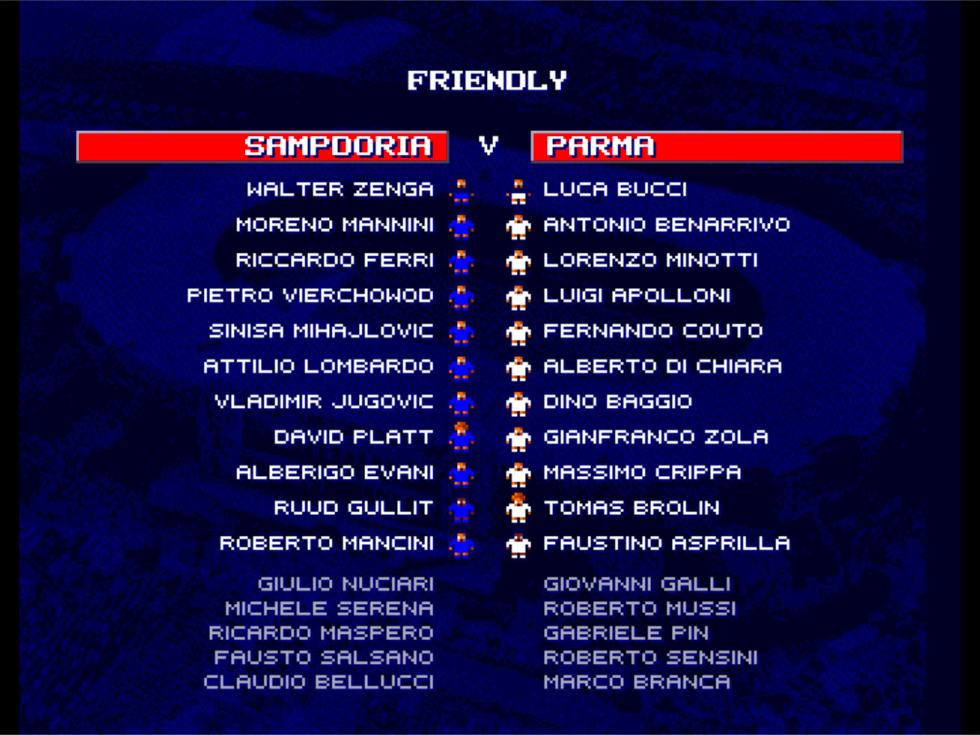
The greatness of SWOS lies in an apparent contradiction: it is incredibly easy to start playing, yet extremely difficult to master. Its control system is essential, almost brutal. You move in eight directions, pass, shoot, tackle and apply spin to the ball. Everything feels immediate, but after only a few minutes it becomes clear that beneath that minimal surface lives a much deeper system.
The ball is not glued to your players’ feet. It has to be guided, controlled, corrected. Shooting is not simply pressing a button, but a matter of angle, timing, momentum and body position. A shot can become a low drive, a chip, a diagonal strike, a central rocket or a mocking curved finish depending entirely on how you reach the ball and what you do in the instant that follows. This is where Sensible World of Soccer becomes almost musical: every move is born from micro-movements, habits and reflexes.
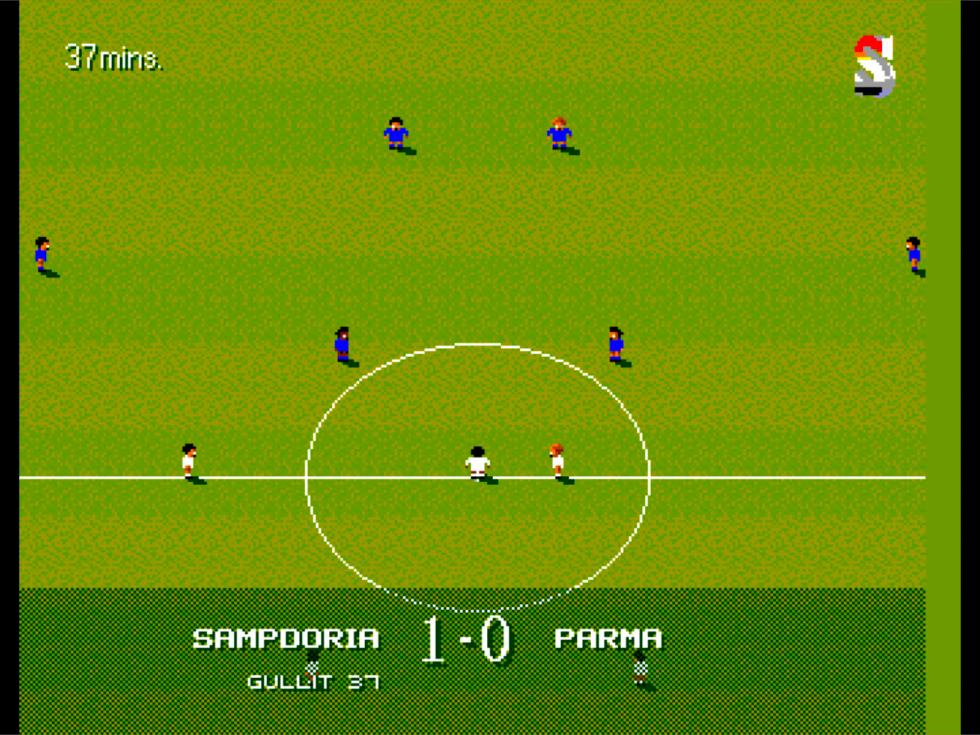
The top-down view, with tiny players and a wide pitch, is not a technical limitation but a design choice. It lets you read space, passing lanes and movement with a clarity that many more spectacular football games would later lose. SWOS does not put you inside the match through graphics. It puts you inside through control.
The world on a floppy disk
The word “World” in the title was not marketing. It was a statement of intent. Sensible World of Soccer included an enormous number of teams, nations and competitions, combining arcade football with a light but surprisingly compelling management structure. Historical sources often point to around 1,500 teams and 27,000 players: astonishing numbers for the time, and still impressive today when compared with the game’s sheer compactness.
It was not a pure management game, and it never tried to be. It was something stranger and more original: a game where you could take a modest team, play the matches yourself, enter the transfer market and build, season after season, a small personal epic. The database was not there just to add volume. It gave the player the feeling of standing in front of a vast, branching, living football world.
For many players, this was the real revolution. FIFA was beginning to build the future of televised football, with licences, presentation and isometric perspective. SWOS moved in the opposite direction: it removed everything unnecessary and gave the player total control. It was not realistic in appearance, but it was credible in emotional rhythm. It took only a few seconds to understand whether a team was working, whether a striker had the right touch, whether the midfield could survive the pressure.
Amiga, its natural home
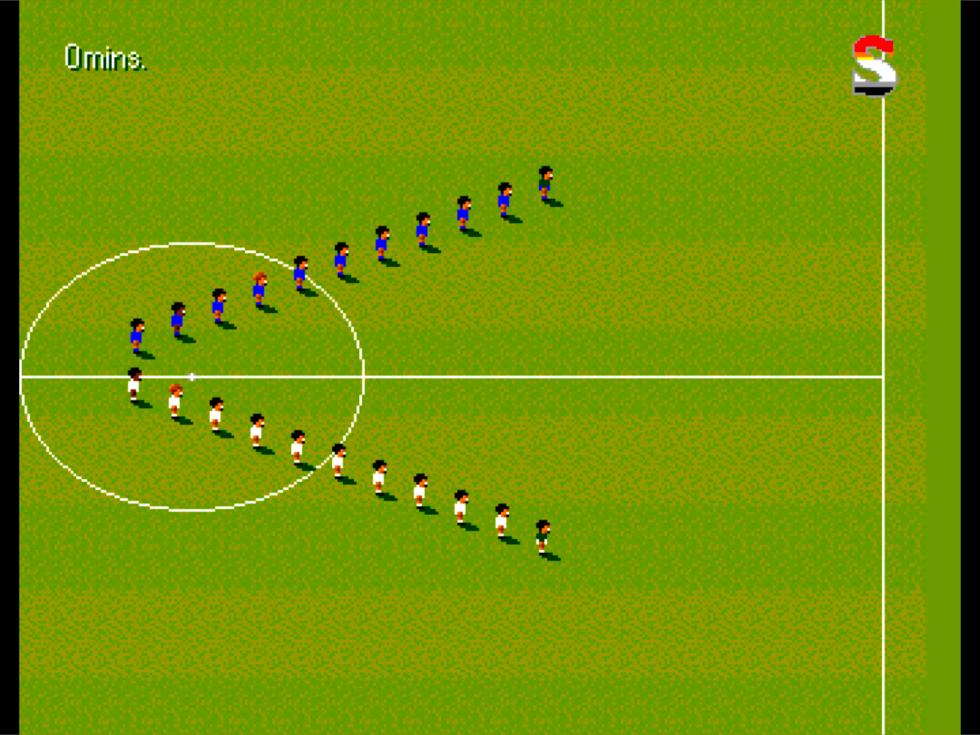
This review focuses on the Amiga version because that is where Sensible World of Soccer still preserves a very special balance. The relationship between graphics, speed, joystick response and screen clarity feels almost tailor-made for Commodore’s machine. There is no visual abundance, no spectacle for its own sake, but there is a dry, readable, almost nervous precision.
On Amiga, the game has a physical character. You feel the timing of the joystick, the pressure of the button, the short movement of your hand. Every successful shot feels like the result of a gesture you have learned, not of an animation. And every mistake hurts, because it rarely feels unfair. More often, it is simply your fault. You pressed too early, applied the wrong spin, tried the impossible pass, underestimated a rebound.
Technically, SWOS does not try to impress with elaborate backgrounds or animations. Its impact is functional. The players are moving icons, the pitch is a tactical map, the goals are emotional magnets. The sound is essential, with dry effects and music that never steals space from the action. Everything serves the flow of the match.
Sensible Soccer or SWOS?
The first Sensible Soccer, released in 1992, remains a masterpiece of synthesis. It is arcade football in its purest form: immediate matches, blistering rhythm, razor-sharp control. Sensible World of Soccer does not erase it and does not make it obsolete. It does something different: it takes that formula and places it inside a broader, almost encyclopaedic structure.
That is why choosing between the two depends on what you are looking for. Sensible Soccer is the perfect match: fast, essential, ideal for an improvised tournament. SWOS is the match that becomes a season, a career, a story. It is the game that makes you say “just one more” and then, three hours later, you find yourself buying an Icelandic striker, selling a Belgian midfielder and chasing promotion with a team you did not even know existed the day before.
That is the magic: SWOS adds depth without losing arcade speed. It is a very rare balance.
The versions and the 96/97 edition
As often happens with sports games, Sensible World of Soccer also lives through its revisions. For many fans, the 96/97 edition is the definitive version, because it updates squads and database and refines the experience until it becomes a kind of absolute standard. Sources such as The Codemasters Archive describe SWOS 96/97 precisely as an updated version of the game, with renewed squads compared with previous editions.
There were also PC versions and later conversions, but the feeling was not always identical. Change the controller, the perceived speed, the response of the controls and the technical context, and the flavour of the match changes too. On Amiga, SWOS retains a particular naturalness. It seems to belong to that machine not only by origin, but by character.
The console versions connected to the Sensible family brought the game outside the home computer world, but they did not always manage to reproduce the same immediacy. Sensible, more than many other sports games, depends on control. If the feeling changes, everything changes.
The 96/97 version
For many enthusiasts, Sensible World of Soccer 96/97 is the reference edition: updated squads, refined database and a formula that had reached full maturity. When people speak about SWOS in an absolute sense today, their memories often go straight to this version.
Football before realism
Played today, Sensible World of Soccer feels almost alien compared with modern football games. It has no licences presented as events, no recognisable faces, no modelled stadiums, no commentary, no integrated online modes in the contemporary sense. And yet it still communicates football with surprising force.
Perhaps that is because it does not try to simulate television. It does not ask you to watch a match. It asks you to understand it. Where is the space opening up? When is it worth shooting? How much can you risk with the goalkeeper out of position? Is it better to play vertically or go wide? The game is fast, but not blind. Arcade, but not random. Simple, but not superficial.
Its longevity comes from this purity. Every match is short, but it can contain everything: domination, injustice, comebacks, own goals, impossible shots, miraculous saves, last-second drama. SWOS is one of those games that does not need to explain why it works. You understand it when you lose and immediately press “rematch”.
The game that never stopped living
The most surprising thing is that Sensible World of Soccer has not remained only a memory. Around the game there is still an active community, with tournaments, online matches, leagues and seasonal updates. SensibleSoccer.de explicitly invites players to join the community for friendlies, leagues and tournaments, with sections dedicated to online play and events.
And this is not just generic nostalgia. In 2026, a SWOS 25/26 update for Amiga was published, initially in WHDLoad version, curated by Playaveli and collaborators. GamesNostalgia identifies it as “SWOS season update 25/26 - Playaveli & Friends, SWOS United Community”.
This detail changes everything. SWOS is not simply a game that people remember fondly. It is a game that some still treat as a living platform. Updated squads, tournaments, community competitions, modern versions to load on real or emulated Amiga hardware. Very few sports games from the Nineties can claim that kind of continuity.
In a genre that tends to erase the previous chapter every year, Sensible World of Soccer did the opposite. It remained. Not because it was the most realistic, but because it had found an almost definitive form.
A classic that asks no permission
Sensible World of Soccer is one of the great European masterpieces of the Nineties. A game born far from Japanese spectacle and American commercial power, yet capable of building a language entirely its own. Minimalist, lightning-fast, intelligent, incredibly deep.
Its secret is not just nostalgia. Of course, for those who experienced it on Amiga, there is the memory of matches with friends, floppy disks, worn-out joysticks, championships started “just to try it” and carried on for weeks. But SWOS still holds up because its idea of football remains clear. Not everything old is outdated. Sometimes it simply reached the point before everyone else.
Sensible World of Soccer put the world into a few pixels and made it playable. Not perfect, not realistic, not televisual. Playable. And that is an enormous difference.

Reader memories
Comments, memories and points of view stay here, beside the article.
Comment rulesLog in or register to leave a comment.
Leave a comment
Create your account
Loading comments...