


In 1993, Commodore desperately needed a fresh start. The Amiga 1200 had been on the market for less than a year, but it had failed to repeat the impact of the Amiga 500. PCs were advancing rapidly, the Mega Drive and Super Nintendo dominated the console market, and new machines built around CD-ROM, three-dimensional graphics and a completely different idea of video games were appearing on the horizon.
Commodore’s answer was the Amiga CD32.
Presented at the Science Museum in London in July 1993 and released across Europe from September of the same year, the CD32 was the first 32-bit CD-ROM console commercially released in Western Europe. Its black shell did not contain a new architecture, however. Inside were the same 14 MHz Motorola 68EC020, 2 MB of Chip RAM, AGA and Paula. It was essentially the heart of an Amiga 1200 stripped of its keyboard and floppy drive, joined by a double-speed CD-ROM unit and the new Akiko chip. Commodore’s own technical documentation described it as a system built around a simplified A1200 motherboard.
Commodore tried to enter the new generation by turning the Amiga into a console. That was precisely the problem: it did not design a machine capable of following the direction the market was taking. It started with what it already had and tried to adapt it.
It was the last major Amiga machine commercially released by Commodore, but also the final proof that the company could no longer keep pace with the times.
The CD32 was a clumsy attempt to buy time.
A console born old
The CD32 was directly derived from the architecture of the Amiga 1200. It shared the same CPU, AGA chipset, 2 MB of Chip RAM and audio system. The CD-ROM drive replaced the floppy and offered vastly more storage, while Akiko acted as an interface between the processor, the custom chips and the optical drive. It also included hardware designed to accelerate chunky-to-planar conversion.
It was a quick and economically understandable solution. Commodore could reuse a large part of the technology it had already developed, adapt existing Amiga software and reach the shops without facing the cost and development time required to create a completely new platform.
But what was convenient for Commodore was not what the market needed. Quite the opposite.
The machine retained all the limitations already exposed by the Amiga 1200. The 68EC020 operated in a configuration without Fast RAM, sharing memory with the chipset. Graphics remained planar. Paula still provided four 8-bit digital audio channels. AGA improved colours and video bandwidth, but introduced no genuine three-dimensional acceleration.
There was also a deeper problem: the CD32 had no truly independent technological or software identity.
It was a console in form, but remained an Amiga in substance.
The real appeal of CD-ROM
In 1993, CD-ROM still held enormous appeal.
An optical disc offered hundreds of megabytes, while an Amiga floppy stored less than one. It meant eliminating constant disc changes and introducing recorded soundtracks, speech, video sequences, more images and quantities of data that had been impossible in the home market only a few years earlier.
The CD32 finally made it possible to switch on a Commodore machine, insert a disc and play. There was no keyboard or Workbench, but above all there was no need to keep changing floppy disks. For anyone coming from an Amiga 500, the idea had immediate power.
But a storage format cannot turn an old machine into a modern and powerful one by itself.
Many CD32 conversions simply transferred games originally created for the Amiga 500 or, in the best cases, the Amiga 1200 onto an optical disc. The additions often consisted of CD audio tracks, longer introductions, speech or small visual changes. The core of the game remained exactly the same.
An Amiga game pressed onto an optical disc was still an Amiga game pressed onto an optical disc.
When the CD32 felt like the natural choice
For me too, the CD32 initially represented the natural successor to my beloved old Amiga 500 Plus.
I did not see it as just another console, but as the continuation of a world I knew, loved and still felt deeply connected to. Moving to the CD32 felt like the most logical path.
Only one unit arrived at my trusted video game shop. Microcosm was running on the screen, accompanied by full-motion video sequences that looked like science fiction in 1993. It did not matter that the actual game was nothing special. That presentation alone was enough to turn the CD32 into an object of desire.


I left the shop convinced that it would become my first console.
Then, as we sadly know, Commodore collapsed and the market changed direction with astonishing speed. A short time later, in that same shop, I saw a Japanese PlayStation running Ridge Racer. What I was watching was not an introductory movie and it was not another crooked promise of the future I had been waiting for. Those three-dimensional graphics were really moving in real time.
Wonderful!
At that moment, I understood that Sony was about to inherit a heavy legacy. In my home, this was the machine that would take the place Commodore had occupied until then. No small task.
I told the full story of that transition, from wanting a CD32 to choosing Sony’s new machine, in the Memory The Future Behind a Shop Window (1993–1995).
The CD32 lost its battle in this way too. Not only through technical comparisons or corporate balance sheets, but through shop windows, when the same Amiga users who wanted to believe until the very end saw the future taking another form.
This time it was real.
The new Japanese machines were already waiting just around the corner.
Akiko: the chip that went almost completely unused
Akiko was supposed to be one of the elements that distinguished the CD32 from the Amiga 1200.
Among its functions was hardware conversion from chunky to planar graphics. In systems using a chunky framebuffer, each byte could directly represent the colour of a pixel. The Amiga organised the image into separate bitplanes instead. To display a scene calculated in chunky format, the software therefore had to convert it into the structure required by AGA.
Akiko accelerated this operation.
It was not a processor capable of generating three-dimensional graphics. It did not draw polygons, apply textures, manage geometric transformations or transfer an entire framebuffer to the screen by itself. The CPU still had to provide the data to the conversion block, retrieve the resulting bitplanes and copy them into Chip RAM.
It was a genuine aid, but one limited to a specific part of the work.
It could also provide some benefit in two-dimensional graphics, but only in engines that generated their images in chunky format, for example through pixel-by-pixel effects, rotations, distortions or conversions from systems based on linear framebuffers.
It offered little in traditional Amiga 2D. Tile maps, backgrounds, Bobs and sprites were normally prepared directly in planar format and used the Blitter, Copper and the other tools of the original architecture. Adding Akiko to that workflow brought no significant advantage.
Most importantly, very few commercial games were built around its chunky-to-planar conversion. The commercial base remained the Amiga 500 or, for more recent productions, the Amiga 1200. Building an engine specifically for the CD32 meant investing time and money in a market that was too small while abandoning compatibility with millions of Amigas already in people’s homes.
Akiko therefore remained an interesting feature on paper and useful in a few specific cases, but it never became the starting point for a new generation of games.
It was a correction applied to an old limitation, not the stroke of genius users were waiting for.
A console nobody really needed
The CD32’s main limitation was not merely technical. It lay in the very reason for its existence.
Anyone who already owned an Amiga 1200 had little reason to buy a console with the same processor, the same chipset, the same audio and much of the same software. The CD-ROM drive and Akiko were not enough to justify the move.
Anyone coming from the Amiga 500 expected a far more substantial generational leap. After years with OCS and ECS, users did not merely want more colours and a higher-capacity optical medium. They wanted another demonstration of strength, something capable of repeating the shock Commodore had created with the Amiga 1000.
The CD32 offered none of this.
The console audience also had little reason to consider it. The Mega Drive and Super Nintendo had enormous catalogues, recognisable mascots, support from the leading Japanese software houses and companies capable of defending their platforms with real strength.


The 3DO and Jaguar offered more ambitious architectures, while Saturn and especially PlayStation would soon overturn the market.
The CD32 was completely out of place.
We were still waiting for another stroke of genius from Commodore.
Instead, the company once again chose to commercially exploit a technology that had worked magnificently but was no longer enough in 1993.
CD32 and 3DO: two opposing visions of the future
The comparison with 3DO is particularly significant because the two platforms reached the market during the same period.
The 3DO was an extremely expensive machine. The first Panasonic model launched in the United States in October 1993 at 699 dollars, a price that placed it beyond the reach of most players. It was not a console manufactured directly by 3DO either, but a hardware standard licensed to several companies. It was an ambitious project supported by major corporations, but built around an industrial model that made it difficult to reduce the price of the hardware.
Technically, however, the 3DO immediately attracted the attention of the specialist press. It was not derived from a computer designed in the 1980s. It was conceived from the outset around CD-ROM, scalable bitmap graphics, video and a far more modern use of 3D.


The CD32 cost less and was more accessible. It could also draw on the enormous experience of Amiga developers, who knew how to push that hardware beyond every apparent limit.
But the comparison was merciless.
In the end, there was no winner. The 3DO failed because of its prohibitive price and an industrial model that was too difficult to sustain. The CD32 failed because it remained tied to a past that had been squeezed dry and that a growing part of the public wanted to leave behind.
Atari Jaguar: great ambition, the same industrial problems
The Jaguar also arrived in 1993 and was advertised by Atari as the first 64-bit console.
The definition was largely marketing. The machine used a complicated combination of processors, with the Tom and Jerry chips supported by a Motorola 68000. Its architecture had more advanced graphical capabilities than the CD32, but it was difficult to programme and suffered from bottlenecks that prevented many developers from exploiting it fully.
The Jaguar was nevertheless a more radical attempt. Atari had not simply turned the ST or Falcon into a console. It had tried to design something different and better suited to the new generation.


The result was a confused machine, supported by too few games capable of revealing its potential and by a company that, like Commodore, no longer possessed the strength required to fight a worldwide console war.
The CD32 and Jaguar told two parallel stories of crisis.
Commodore chose continuity and produced a machine that was too conservative. Atari chose greater ambition, but built a complex architecture it was unable to support.
Both companies had historic brands, loyal users and an enormous legacy. Neither still possessed enough money, distribution, marketing or developer support to turn a new machine into a lasting success.
Saturn and PlayStation: the future that arrived after Commodore
Saturn and PlayStation were not direct competitors to the CD32 during its short commercial life. They reached Japan at the end of 1994, after Commodore had already collapsed and CD32 production had ended. They arrived in Europe during 1995.
They nevertheless prove how obsolete Commodore’s machine was from birth.
Sega designed the Saturn to deliver a new generation of arcade conversions and games using polygonal graphics. Its architecture was complicated and would cause serious difficulties for developers, but its power and audiovisual capabilities belonged to a completely different category.


Sony designed PlayStation around a much clearer vision: three-dimensional graphics, accessible development tools, strong publisher support and an aggressive international strategy. Ridge Racer, Tekken, Wipeout and the games that followed broke completely with the previous generation. They represented the new language of home video games.


PlayStation launched in Japan on 3 December 1994 and eventually sold more than 102 million units.
The CD32 could not have faced that generation on equal terms. It would have been torn apart.
Keeping Commodore alive for a few more months would not have made the CD32 competitive. The company needed a new architecture, enormous investment, modern tools, agreements with developers, exclusive games and a global strategy.
Commodore no longer possessed any of these things.
The catalogue: the same Amiga games, very little CD32
The CD32 catalogue was not devoid of good games.
Flink, Guardian, Liberation: Captive II, Super Stardust, Roadkill, Alien Breed: Tower Assault, Simon the Sorcerer, Wing Commander and Defender of the Crown II proved that the machine could provide worthwhile experiences. Some games used the CD for music, speech, animated sequences or a more polished presentation.


The problem was the catalogue as a whole.
Too many games came directly from the Amiga 500 and Amiga 1200. The differences were often limited to removing disc changes, adding new audio tracks, extending introductions or making a few small visual improvements.
The console never developed an identity of its own.
There was no generation of games capable of driving the public to buy a CD32. It lacked the title that could define the machine, show something no other Amiga could reproduce and make users want to move to the new system.
The Amiga catalogue was an enormous resource, but it also became a cage.
Reusing existing software made it possible to fill shop shelves quickly. At the same time, it reinforced the impression that the CD32 was nothing more than the same Amiga everyone already knew.
Once again, Commodore chose the cheapest path.
The controller, its only “revolution”
The CD32 pad offered more buttons than the traditional Amiga joystick and allowed developers to create controls better suited to a console. Its shape, however, was uncomfortable, the shoulder buttons were not particularly pleasant to use and the overall quality did not match Sega or Nintendo controllers.
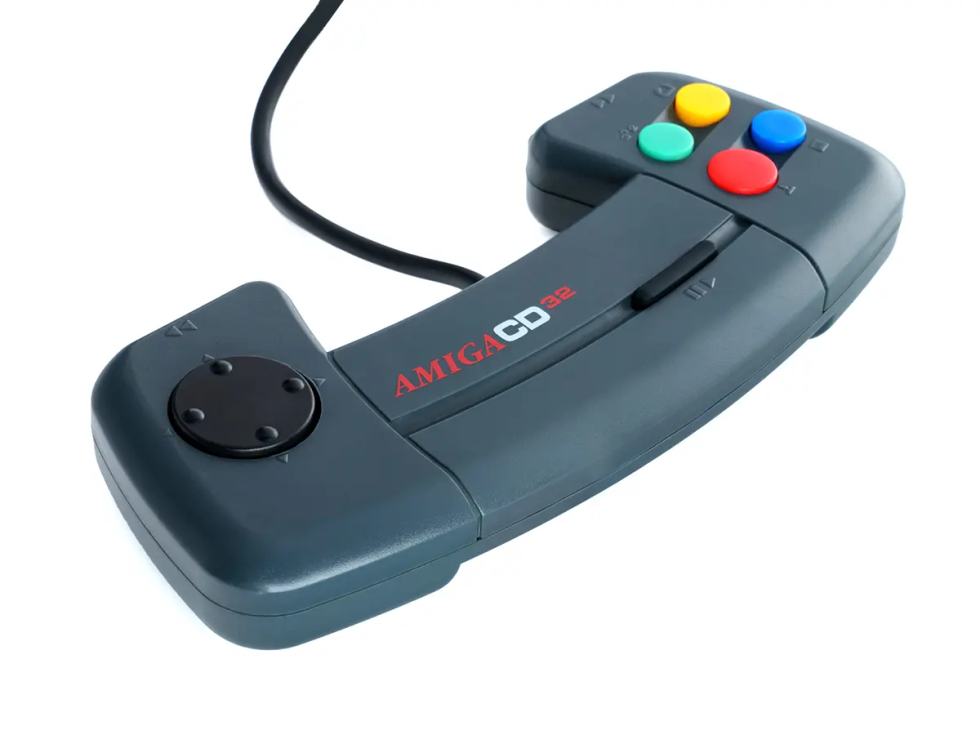
The controller was certainly not the CD32’s real problem.
It was another sign of a project created without the care, desire or experience accumulated by companies that knew how to build consoles.
Commodore knew how to produce computers. It had created revolutionary machines and sold them to millions of people. But designing a console required more than removing the keyboard, adding a CD drive and supplying a gamepad.
It required exclusive games, marketing, publisher relationships and a coherent vision for the entire ecosystem.
The CD32 had only the shell of a console. Nothing else.
And it was not particularly attractive either.
The American market that never came
Commodore planned to release the CD32 officially in the United States, but the launch never happened.
A dispute with Cad Track concerning a patent related to the XOR cursor led to a federal injunction preventing Commodore from importing its products into the country. Units prepared for the American market remained blocked while the company faced an irreversible financial crisis.
It was a serious blow. The United States could have provided valuable sales and liquidity at a desperate moment.
But blaming the failure of the CD32 entirely on that dispute would be a convenient simplification.
Commodore already had enormous structural problems. It lacked money, research and development resources, components, strategy, distribution and market confidence. European sales alone could not support the company, and time was running out.
The American injunction accelerated a crisis whose outcome was already decided.
Commodore International filed for liquidation on 29 April 1994, only a few months after the CD32 launch. The console disappeared before Saturn and PlayStation could demonstrate just how much the world had changed.
The console that was ultimately only an Amiga
The CD32 had a large rear expansion connector that allowed peripherals to be added, turning the console into something very close to a complete Amiga computer.
Commodore’s own documentation anticipated an expansion unit capable of adding a floppy drive, standard connectors, room for a hard disk and Fast RAM. Commercial expansions such as the SX-1 and SX32 later added memory, hard drives, keyboards, ports and, in the more advanced solutions, faster processors.
It was a fascinating feature, especially for enthusiasts.
But it contained another paradox: the best way to make the CD32 more interesting was to turn it back into an Amiga.
The console became more powerful when it started to resemble a computer.
This possibility strengthened its modern appeal, but at the time it made its purpose even less clear. Anyone who wanted a computer could buy an A1200. Anyone looking for a console did not need expansions, keyboards and hard drives.
The CD32 remained trapped in limbo and could establish itself neither as a computer nor as a console.
The CD32’s modern redemption
Today, the CD32 is a far more fascinating machine than it was in 1993.
It was the final Amiga machine commercially released by Commodore before the collapse and remains the physical symbol of the end of an era. Its short life, recognisable design and limited production numbers have made it a desirable collector’s item.
The community continued to develop adaptations, compilations, controllers, expansions and solutions capable of making the machine more practical and versatile. Many Amiga games can be launched through compilations prepared for CD32, while new peripherals overcome some of the limitations of the original configuration.
As with the Amiga 1200, the community completed what Commodore had left unfinished.
But its modern redemption does not change the historical judgement.
The CD32 is fascinating because it simultaneously reveals what the Amiga could still offer and what Commodore was no longer capable of building.
It was a modest machine compared with the ambitions surrounding its launch, sold as a gateway to a new generation it could never truly represent.
Conclusion: the last war fought with weapons from the past
Over the years, the Amiga had faced consoles, PCs, the Atari ST and even its own next generation.
It had survived thanks to an extraordinary architecture, the creativity of its developers and a community capable of extracting far more from the hardware than its specifications suggested.
That longevity eventually became a prison.
Commodore continued to exploit the same foundation because it worked, because developers understood it and because creating something completely new would have required investment, time and industrial ability the company no longer possessed.
The CD32 was the final result of this approach.
Minimum expenditure, maximum return. That was the plan.
But the market no longer needed an Amiga disguised as a console.
Users expected another stroke of genius from Commodore. They received an Amiga 1200 turned into a console, with a new chip that was interesting but almost unused and too many games inherited from a platform that was already exhausted.
The market no longer had room for an Amiga that remained so loyal to its original architecture. It was preparing for a generation built on polygonal graphics, textures, cinematic productions and new frontiers for video games.
When I saw Ridge Racer moving on PlayStation, I understood that the transition had already happened.
Commodore was no longer trying to carry the Amiga into the future. It was trying to survive by exploiting the past.
The Amiga had won many battles because it was different. With the CD32, Commodore fought its final war using a platform that remained too faithful to itself.
Only eight years had passed since the presentation of the Amiga 1000. In computing, however, eight years are an entire era.
That is the whole story of the CD32’s failure.
Reader memories
Comment on the article and join the discussion.
Comment rulesLog in or register to leave a comment.
Create your account
Loading comments...