



The computer of the future and the office machine
For many European players in the late 1980s, the Amiga seemed to have a more interesting future than its competitors. The IBM-compatible PC, on the other hand, still looked like a machine mainly destined for professional use in offices.
The differences were huge. The Amiga had graphics, sound, a mouse, multitasking, games, creative software, demos, floppy disks, magazines, music and animation. Even if you did not really know what was happening inside the machine, you could immediately understand that it was designed to create things worth seeing on screen and hearing through the speakers. It was not just a work tool. It was a home computer with a strong audiovisual personality.
For many users, the PC was something else. Expensive, modular, not especially attractive, often associated with spreadsheets, offices, schools, typed commands and less exciting screens. Early comparisons with the Amiga were often brutal: CGA, EGA, the internal speaker, complicated configurations, and games that often felt stiffer and less spectacular.
But then the PC changed.
It did not change because it suddenly became more attractive than the Amiga. It did not change because people suddenly loved it more. It did not change because it became easier to use. It changed because it had one feature that would become decisive in the 1990s: the ability to expand quickly.
VGA, AdLib, Sound Blaster, hard drives, 386, 486, mice, CD-ROM drives, video cards, sound cards, memory, hard drive installations, a huge market. Piece by piece, the IBM-compatible PC stopped looking like a struggling follower and began to become the platform on which many publishers wanted to build their future.
The Amiga looked like the future in 1987. The PC was the future in 1993.
Between those two points there were crucial years full of overlap, comparisons, conversions, different versions and endless arguments.
When the PC looked behind
At first, the comparison often favoured the Amiga, at least in terms of immediate impact.
An Amiga 500 running a good game, a demo or a graphics program immediately gave you a sense of modernity. Paula had a recognisable sound of its own. The colours and smooth movement were striking. The mouse was not an exotic extra. The machine seemed designed for both games and creativity. Deluxe Paint, ProTracker, crack intros, the demoscene, Psygnosis games and the most ambitious European productions all helped create a very strong overall image.


The PC of the late 1980s, by contrast, often seemed much further away from video games. Not because it lacked important games, but because the platform was fragmented and depended heavily on configuration. A PC with CGA and an internal speaker was one thing. A PC with VGA, a sound card and a hard drive was something else entirely. The word “PC” covered very different machines.
That difference created very clear perceptions. If you came from a Commodore 64, an Amiga, an Atari ST or another home computer, the PC could feel cold. It had potential, yes, but it did not always show it. It was a machine to expand, upgrade and configure. The Amiga felt more coherent, with a clear identity and a stronger sense of being ready to use.
This is the first point to keep in mind: the Amiga was not overtaken because it lacked ideas. Quite the opposite. It arrived early in many areas that would become central to the home computing experience: graphics, sound, mouse control, creative software, and the connection between playing and making things.
The problem was different. The PC was not a single closed machine. It was an entire ecosystem. And once that ecosystem found its rhythm, it could grow much faster.
VGA and Sound Blaster: the PC finds colour and voice
The move to VGA was one of the key moments for the PC as a gaming machine. It was not enough on its own, of course, but it changed the visual perception of PC games. DOS titles could finally offer graphics that looked richer, more colourful and easier to read. VGA’s 256-colour modes kept raising the bar, while the standard Amiga 500 usually displayed 32 colours on screen, apart from specific modes, technical tricks and special cases.
Before that, many players had associated PC gaming with obvious audiovisual compromises. With VGA cards, the conversation started to change. Graphic adventures, role-playing games, simulators, strategy titles and, later, first-person action games found more fertile ground. Not every PC game suddenly looked better, far from it, but the platform was starting to be taken seriously even by people who had recently seen it mainly as a work machine.
The audio side followed a similar path. AdLib first, and then Sound Blaster, gave the PC a cleaner and more recognisable voice. Again, this should not be simplified too much. Paula had a very strong identity, and for sampled music, mods and the tracker scene, the Amiga held a special place. But the PC had an increasingly important advantage: the standard.
Once Sound Blaster became a reference point for developers, the PC began to receive broader and broader support. This was not only a technical matter. It was also commercial. If many studios developed with VGA and Sound Blaster in mind, those technologies became the centre of the market. The PC absorbed components, standards and investment. And every new standard brought more games, more users and more support.
The Amiga had a strong, defined and recognisable hardware identity. The PC was more uneven, but very effective: it could keep changing.
Hard drives versus floppy disks: a change in habit
To the player’s eye, the move to hard drives looked less dramatic than a graphical leap, but it changed the way people played.
On Amiga, the floppy disk was part of everyday life. Cheap, widespread, familiar, easy to swap and copy, central to European home computer culture. But it had clear limits: long loading times, constant disk swapping, compression, and a more rigid way of handling data. For many games, that was perfectly fine. For others, especially long adventures, RPGs, simulators or increasingly large titles, it became a real limitation.
On PC, the hard drive made another idea normal: installing the game. It was not just a convenience. It meant fewer interruptions, easier saving, faster access to data, bigger games and a more continuous experience. Graphic adventures benefited enormously, as did role-playing games, strategy titles and simulators.
For anyone used to floppy disks, the hard drive changed the feel of the machine. The PC was still complicated to use, but it was beginning to offer a more stable and satisfying experience in certain genres. You no longer had to experience the game as a sequence of disks to change. You could install it, load it and play.
Of course, the Amiga could also use hard drives, especially expanded models and more advanced configurations. But the historical point is about diffusion and market direction. On PC, the hard drive became an increasingly natural part of the gaming experience. On Amiga, for many users, the floppy disk remained the main medium for a long time, partly because hard drives were expensive.
This helped shift the balance. Not only because of graphics or CPU power, but because of the concrete way games were distributed, installed and perceived.
LucasArts: the common ground
LucasArts adventures are the most interesting example for describing the relationship between Amiga and PC DOS, because they do not force the discussion to be only about raw power.
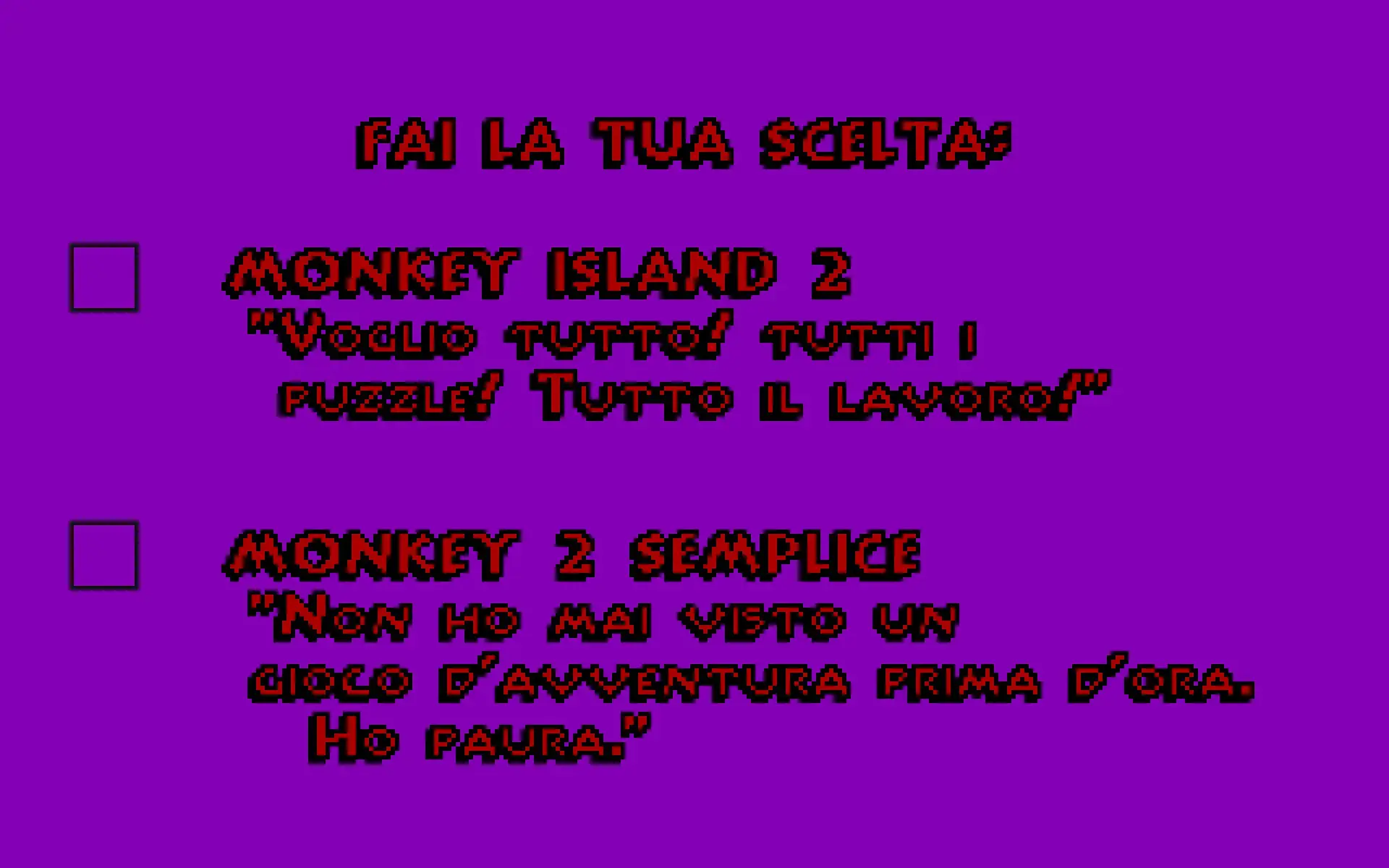
The Secret of Monkey Island, Monkey Island 2, Indiana Jones and the Fate of Atlantis and the other LucasArts classics were built around writing, atmosphere, interface, rhythm, puzzles and memorable characters. They did not need fast scrolling, large numbers of sprites on screen or extreme performance. They were experiences where mouse control, graphics, audio, text and reading pace mattered more than speed.


For a while, Amiga and PC genuinely shared a major part of that imagination. Many players experienced those adventures on Amiga, others on PC, and others were able to compare the differences between versions: music, colours, loading times and general feel. It was not a clean break. It was a gradual transition.
The PC, however, began to gain increasingly visible advantages: hard drives, VGA, widely supported sound cards, more memory and a growing market. In LucasArts games, the change is especially clear because it was not only technical. It was practical too. Once installed on a hard drive, the experience became smoother. VGA graphics became more satisfying. PC audio improved quickly. DOS versions began to feel more and more central.
This does not reduce the value of the Amiga versions. On the contrary, it shows how much the Amiga was still in the game. But it also shows the moment when the PC stopped looking like just an alternative machine and began to become the main destination for many genres.
LucasArts was therefore a meeting point, but also a breaking point.
The genres that made the PC grow
The PC did not win the gaming battle only because it had Doom. Before Doom, and around Doom, there were already very clear signs that DOS gaming was becoming richer, more varied and much more credible even to players who came from Amiga.
Simulators were among the first genres to show the strength of a standard that was beginning to establish itself. Flight simulators, military sims, more technical driving games, experiences that needed a keyboard, memory, a capable CPU, installations and configuration. These were genres closer to computer culture than console culture. The Amiga had many important titles, but the PC was becoming an increasingly natural environment for that kind of production.
Wing Commander was a major case. It was not just a space combat game. It was a heavy production for its time, with a cinematic presentation and an idea of the PC as a machine capable of handling briefings, dialogue, missions, sampled audio and increasingly ambitious graphics. It needed suitable hardware, but that was part of the point: the PC was pushing users to upgrade it.
Then came another change that many players noticed even more immediately: arcade conversions. For years, Amiga owners had often had to accept compromised ports, especially when it came to fighting games, beat ’em ups and arcade titles closely tied to sprites, controls and rhythm. Some conversions were respectable, others much less so, but they rarely gave you the feeling of having something truly close to the coin-op at home.
On PC, at a certain point, conversions started to appear that looked impressive in magazine screenshots. Super Street Fighter II Turbo, Mortal Kombat, Mortal Kombat II and other titles showed that DOS was no longer only the territory of adventures, simulators and strategy games. With VGA, hard drives, faster CPUs and increasingly common sound configurations, the PC began to bring home more spectacular and credible versions of games that had often struggled on Amiga.
For anyone reading magazines at the time, that was a strong signal. It was not only about frame rates, colours or more faithful screens. It was the feeling that the PC was entering a territory that had once seemed distant from its identity. The grey office computer was becoming a games machine that could make you stare at screenshots and want the upgrade.
Alone in the Dark and Ultima Underworld then moved things to another level, using early 3D engines to work with atmosphere, exploration and spatial simulation. They look primitive today, but at the time they pointed in a very clear direction. The PC was becoming the place where many technical experiments could grow successfully.


The Amiga still had a living scene, important games, impressive demos and fiercely loyal users. But the PC was gathering advantages in too many different areas: simulators, adventures installed on hard drive, 3D, audio, increasingly credible arcade conversions and, shortly after, first-person action.
Doom and the point of no return
Doom should not be used as a weapon against the Amiga. That would be a very poor reading of the period.
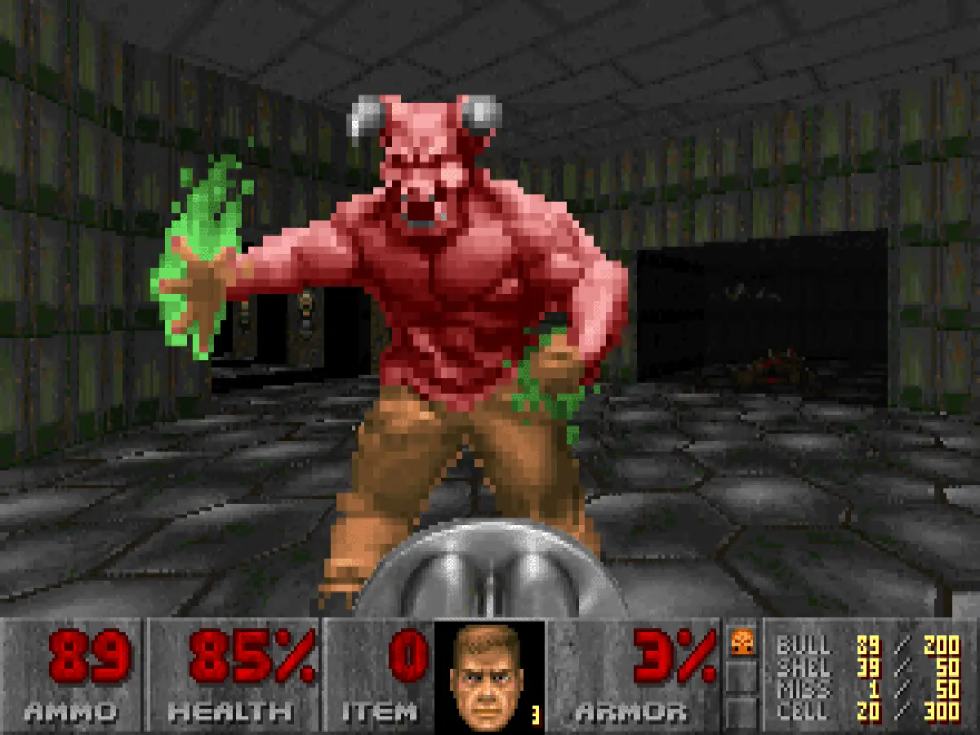
Still, Doom is impossible to ignore as a symbol of that era. When it arrived in 1993, it made a transformation already underway impossible to miss. The PC was no longer only the machine for adventures, strategy games, simulators and RPGs. It was also the platform where a new kind of fast, violent, technical, modifiable action game could be born and distributed in a different way.
Doom meant having a PC equipped with a 386 or 486, VGA, Sound Blaster and a hard drive. It brought shareware, networks, mods, editors and community to a much wider audience. It was not just a game. It was a practical and commercially effective ecosystem. It ran on a platform that could be upgraded, spread, copied, exchanged through files, installed in offices, homes and universities. The PC was not only showing an impressive game.
It was showing a different way for games to circulate.
For the Amiga, this was a difficult moment. Not because everything ended there, but because the most visible centre of gaming innovation was moving elsewhere. The standard Amiga was not designed for that kind of experience. Expanded Amigas would explore many routes, and the scene would continue to push the machine beyond its limits, but the main market was looking in another direction.
Doom made it clear that the PC had stopped chasing. Not in every genre, not in every area, not in the emotional memory of users. But on an industrial and technical level, the signal was strong.
From that point on, the PC was no longer just another platform to compare with other home computers. It was one of the main places where home gaming was finding its future.
CONFIG.SYS, AUTOEXEC.BAT and the other side of PC gaming
There is one thing that should not be forgotten: the PC was not immediate.
Anyone who played on DOS remembers it well. Audio drivers, conventional memory, mouse drivers, IRQ, DMA, CONFIG.SYS, AUTOEXEC.BAT, boot disks, installations, conflicts, different cards, manuals and files to edit. The PC was powerful, but it often demanded patience. It did not have the immediacy of a console, and it did not have the ease of use many people associated with the Amiga.
That makes its success even more interesting. The PC did not win because it was the most intuitive machine. It won because it offered a path for growth. Every configuration problem was annoying, but the advantages were worth the effort: more memory, more speed, better audio, better graphics, more games and more possibilities in general.
The Amiga was more coherent as a closed system. The PC was more open to the hardware expansion market. And in the 1990s, that openness became an enormous strength.
The Amiga did not disappear, but its position changed
Saying that the PC overtook the Amiga does not mean saying that the Amiga lost its value.
The Amiga scene continued to produce games, demos, music, graphics, software and experiments. The Amiga 1200 introduced AGA, the 68020 and new possibilities. Expansions, hard drives, accelerator cards and user passion would extend the life of the platform enormously. Even today, the Amiga is certainly not remembered as a dead machine simply because the PC pulled ahead.
The point is different. The Amiga changed position in the market. From a machine that had anticipated much of the future of home computers, it became a platform increasingly tied to its community, its scene, the passion of its users and a less central market. The PC, meanwhile, became the territory where investment, standards, expansions and major productions were concentrating.
Commodore had huge responsibilities in this story. There was no clear strategy, no ability to evolve the Amiga quickly enough, no strong industrial response to the changing market. It was not only a question of chips. It was a question of timing, investment, distribution, communication and developer confidence.
The Amiga still had a lot to say. But the PC had become the place where many publishers believed they could grow more.
The day the PC stopped chasing
The comparison between Amiga and PC DOS does not have a single moral winner.
The Amiga was a modern and extraordinary machine for the time in which it appeared. It was more immediate for people working with graphics, music, creativity, demos and homebrew in the late 1980s. For many European users, it was the machine that turned the computer into something personal, audiovisual and creative. It was not only a tool. It was a fertile environment for ideas.
The PC was less attractive at first, but better able to adapt to change. VGA, Sound Blaster, hard drives, 386 and 486 processors, CD-ROMs and a huge market allowed it to pull ahead. It did not have a single identity like the Amiga. It did not have the same “soul”. But it had an increasingly strong industrial direction.
In the end, the difference was this: the Amiga had shown, well before many others, what a creative home computer could be. The PC showed what an expandable platform could become once the market started moving in its direction.
That is why this transition is still worth analysing. Not because the PC erased the history of the Amiga. Not because Doom made Deluxe Paint, ProTracker, the demoscene or the great European games irrelevant. But because, at a certain point, the centre of gravity shifted.
And many people noticed it exactly like that: one day the Amiga still felt ahead in terms of identity, memory and affection, but the PC was already setting the technical and commercial direction of the years to come.
Tell us your version
This series is also built around the memories and points of view of people who lived through those years, discovered them later or are rediscovering them today. In the comments, you can add examples, games, corrections and different opinions. The goal is not to declare a winner, but to reconstruct a piece of video game culture together.
When did you feel that PC DOS had stopped chasing the Amiga? Was it with VGA and Sound Blaster, hard drives, LucasArts adventures, Wing Commander, Doom or another game entirely?
Reader memories
Comments, memories and points of view stay here, beside the article.
Comment rulesLog in or register to leave a comment.
Leave a comment
Create your account
Loading comments...