


Early computers certainly did not have the graphics we know today, and one of the few ways to create virtual worlds was through text. It was only natural for literature to become such fertile ground. With a few lines and a blinking cursor, the player could think of an action and try to type it, only for the machine to misunderstand the command or, more simply, for it not to be the right action at that particular moment.
It was a natural encounter: on one side, the book, filled with words capable of setting the imagination in motion; on the other, a machine still unable to represent those same imagined worlds visually. Text was their common language.
Conceptually, they were two closely related forms, but also extremely distant ones. A novel follows an order of events already established by its author, with a controlled point of view and timeline. A videogame must instead leave room for the player’s actions, allowing for mistakes, deviations, failures and behaviours that the original author never had to consider.
For this reason, the fidelity of a videogame adaptation cannot be measured only by the presence of characters, locations and events from the plot. A game can follow the story of a novel almost word for word and still fail to capture its spirit. It can also move away from the original events, find its own path and build something that remains consistent with the source material.
The question we should ask is therefore this: what remains of a book when its pages are transformed into worlds, actions and decisions placed in the player’s hands?
Middle-earth Comes Alive
In 1982, Melbourne House published The Hobbit, developed in Australia by Beam Software for the ZX Spectrum and later converted for several other computers. The game followed the journey of Bilbo Baggins, but it did not simply retrace the sequence of events established by J.R.R. Tolkien.
Veronika Megler, responsible for recreating the world electronically and designing the behaviour of its characters, has explained that she used the book as her guide, trying to remain as close as possible to the original despite the inevitable technical limitations. Philip Mitchell worked on the language system responsible for interpreting the player’s commands.
The goal was not merely to recognise simple verb-and-object instructions, but to understand more complex sentences and turn them into actions that the game could perform.
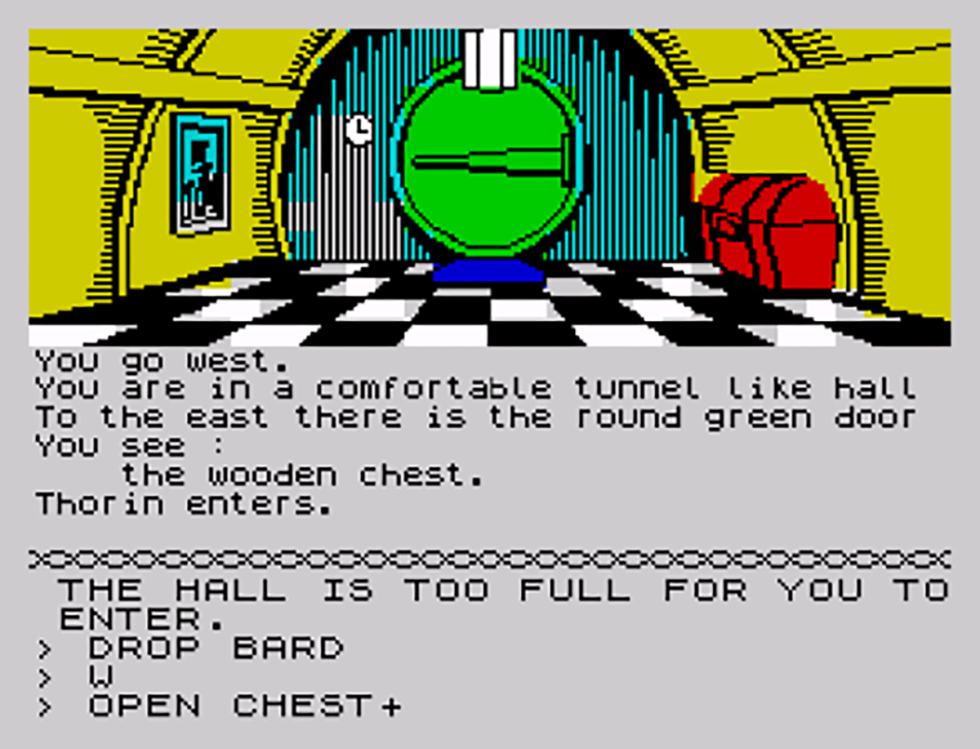
The most interesting feature, however, was hidden behind what appeared on the monitor. The game engine allowed animals and other characters to have behaviours of their own. After the player had taken a turn, they could also move, collect objects and interact with one another according to processes independent of the player’s immediate actions. Many events could unfold far beyond the player’s view.
Megler later described how difficult it was to predict the game’s behaviour for precisely this reason. Characters could meet in the same location, fight one another or alter a scene before Bilbo arrived. Each playthrough could therefore develop differently.
The difference from the book was clear. In the novel, Thorin and the other dwarves appear and act only when the author brings them into the story. In the game, they can continue moving even when they are not part of the scene currently being observed.
Middle-earth is no longer a world that moves only when and how Tolkien had already decided. It becomes a small system in which people, animals and objects maintain an existence of their own.
This could lead to absurd situations, errors and a considerable departure from the narrative sequence of the book. Yet that loss of control also offered something the novel could not. The player was not simply retracing Bilbo’s journey, but entering a world that could escape their control and move away from the original text.
The adaptation was no longer only about retelling a familiar story. Decision by decision, it built the conditions through which that story could happen, fail or assume an unexpected form.
Two Ways of Experiencing Arrakis
Few novels seem to contain as many elements ready to be transformed into gameplay as Dune.
Frank Herbert’s work brings together military conflict, dynastic rivalry, religion, ecology, control of resources and personal transformation. Choosing which of these elements should become playable is already an important decision about how to interpret the book.
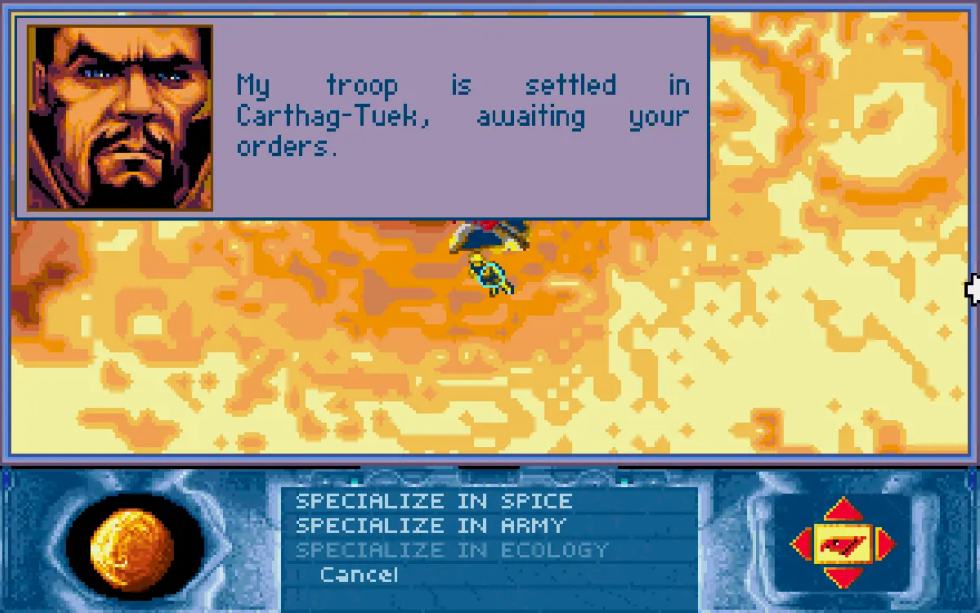
In 1992, two very different adaptations appeared. The first, developed by the French company Cryo Interactive, combined adventure, exploration and strategy. The player assumed the role of Paul Atreides, met the Fremen, organised spice production and gradually led the struggle against the Harkonnens. The conquest of the desert developed alongside Paul’s personal and political growth.
The interface, character portraits, journeys between sietches and music by Stéphane Picq and Philippe Ulrich attempted to recreate the atmosphere of Arrakis in digital form. The novel had been reduced and altered, but the game preserved the connection between Paul, the Fremen, the spice and the balance of the planet. The strategic component did not replace the narrative journey, but accompanied it.
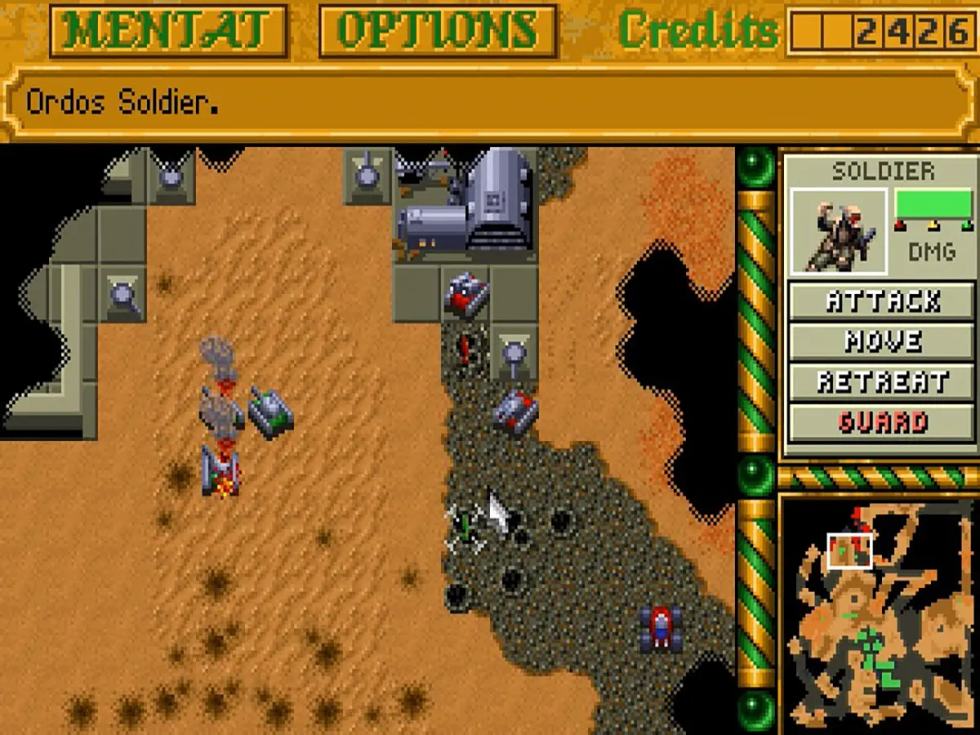
In the same year, Westwood Studios released Dune II: The Building of a Dynasty, known in Europe as Battle for Arrakis. Its relationship with the novel was far looser. The conflict was organised around three competing houses, including the Ordos, who occupied only a marginal position within the broader literary canon. The player harvested spice, built bases, produced units and conquered territory in real time.
Much of Herbert’s political, religious and ecological complexity disappeared. Some of the forces governing his universe remained, however: dependence on spice, territorial control, rivalry between houses and the hostility of the desert.
These elements were no longer conveyed through dialogue or reflection. They had become resources, factions, buildings and objectives.
Dune II did not invent the real-time strategy game from nothing. Earlier titles had already experimented with direct unit control, resource management and commanding troops. Westwood’s game did, however, organise these elements into a recognisable structure that would deeply influence Command & Conquer, Warcraft and much of the genre in the years that followed. Brett Sperry himself connected its design to Westwood’s earlier experiences and its search for a form of strategy played in real time.
The two Dune games demonstrate how many interpretations can emerge from the same book once it must be transformed into an interactive experience.
Cryo’s game follows Paul’s journey more closely and attempts to combine narrative, atmosphere and resource management. Westwood moves away from the structure of the novel, but finds in the struggle for Arrakis a system capable of functioning on its own.
One tries to make the story interactive. The other extracts the forces governing that world and transforms them into a game system.
Literature provides characters, settings and situations. The videogame decides how to place that world in the player’s hands.
Entering the Cruelty of Harlan Ellison
In Harlan Ellison’s 1967 short story I Have No Mouth, and I Must Scream, the supercomputer AM has exterminated almost all of humanity. Five people are kept alive so that it can torture them without end, victims of an artificial intelligence that humanity created with consciousness but denied any freedom.
It is a short, enclosed and suffocating text. The reader witnesses AM’s cruelty but cannot alter its outcome. Turning it into a videogame immediately posed a question for its developers: what role can the player occupy within a story built around the impossibility of escape?
Ellison was not a videogame enthusiast. He later described his relationship with the medium in openly hostile terms, yet he agreed to work on the project developed by The Dreamers Guild and published by Cyberdreams in 1995.
He did not simply license the short story. He contributed to the narrative, wrote extensive character biographies and helped expand figures who had occupied far less space in the original text. He also voiced AM.
The game divides the experience into five separate paths. AM subjects each character to a scenario built around their past, their guilt and their trauma. The player must confront these wounds through objects, dialogue and decisions.
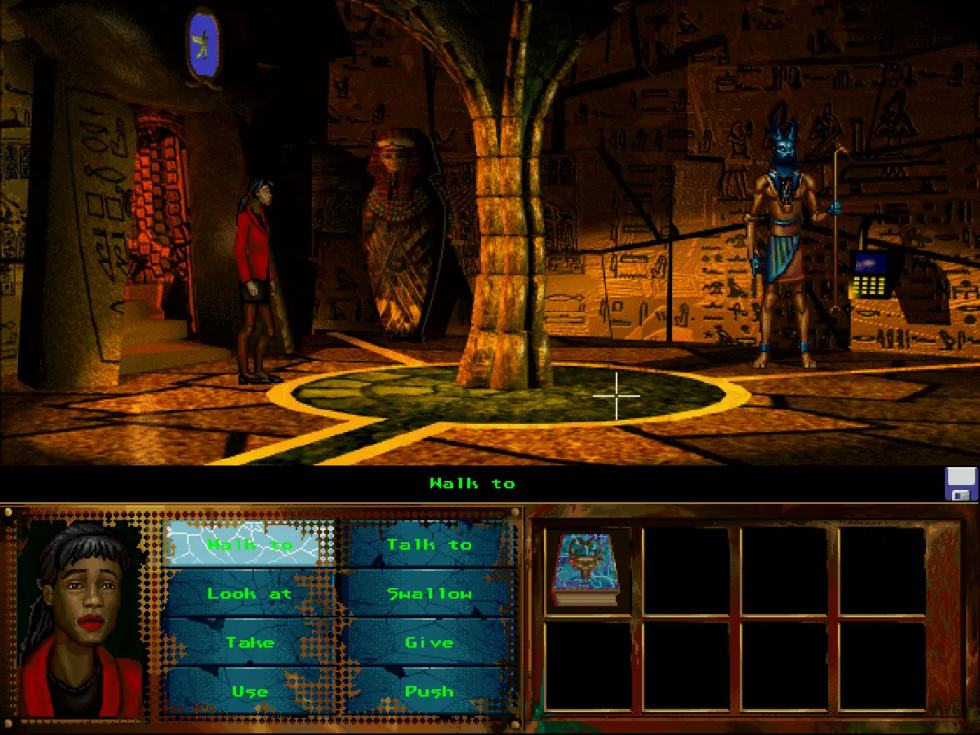
Ellison described the result as a game based on ethics rather than violence. In Gorrister’s section, for example, overcoming a particular situation depends on the ability to forgive. The solution is not to find a more powerful weapon, but to understand the moral meaning of the scene and act accordingly.
Here, the adaptation moves in the opposite direction from Dune II. It does not reduce the text to a few governing forces, but explores and expands the spaces that the original story left open. It builds biographies, memories and personal trials around the five survivors.
Above all, it changes the position of the person experiencing the story. The reader was a witness to the horror. The player must accept responsibility for making choices, knowing that AM has designed every scenario to exploit weakness and guilt.
The game does not offer unlimited freedom. Every path follows possibilities already anticipated by its authors. Every decision has been programmed, and many actions lead to failure. Yet the player can still oppose AM’s logic with a moral response. They cannot erase the horror created by the supercomputer, but they can alter at least some of its consequences.
This opening may appear to betray the original story, whose ending retains a force that is difficult to reproduce. Yet this is also the point at which the videogame finds a purpose of its own.
It does not simply tell us what AM will do to its prisoners. It confronts the player with their guilt and asks them to accept responsibility.
Geralt Beyond the Last Page
With The Witcher, the relationship between literature and videogames assumes yet another form.
CD Projekt Red did not choose to adapt a single novel by Andrzej Sapkowski directly. It used the universe, characters and events of the books as the foundation for new stories. Geralt, Yennefer, Ciri, Triss and the lands of the Continent entered the games carrying the weight of their literary past, but within a new continuity developed by the Polish studio.
CD Projekt has always made clear that its videogames are set within the universe created by Sapkowski. The works remain separate in terms of authorship, however, and the writer does not regard the games as a canonical continuation of his books.
The first The Witcher, released in 2007, used Geralt’s amnesia as a way of gradually introducing characters, relationships and earlier events. Players could enter the world without knowing the literary series, while readers of the books could recognise names, political tensions and personal connections.
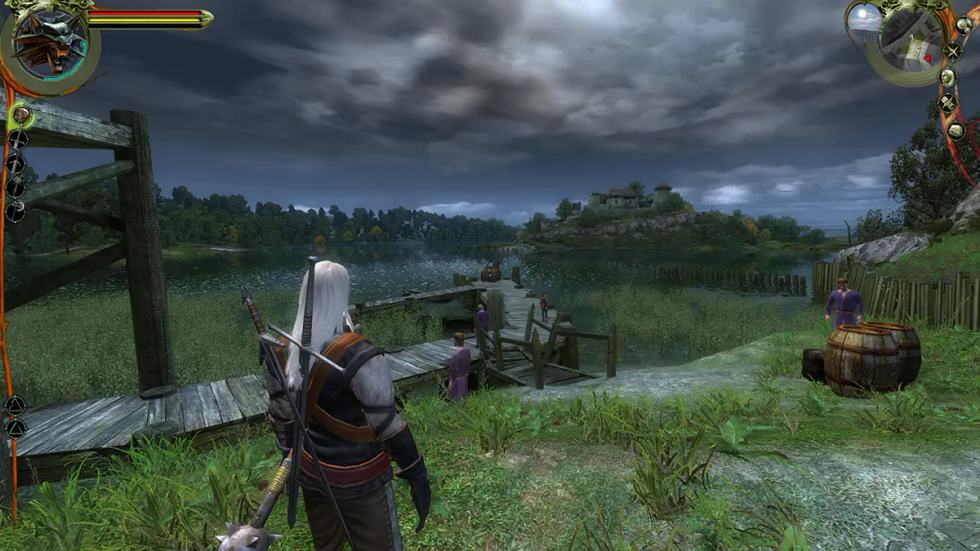
With the later games, CD Projekt gradually expanded both the scale and autonomy of the project. Player choices no longer affected only individual scenes. They could influence alliances, personal relationships and political consequences, often without offering a clear separation between what appeared right and what appeared wrong.
This system found fertile ground in Sapkowski’s stories, where Geralt is constantly forced to navigate conflicting interests, prejudice, war and moral compromise. The videogame did not have to invent ambiguity from nothing. It had to transform it into a decision entrusted to the player.
In the books, the reader can judge Geralt’s choices. In the games, the player must make some of those choices in his place, often without immediately knowing what consequences they will produce.
The series went on to achieve worldwide success. In May 2025, CD Projekt announced that The Witcher 3: Wild Hunt had passed 60 million copies sold. It is therefore reasonable to say that the games contributed decisively to the international recognition of Geralt and his world, without attributing the origin of the work to them.
The distinction becomes particularly important when discussing the television series. Netflix officially presents The Witcher as a production based on the original books. It is not an adaptation of the videogames, even if part of its audience may first have encountered Geralt through CD Projekt Red.
The correct path is therefore not a simple line from book to videogame to television. The books are the original source for both the games and the television series. Each develops from them through its own continuity and creative decisions.
Thanks to their enormous reach, however, the videogames have become a central part of the way the wider public now perceives The Witcher.
When the Book Becomes a Starting Point
Not every adaptation follows the same path.
Douglas Adams worked with Steve Meretzky on Infocom’s version of The Hitchhiker’s Guide to the Galaxy, bringing into the game not only its characters and situations, but also the absurd and often hostile logic of his humour. Terry Pratchett worked closely on the early Discworld games, gradually reducing his involvement once the developers demonstrated that they had absorbed the spirit of his world.
In Japan, Digital Devil Story: Megami Tensei originated in the novels of Aya Nishitani. The videogame series soon moved away from their original plot, but retained the encounter between technology, demonic summoning and negotiation with supernatural creatures, eventually giving rise to the later Shin Megami Tensei and Persona lines.
Parasite Eve used Hideaki Sena’s novel as the foundation for a new story set in New York, while American McGee’s Alice took characters and locations from Lewis Carroll and reworked them into a darker reinterpretation.
Dracula and the Lovecraftian universe demonstrate another phenomenon. In many cases, there is no single text being adapted from beginning to end. Instead, there is a shared collection of creatures, places, atmospheres and ideas that videogames freely recombine.
Castlevania is not a direct translation of Bram Stoker’s novel. Dracula becomes a recurring enemy, the castle becomes a space to cross and the wider Gothic imagination is reorganised around combat and exploration.
In the same way, many games connected to Lovecraft do not adapt a single story. They use cults, forbidden knowledge, psychological fragility and incomprehensible presences to create experiences based on investigation or survival.
In these cases, literature acts as a shared cultural memory. The videogame takes recognisable elements and decides which of them can become locations, enemies, resources or rules.
Fidelity in Action
A videogame adaptation must always make a selection.
It may attempt to follow a familiar plot, as The Hobbit partly does. It may isolate the forces governing a universe and transform them into a system, as in Dune II. It may expand characters who were only briefly explored and entrust the player with moral responsibility, as in I Have No Mouth, and I Must Scream. It may begin with books whose stories have already concluded and build a new continuity, as the The Witcher series does.
None of these approaches automatically guarantees a successful result. Closeness to the text is not enough, just as creative freedom is not a virtue in itself.
What matters is not how much of the book has been preserved, but how it has been transformed.
What can the player do that the reader could only imagine? Which relationships become decisions? Which ideas are reduced to combat? Which conflicts instead find a new form within the rules?
When the transition works, the book does not disappear inside the videogame. It remains recognisable, but a new variable enters the story, one that the original text could never have anticipated: the player no longer simply reads the story, but becomes its protagonist.
Reader memories
Comments, memories and points of view stay here, beside the article.
Comment rulesLog in or register to leave a comment.
Leave a comment
Create your account
Loading comments...