



In 1993, LucasArts did not simply put a Star Wars game on a compact disc. It made the compact disc itself part of the fantasy.
There was a moment in the early 1990s when the CD-ROM drive felt less like a computer component and more like a small portal into a new kind of entertainment. It promised speech, recorded music, video and quantities of data that made a box of floppy disks suddenly look provincial. Nobody was entirely certain what all that storage should be used for, but the word “multimedia” appeared everywhere, usually accompanied by chrome lettering, rendered spheres and the solemn suggestion that civilisation had reached a turning point.
Then Star Wars: Rebel Assault arrived.
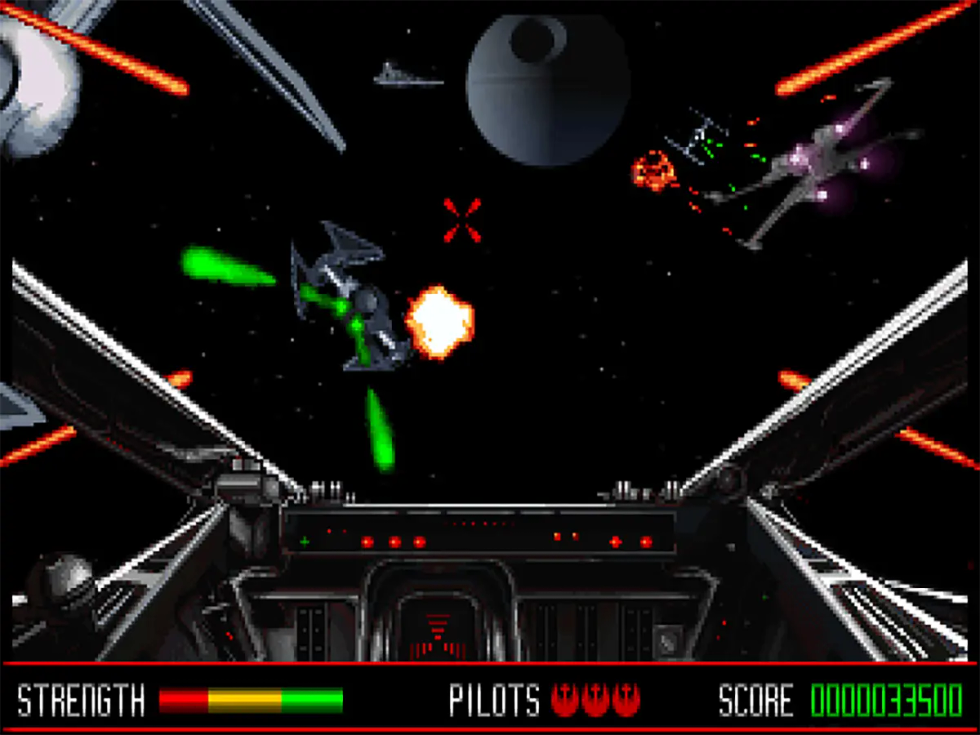
Released for PC and Macintosh in 1993, it combined digitised footage from the original trilogy with pre-rendered environments, newly created material, familiar music and arcade-style action. It was not the first CD-ROM game, nor the first attempt to mix cinema with interactivity. It was, however, one of the titles that made ordinary players look at an optical drive and immediately understand why they might need one.
Rebel Assault was not merely stored on a CD-ROM. It performed CD-ROM at the player.
That distinction is the reason it remains historically important, even though returning to it today can be an exercise in nostalgia, patience and negotiating with a targeting cursor that appears to have developed personal objections.
Two Different Futures Arrived in the Same Year
The easiest way to understand Rebel Assault is to compare it with another LucasArts Star Wars game released in 1993: X-Wing.
X-Wing used the computer to create systems. It asked the player to manage shields, lasers, engines, targets and mission objectives. Manuals, keyboard commands and joystick control turned the desk into a miniature cockpit. Its fantasy came from responsibility. You were not simply watching an X-wing fly; you were expected to understand how to operate one while several TIE fighters tried to end your promising military career.
Rebel Assault moved in the opposite direction. It reduced direct control and concentrated on presentation. Instead of building a free space around the player, it moved the player through carefully prepared sequences. The backgrounds were already rendered, the camera already knew where it was going, and the action unfolded along predetermined paths. Your task was to aim, dodge, fire and remain alive long enough to see the next piece of spectacle.
One game imagined the future of PC gaming as simulation. The other imagined it as cinema delivered through a computer.
Neither vision was foolish. Both would shape the decade.
Retro-Gamers.it has already explored how LucasArts transformed cinematic language into interactive design through adventures such as Monkey Island, Indiana Jones and the Fate of Atlantis and Day of the Tentacle. Those games borrowed rhythm, dialogue, framing and character from cinema without surrendering control to it.
Rebel Assault was a more literal experiment. Rather than absorbing the language of film, it placed fragments of film directly inside the experience.
The result was less elegant, but immediately impressive.
The Disc Was Not Just Storage. It Was the Attraction
Before CD-ROM, storage limitations forced developers to compress their ambitions into floppy disks and cartridges. Voice acting was expensive in terms of space. Recorded music was usually impractical. Video could exist only in extremely limited forms. A large game might arrive on several disks and ask the player to swap them repeatedly, turning data management into an unofficial secondary mechanic.
A compact disc offered hundreds of megabytes. In 1993, that figure was almost indecent.
As Retro-Gamers.it observed in its feature on the Amiga CD32 and the arrival of the CD-ROM generation, optical media promised recorded soundtracks, speech, video sequences and quantities of content that earlier home formats could barely contemplate.
Greater capacity did not automatically create better games. Many CD releases simply placed familiar software on a larger medium and added a longer introduction or some recorded music.
Rebel Assault was different because its design depended on the disc. Remove the streamed scenery, digitised images, voices, music and cinematic transitions, and very little of its original attraction remains.
Players took the role of Rookie One and moved through a compressed variation of familiar Star Wars events: flight training, Beggar’s Canyon, the assault on Hoth, battles against Imperial forces and another attack on the Death Star. The story rearranged film material freely because historical accuracy mattered less than delivering one recognisable attraction after another.
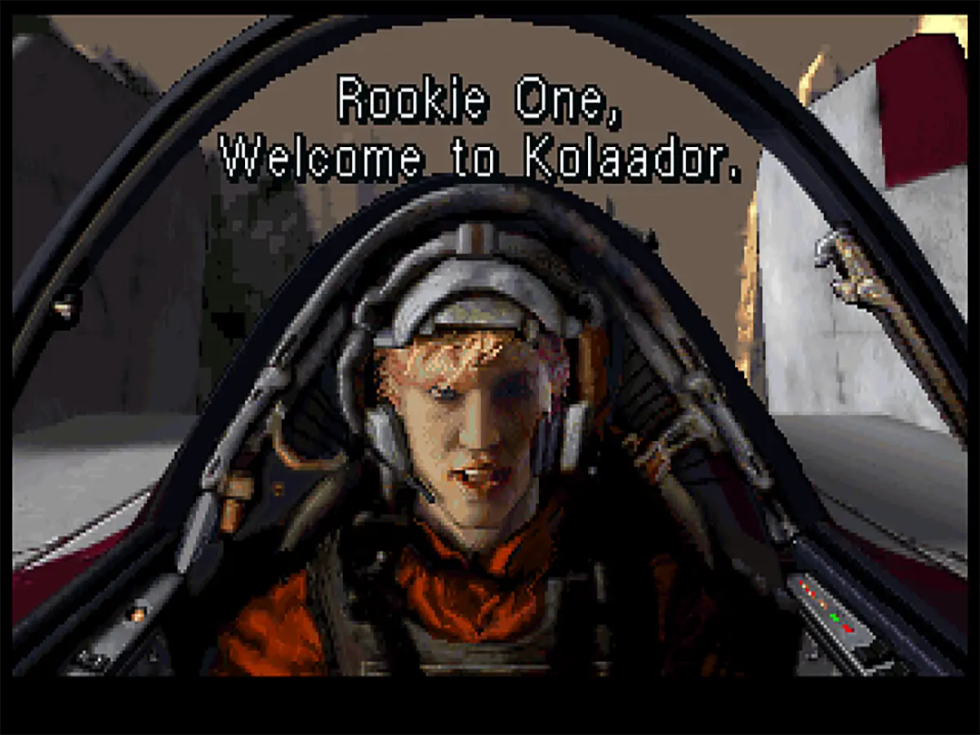
It operated like a Star Wars theme-park ride installed inside a home computer. You did not decide where the vehicle travelled, but you were given enough control to feel responsible when it hit something.
That balance could be frustrating. The player often had to react to obstacles and enemies without possessing full freedom of movement. Perspective could make collisions difficult to judge, while the aiming controls were not always as precise as the game demanded.
Yet those limitations were inseparable from its purpose. A fully explorable 3D Star Wars world was beyond the practical reach of the average home PC in 1993. Pre-rendered movement allowed LucasArts to show speed, scale and detailed scenery that real-time technology could not yet provide at the same visual level.
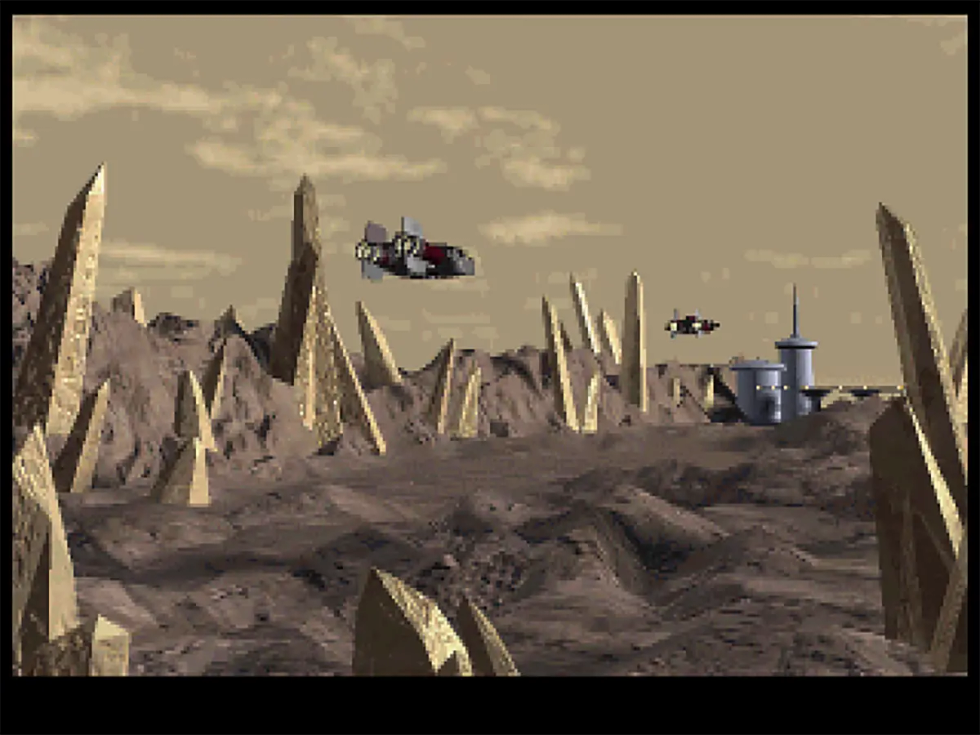
The path was fixed because the picture was the point.
When a Computer Game Looked Like Evidence From the Future
It is difficult to reproduce the impact of early CD-ROM games on a modern display.
Today, Rebel Assault reveals every compromise. The video is small, compressed and grainy. The pre-rendered scenery repeats. Character images can appear pasted onto backgrounds. Animation that once looked cinematic can now resemble a slideshow trying very hard to escape from itself.
In 1993, those weaknesses were often overwhelmed by novelty.
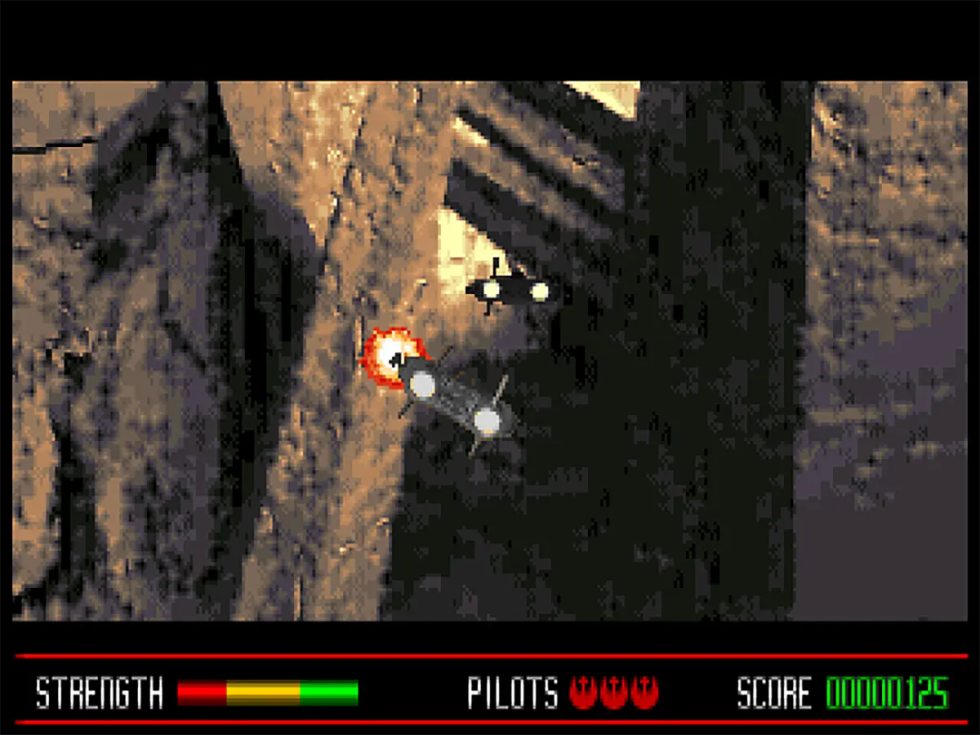
The computer was showing recognisable Star Wars footage, playing familiar music and moving through environments far richer than the flat screens and simple polygons many players knew.
Marco Finelli captured this feeling in The Future Behind a Shop Window, his memory of seeing a new generation emerge through shop displays, magazines and machines that belonged to a world just beyond reach. The early 1990s were full of encounters like these. A rendered introduction, a digitised actor or a recorded soundtrack could make an otherwise ordinary game enormously impressive.
Rebel Assault benefited from that historical moment. It was not only entertainment, but evidence that CD-ROM mattered and that “multimedia” had practical meaning.
The hardware surrounding the game was part of the memory. A CD-ROM drive was not yet guaranteed. Neither was a suitable sound card. DOS users might have to consider memory configuration, drivers, DMA or IRQ conflicts and the creation of a boot disk before Rookie One was allowed anywhere near the Rebellion.
The path to the Death Star sometimes began inside CONFIG.SYS.
In a strange way, that inconvenience could strengthen the experience. The player had assembled the machine, installed the drive, configured the sound and persuaded several technologies to cooperate. When the Star Wars music finally emerged from the speakers, it felt earned.
Bill Tiller and the Game That Became Much Bigger Than Expected
LucasArts artist Bill Tiller later recalled that Rebel Assault began with relatively modest commercial expectations but expanded dramatically once its potential became clear.
His memories, shared during a 2023 appearance on The Retro Hour and later summarised in Star Wars: Gaming’s account of the game’s development, describe the production of new live-action material, George Lucas taking an interest in the footage and a project that rapidly exceeded its early sales forecasts.
According to Tiller’s recollection, the game had initially been expected to sell only around 15,000 copies. Its first production run of approximately 100,000 reportedly sold through within days, and it passed 500,000 copies within its first five months.
Those figures should be understood as a participant’s retrospective account rather than an audited financial report, but the larger point is beyond dispute: Rebel Assault became a major success and quickly led to a sequel.
The scale of that success mattered beyond LucasArts. This was the sort of game demonstrated in shops, bundled with hardware and shown to relatives who had asked why anyone needed a CD-ROM drive attached to a computer.
The answer was suddenly easy.
Because Star Wars was inside it.
The game also reached people who might never have wanted the complexity of a simulation such as X-Wing. It used a universally recognisable licence, straightforward action and an audiovisual presentation that could be understood within seconds.
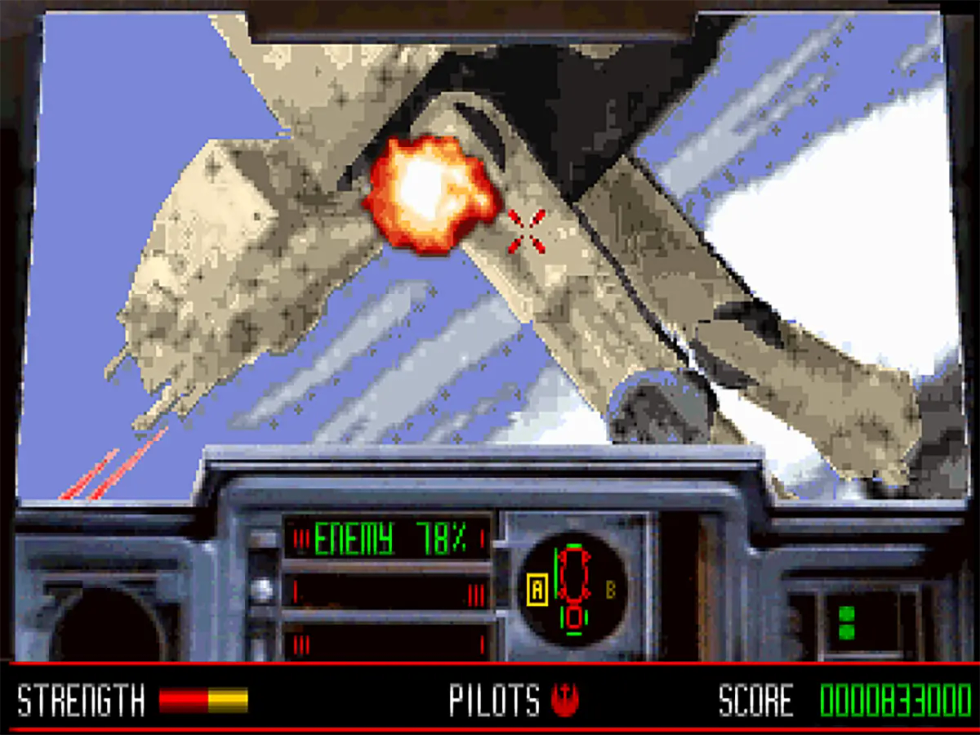
A customer did not need to understand texture mapping, data streaming or storage capacity. They only needed to see an X-wing moving through a canyon while familiar sound effects came from the speakers.
The game explained the hardware by entertaining the audience.
When Spectacle Became the Gameplay
The standard criticism of Rebel Assault is that it is not very interactive.
That criticism is true, but incomplete.
Predetermined movement allowed the artists to control composition, timing, scenery and camera position. They could create the impression of detailed three-dimensional flight without asking the computer to calculate an unrestricted world in real time.
The player’s role was narrower but still essential. You fired, aimed, moved within limited boundaries and responded to threats. The game did not allow you to direct the scene, but it required you to keep the scene alive.
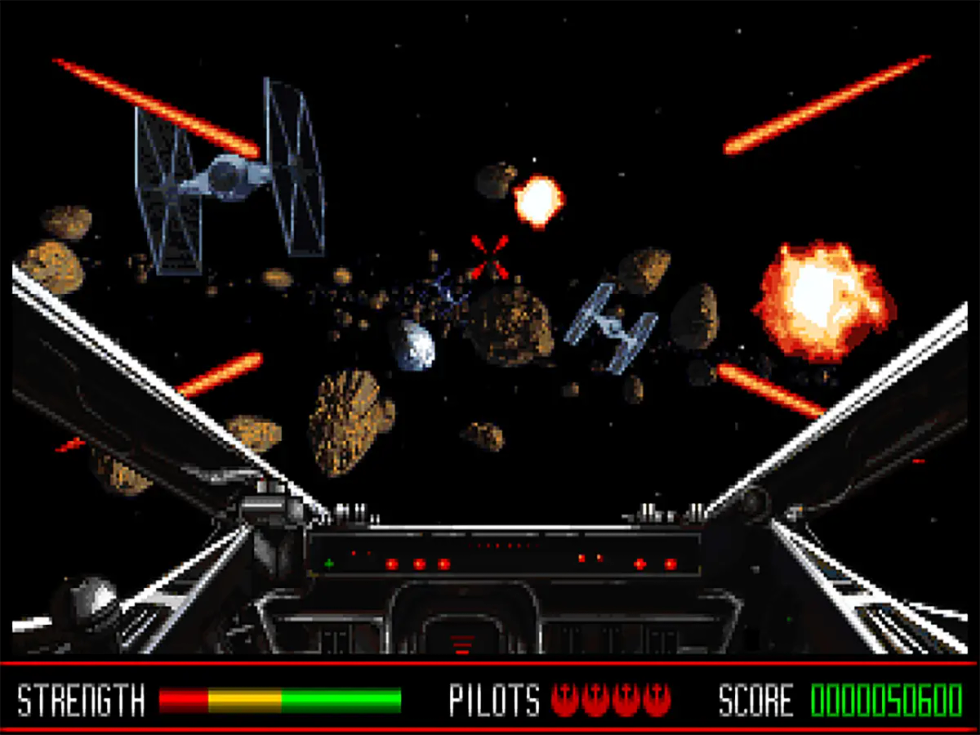
That made Rebel Assault part game, part cinematic sequence and part hardware demonstration. It belongs to the period when developers were still discovering what an “interactive movie” might be.
Many multimedia productions assumed that digitised actors and video automatically created sophistication. Rebel Assault was more direct. It used spectacle in service of an arcade ride rather than pretending to offer limitless narrative choice.
Its best moments did not make players think they were directing a Star Wars film. They made them feel as though a Star Wars film had briefly allowed them to touch the controls.
That also explains its severe ageing. Once the shock of the images disappears, the underlying structure becomes exposed. Repeated attempts, uncertain collision detection and limited control can become exhausting. The password system and unforgiving stages belong to a period when extending a short game through difficulty was still considered a perfectly respectable business arrangement.
It is not necessary to declare Rebel Assault a timeless masterpiece.
It is more interesting to recognise it as a perfectly preserved argument from 1993: presentation itself could be the event.
A Turning Point, Not a Destination
The future of Star Wars gaming did not ultimately look like Rebel Assault.
TIE Fighter deepened the space simulation. Dark Forces moved through real-time three-dimensional environments. Jedi Knight expanded that freedom. Rogue Squadron built readable vehicle action around console hardware, while Knights of the Old Republic used dialogue, choice and role-playing systems to make the galaxy personal.
Rebel Assault II: The Hidden Empire expanded the cinematic model with more original live-action footage and a story created specifically for the game, but the wider industry was already moving towards real-time 3D.
The PlayStation, Sega Saturn and increasingly powerful PCs were showing that players would not always have to choose between impressive images and direct control.
The optical disc remained essential, but the idea of the CD-ROM game as a distinct genre faded. Recorded music, speech and video stopped being the entire selling point and became expected ingredients.
That is what happens to successful technology. First it is the spectacle. Then it becomes invisible.
Looking across Star Wars: Gaming’s archive of Star Wars video games, Rebel Assault occupies a strange but important position. It is not the deepest Star Wars game, nor the most mechanically accomplished. It is one of the clearest records of a moment when storage capacity changed what developers believed a computer game could sell.
Retro-Gamers.it’s earlier feature on why classic Star Wars games still matter argued that the old catalogue is valuable because every generation translated the films into different verbs, machines and memories.
Rebel Assault chose unusually limited verbs: aim, fire, dodge and hold on. But around those simple actions it built an experience that could scarcely have existed on the previous generation of home hardware.
For many players, that was enough.
They did not remember the game because it gave them freedom. They remembered the disc spinning, the speakers coming alive and familiar Star Wars images appearing on a computer in a form that had been impossible only a few years earlier.
Rebel Assault did not make Star Wars interactive by handing over the entire galaxy.
It gave the player just enough control to believe the movie had noticed them.
Reader memories
Comments, memories and points of view stay here, beside the article.
Comment rulesLog in or register to leave a comment.
Leave a comment
Create your account
Loading comments...