



Chuck’s son takes the spotlight
In 1993, Core Design returned to its prehistoric comedy world with Chuck Rock II: Son of Chuck, a direct sequel to Chuck Rock and another attempt to bring a colorful, character-driven platformer to Amiga. This time the hero is not Chuck himself, but his young son, Chuck Junior: smaller, livelier and armed with a club. The premise is simple. Chuck has been kidnapped, and his son must cross a series of dinosaur-filled stages to rescue him.
The game was released across several platforms, including Amiga, Amiga CD32, Mega Drive/Genesis, Sega CD, Master System and Game Gear, with Core Design behind the original game. This review focuses on the Amiga version, where Chuck Rock II clearly carries the flavor of early 1990s European platform games: large sprites, busy backgrounds, playful animation and a slapstick tone that tries to give the game more personality than a standard mascot platformer.
A lighter, more agile sequel
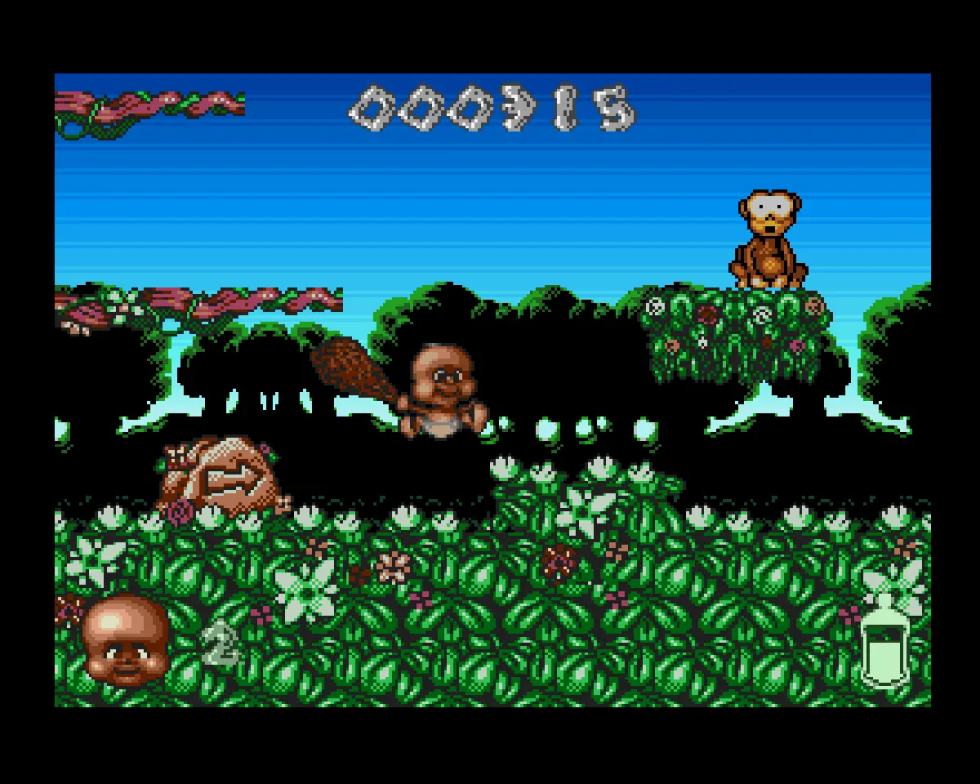
The change of protagonist is not just cosmetic. Chuck Junior feels smaller and more flexible than his father, which gives the sequel a lighter pace than the original Chuck Rock. The club attack is immediate, the jump is easy to read, and the level design seems built around a character who can move with a little more freedom. This is not a platformer with Mario’s precision or Sonic’s speed, but compared to the first game it feels cleaner, clearer and less heavy.
The structure remains traditional: side-scrolling stages, enemies to hit, platforms to cross, environmental obstacles, ridable creatures and a few visual gags. Chuck Junior can use some animals to reach areas he could not access on his own, a feature also noted in descriptions of the console versions. It is a simple idea, but it gives the game a little more variety and helps break up the basic platforming rhythm.
What limits the game today is that Chuck Rock II rarely goes beyond that formula. It is pleasant, charming and often well made, but not especially surprising. The level design guides the player more than it challenges them, and the difficulty sometimes comes from collisions, enemy placement and memorization rather than truly elegant design. That does not ruin the game, but it explains why it works better today as a characterful historical platformer than as an essential classic.
The Amiga look: colorful and distinctive
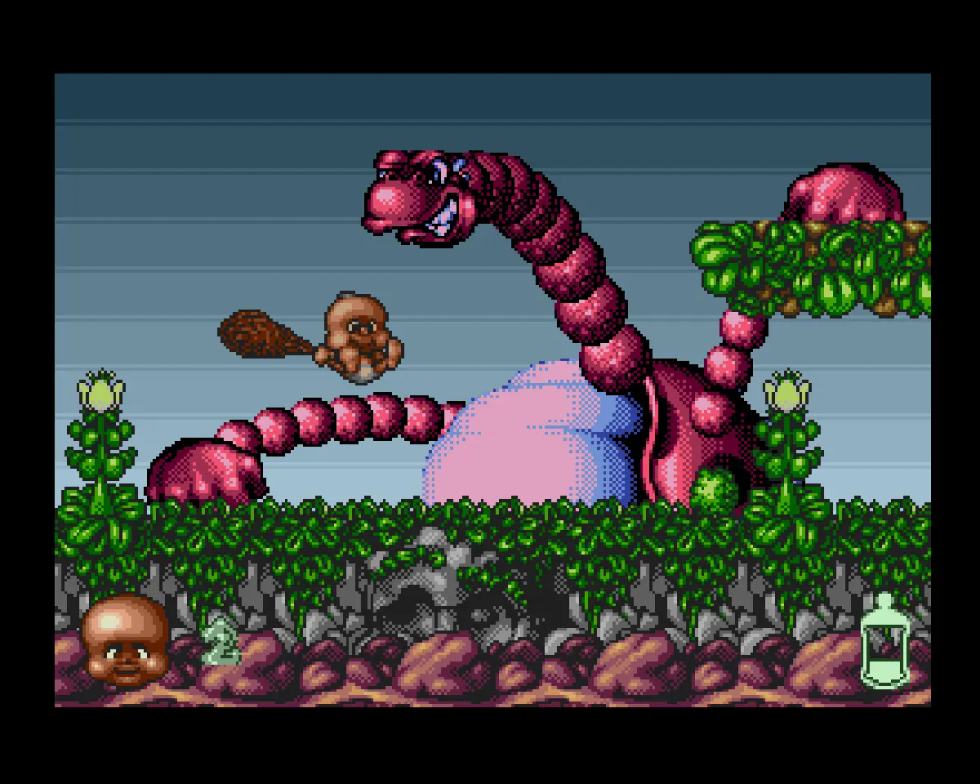
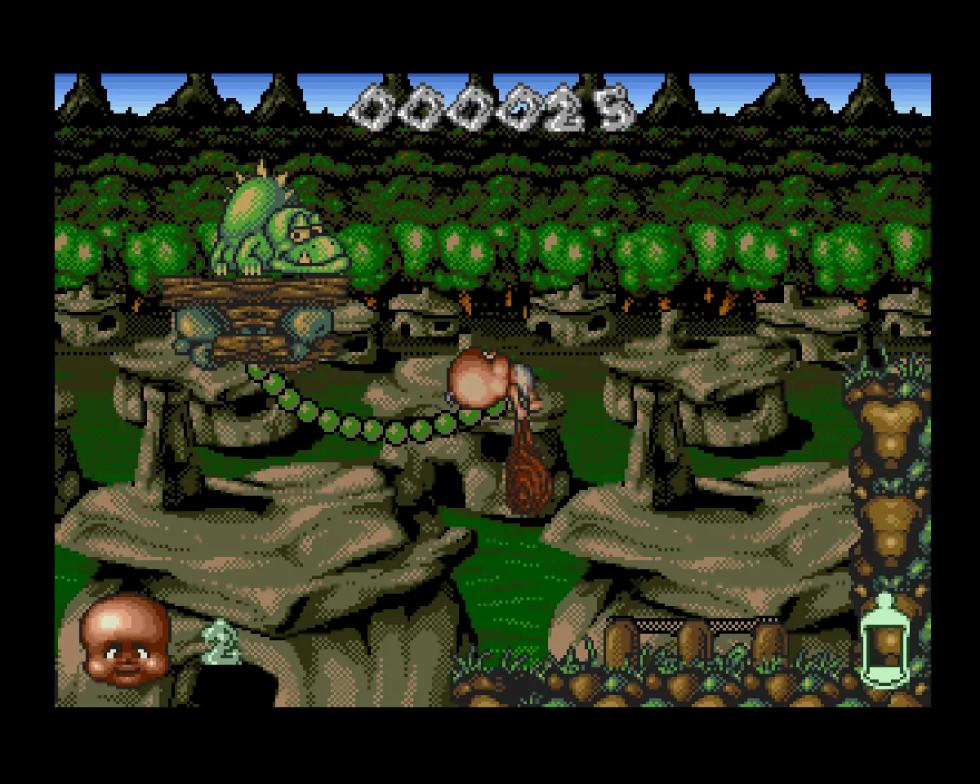
Visually, Chuck Rock II remains one of Core Design’s more appealing Amiga platformers. The sprites are large, expressive and immediately readable, with Chuck Junior giving the game a stronger cartoon identity than the first episode. Backgrounds are colorful and packed with prehistoric details, strange machines and comic touches. It has a very European early 1990s cartoon look, different from the cleaner style of many Japanese console platformers, but distinctive in its own way.
The Amiga handles the overall presentation well, especially considering the amount of artwork and the size of the on-screen characters. At the same time, the game does not always have the absolute smoothness that the Mega Drive version can suggest in motion. Some animations are charming, others feel a little stiff, and the visual rhythm can appear slightly slower today.
Still, the Amiga version has a particular charm. It feels illustrated rather than purely arcade-like. Its appeal is not only about speed or technical flash, but about personality and screen presence.
Martin Iveson’s light touch
The sound fits the game’s tone well. Martin Iveson, credited among the creative team, provides music that supports the prehistoric comedy mood without becoming intrusive. It is not one of the most memorable Amiga soundtracks of the era, but it is well crafted, upbeat and coherent with the game’s identity.
Sound effects are simple and functional, mostly there to underline attacks, hits and comic moments. The audio is pleasant and appropriate, though not strong enough to elevate the game beyond its status as a well-produced platformer.
How does Chuck Rock II hold up today?
Today, Chuck Rock II: Son of Chuck is still enjoyable, as long as it is approached with the right expectations. It is not the deepest Amiga platformer, not the most technically refined, and not a game that rewrites the rules of the genre. But it is well made, visually distinctive, easy to understand and light enough to remain approachable.
Its biggest problem is the competition around it. By 1993, platform games were everywhere. Sonic had already defined speed and spectacle on Mega Drive, Nintendo was still leading in design clarity, and the Amiga had its own wave of visually ambitious European productions. Chuck Rock II is a good platformer, but it does not have the spark that would place it among the absolute greats.
Within Core Design’s pre-Tomb Raider catalogue, however, it remains an interesting piece of history. It shows a studio still rooted in the European home computer scene, capable of strong visual identity, quick production and memorable characters. It is not Lara Croft, and it is not the studio’s leap into global 3D fame, but it helps explain where Core Design came from.
Reader memories
Comment on the article and join the discussion.
Comment rulesLog in or register to leave a comment.
Create your account
Loading comments...