


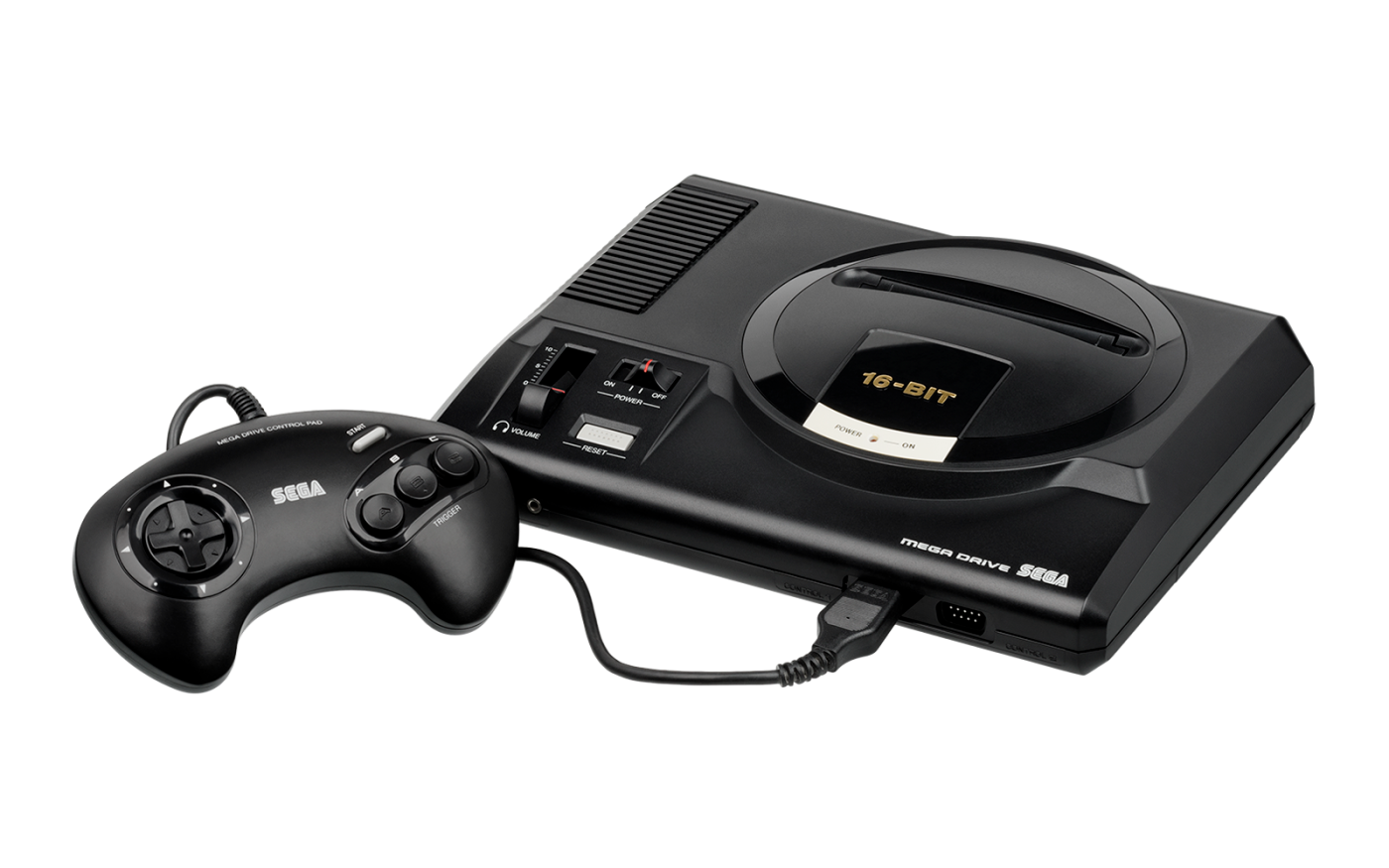



Mega Drive
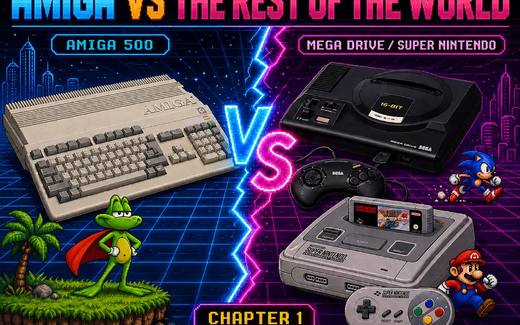
Launched by Sega in Japan in 1988, in North America in 1989 as the Genesis, and in Europe in 1990, the Mega Drive brought the company’s arcade experience into the 16-bit home console market. In Europe, including Italy, it became one of the defining consoles of the early 1990s, thanks to effective distribution, a more aggressive image than Nintendo’s, and a catalogue closely tied to the pace and energy of the arcades.
The console used a Motorola 68000 at 7.67 MHz as its main CPU, supported by a Zilog Z80 for audio management. It featured 64 KB of main RAM, dedicated video memory and cartridge-based software. Graphically, it often operated at 320×224 pixels, with a 512-colour palette and 64 colours displayable simultaneously in standard modes. Audio combined the six-channel Yamaha YM2612 FM synthesiser with the PSG inherited from the Master System, creating a metallic and highly recognisable sound.
Its direct rival was the Super Nintendo, released later but extremely strong thanks to its brands and first-party productions; before that, the Mega Drive also competed with the PC Engine/TurboGrafx-16 and with still-popular 8-bit systems. Worldwide sales are generally estimated at around 30-31 million units. Its legacy lives through Sonic the Hedgehog, Streets of Rage II, Golden Axe, Shinobi III, Gunstar Heroes, Thunder Force IV, Phantasy Star IV and Comix Zone.