


Saturn and the need to dream
In 1996, the Sega Saturn was in a complicated position. Technically fascinating but difficult to program, strong in 2D and arcade conversions, less immediately convincing in polygonal 3D than the PlayStation, SEGA’s console struggled to present a clear identity to the wider public. Sony was imposing a new idea of home gaming: cinematic, aggressive, adult, built around polygons, CD-ROMs and ruthless marketing. SEGA, by contrast, still carried the energy of the arcade and a certain instinct for doing things differently.
It was in this context that NiGHTS into Dreams… arrived, developed by Sonic Team and published in 1996. It was not the new 3D Sonic many were expecting, nor a classic platformer, nor a simple technical showcase. It was something stranger: a game about flight, dreams, repetition, score and freedom of movement inside courses suspended between two and three dimensions.
NiGHTS did not try to prove that the Saturn could do the same things as the PlayStation. It did something else. It built a fluid, colourful and musical world where the goal was not simply to reach the end, but to learn how to fly better.
Two children, a night world
The narrative structure is simple, almost fairy-tale-like. The protagonists are Claris Sinclair and Elliot Edwards, two children troubled by personal insecurities and fears. During sleep, they enter the world of Nightopia, threatened by the evil Wizeman and his servants. There they meet NiGHTS, an androgynous, light and theatrical creature capable of flying through dreams and rebelling against its own creator.
The story never overwhelms the game, but it gives it tone. NiGHTS into Dreams… is built as a metaphor for growth, courage and liberation from fear. It does not express this through long dialogues or heavy narrative sequences, but through colours, music, environments and small symbols. Claris and Elliot are not muscular heroes or aggressive mascots: they are children who must learn to overcome an emotional block. NiGHTS becomes the means through which that process takes shape.
It was a very different approach from the dominant mood of the mid-1990s. While many games were chasing toughness, speed or spectacle, NiGHTS chose a more suspended dimension, almost like an interactive musical. A risky choice, and precisely for that reason a memorable one.
Flying is not running
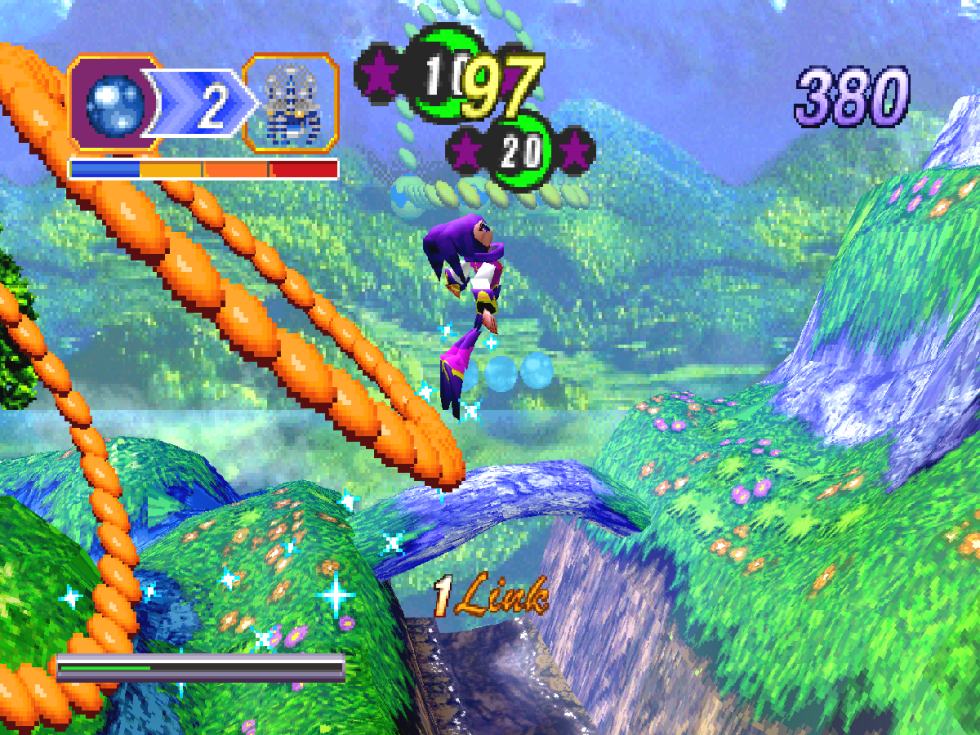
The heart of the game is its control system. At the start of each level, you control one of the two children on foot, but the real game begins when they merge with NiGHTS. From that moment, you fly along three-dimensional paths constrained to a two-dimensional trajectory, with freedom of movement inside the space of the course. It is a peculiar solution, difficult to explain in words, but immediate once you have the controller in your hands.
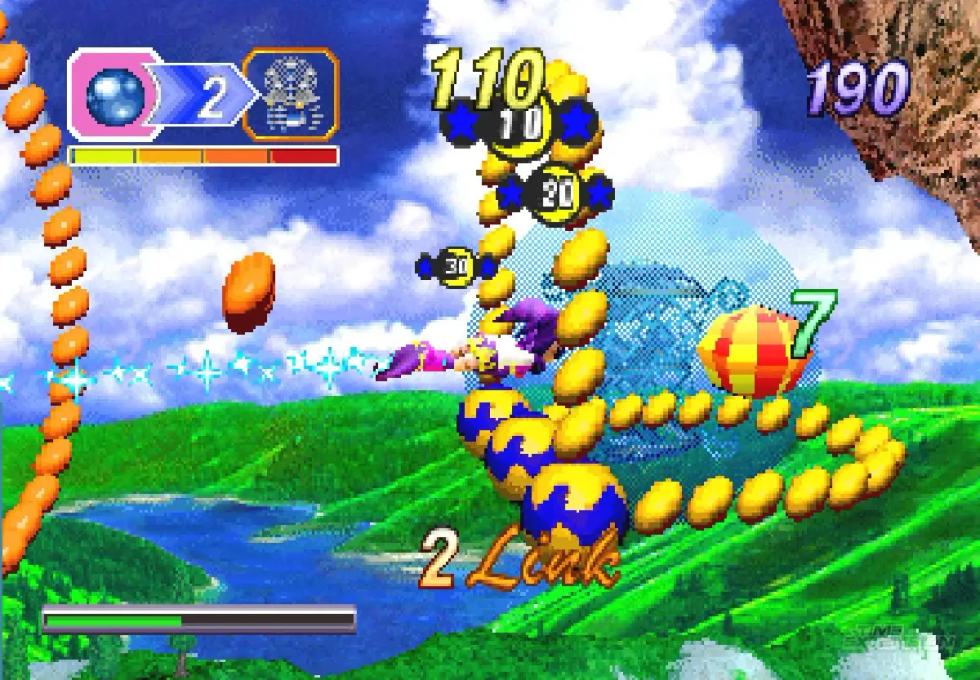
NiGHTS can perform loops, pass through rings, collect spheres, chain movements together and attack enemies through the characteristic paraloop, a manoeuvre that closes a circle in space and captures everything inside it. The basic goal is to recover the stolen Ideya and return to the starting point within the time limit, but reducing the game to this would be a mistake.
The true soul of NiGHTS lies in scoring. Every level is designed to be repeated, studied and optimized. The best trajectories, item chains, the right moment to deliver the Ideya and keep flying to build up points: everything pushes toward arcade score attack logic. It is not simply about finishing the level, but about doing it with elegance.
In this sense, NiGHTS is much closer to SEGA tradition than it may first appear. Behind the dreamlike aesthetic is a precise, technical structure, competitive mainly with oneself. It is a game that only truly reveals itself after repeated play.
3D according to Sonic Team
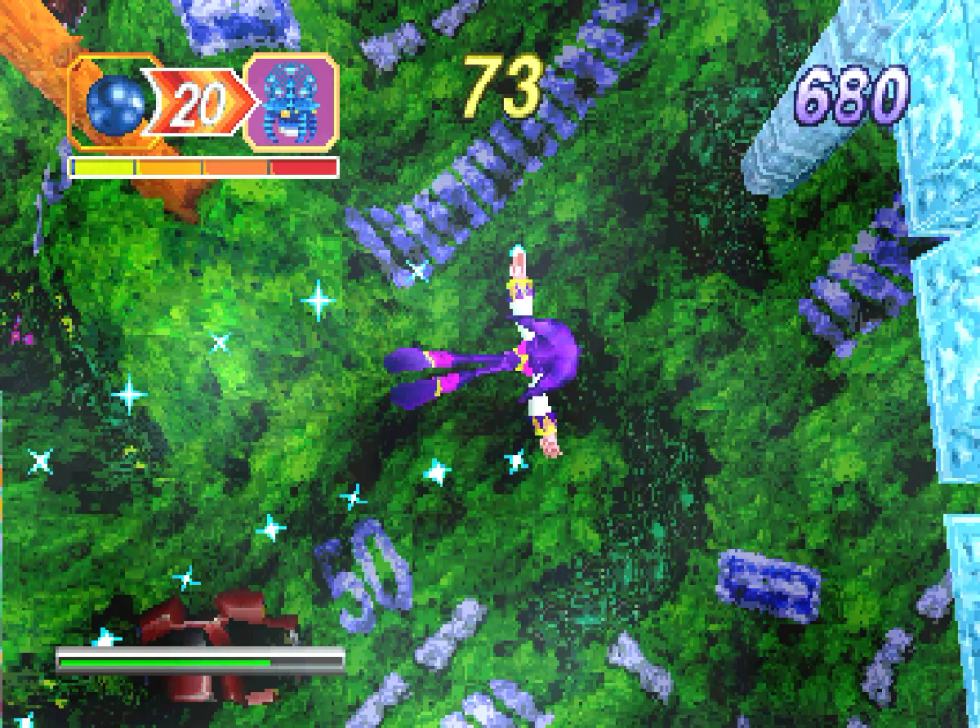
From a technical point of view, NiGHTS is one of the Saturn’s most important titles. Not because it is the most complex game in absolute terms, but because it uses the machine with intelligence and personality. The environments are extremely colourful, full of curves, suspended elements, fantastic backgrounds and details that seem to come from a child’s dream reshaped by arcade logic.
The Saturn was not an easy console to master in 3D, and the game occasionally shows the limits of the hardware: simple geometry, some sharp edges, and a visual cleanliness not always comparable to later PlayStation highlights. But the art direction compensates enormously. NiGHTS does not seek realism, does not want to look like a film, and does not aim for cold technical display. It aims for movement, colour and the sensation of crossing an unreal space.
Levels such as Spring Valley, Splash Garden, Mystic Forest and Soft Museum have a very strong identity. Each dream has its own colours, rhythm and shapes, and flight allows the player to experience them not as simple scenery, but as emotional tracks. The world turns, bends, scrolls and wraps itself around the player. It is still experimental 3D, but full of personality.
NiGHTS’ own design is one of the most successful of the era: neither a traditional mascot nor a conventional hero, but a theatrical, ambiguous, light and immediately recognizable figure. A character that seems born more to move than to be explained.
The analog controller and the feeling of flight
NiGHTS was also tied to the launch of the Saturn 3D Control Pad, SEGA’s analog controller. Played with the standard pad, it remains perfectly enjoyable, but with analog control it gains a different softness. Curves, loops and trajectory adjustments become more natural, and the feeling of flight improves noticeably.
This is not a minor detail. NiGHTS is a game of lines, arcs and fluidity. Precision is not only about pressing a button at the right moment, but about drawing trajectories through space. The 3D Control Pad helped make that promise more convincing, anticipating in some way the importance analog control would have in the following generation.
This attention to movement is one of the reasons the game is still remembered with such affection. Sonic Team was not simply building a new character: it was searching for a new way to translate speed and freedom into a three-dimensional environment. It was not Sonic, but it clearly came from the same sensitivity.
A soundtrack that breathes
The sound department is one of the game’s highest points. The music of NiGHTS into Dreams… is luminous, melodic, full of positive energy and light melancholy. It does not merely accompany the levels: it defines them. Every track seems built to follow the movement of flight, with airy melodies, soft rhythms and a tone constantly suspended between celebration and nostalgia.
The song Dreams Dreams became one of the symbols of the Saturn and, more broadly, of SEGA in those years: emotional, innocent in the best possible sense, far removed from the technological coldness often associated with the 32-bit generation. It is music unafraid of being sentimental, and precisely for that reason it leaves a mark.
The sound effects also contribute greatly to the game’s identity: passing through rings, collecting objects, voices, end-of-course jingles. Everything is designed to provide immediate feedback and make scoring feel almost musical. When the game works at its best, flying in NiGHTS feels like playing a score.
Short, but not small
One of the most common criticisms concerns the length. NiGHTS into Dreams… is not a long game in the traditional sense. There are not many levels, the structure is compact, and anyone looking for a large adventure to explore for dozens of hours may be surprised. But that judgment risks misunderstanding its nature.
NiGHTS is built to be replayed. Like many SEGA arcade games, it lives through repetition and improvement. The final grade, the score, alternative trajectories, the pursuit of better rankings and mastery of the courses give depth to an experience that may seem brief on the surface. It is a game that opens slowly: the first time you pass through it, the second time you begin to understand it, the third time you truly try to dance inside its levels.
Of course, not everyone will enter this logic. Anyone looking for a classic platformer, with jumps, enemies, long levels and linear progression, may find it strange or even elusive. But NiGHTS never wanted to be that. Its fascination lies precisely in refusing to fully belong to any single category.
Saturn’s best dream
NiGHTS into Dreams… is one of the games that best explains why the Sega Saturn is still loved in such a particular way. It was not the easiest machine, it did not win the generation, and it did not impose itself like the PlayStation. But it hosted experiences that would hardly have taken the same form elsewhere. NiGHTS is one of them.
It is a deeply SEGA game: arcade in structure, experimental in control, colourful in aesthetics, musical in rhythm, and little interested in following dominant trends. It did not try to beat Sony on the ground of cinematic realism. It preferred to build a flying dream, a small nocturnal theatre where scoring became choreography.
Today, it remains a unique title. Some aspects inevitably belong to 1996, and its compact nature may surprise those who approach it without context. But when the system clicks, when flight becomes fluid and the course turns into a continuous chain of movements, NiGHTS still reveals a kind of magic that is difficult to imitate.
Few games are better suited to explaining the Saturn. Because NiGHTS is not only one of its best titles: it is the symbol of what SEGA could do when it stopped chasing others and simply started dreaming again.


Reader memories
Comment on the article and join the discussion.
Comment rulesLog in or register to leave a comment.
Create your account
Loading comments...