


There are Amiga games that seem born to prove something. Not only to entertain, not only to fill a few disks and reach the shelves, but to enter the scene with a certain technical arrogance and say: look what this machine can do, if someone really decides to push it. Jim Power in Mutant Planet belongs exactly to that category.
Published by Loriciel in 1992 and developed by Digital Concept, Jim Power arrived at a time when the Amiga had to confront the visual language of consoles more openly than ever. Mega Drive and Super Nintendo were changing expectations: large sprites, aggressive colours, parallax, arcade rhythm, immediacy. And yet, in front of Jim Power, the feeling is that Commodore’s computer had no intention of standing still.
The game is not perfect, and it does not even try too hard to be. It is harsh, often punishing, at times almost hostile. But it is also one of those titles that stay in your mind after only a few seconds: because of the graphics, the movement, the music, and that very European desire to exceed, layer, impress and place the player in front of a spectacular but unforgiving machine.
An action game too large for a single definition
Calling Jim Power in Mutant Planet simply a “platformer” is convenient, but reductive. Its structure alternates side-scrolling sections, top-down moments and horizontal shoot ’em up passages, constantly trying to vary rhythm and perspective. This is not a pure platformer like Sonic, nor an action game ordered according to console logic, but a European hybrid full of changes in register.
The story is little more than a pretext. Jim Power must face a mutant planet and the alien threat that dominates it, crossing hostile environments, deformed enemies, platforms, traps and shooting sections. There is no real narrative holding the adventure together, but that is not the point. Jim Power lives through impact, not storytelling.
The problem, if anything, is that this variety does not always translate into balance. Some sections work better than others, and the game often seems more interested in constantly changing shape than in refining each individual idea. It is generous, but also nervous. It wants to be a platformer, a shooter, a technical arcade game and an audiovisual showcase all at once. When everything works, the effect is remarkable. When the level design tightens its grip too much, frustration arrives quickly.
Loriciel, Amiga and the European taste for excess
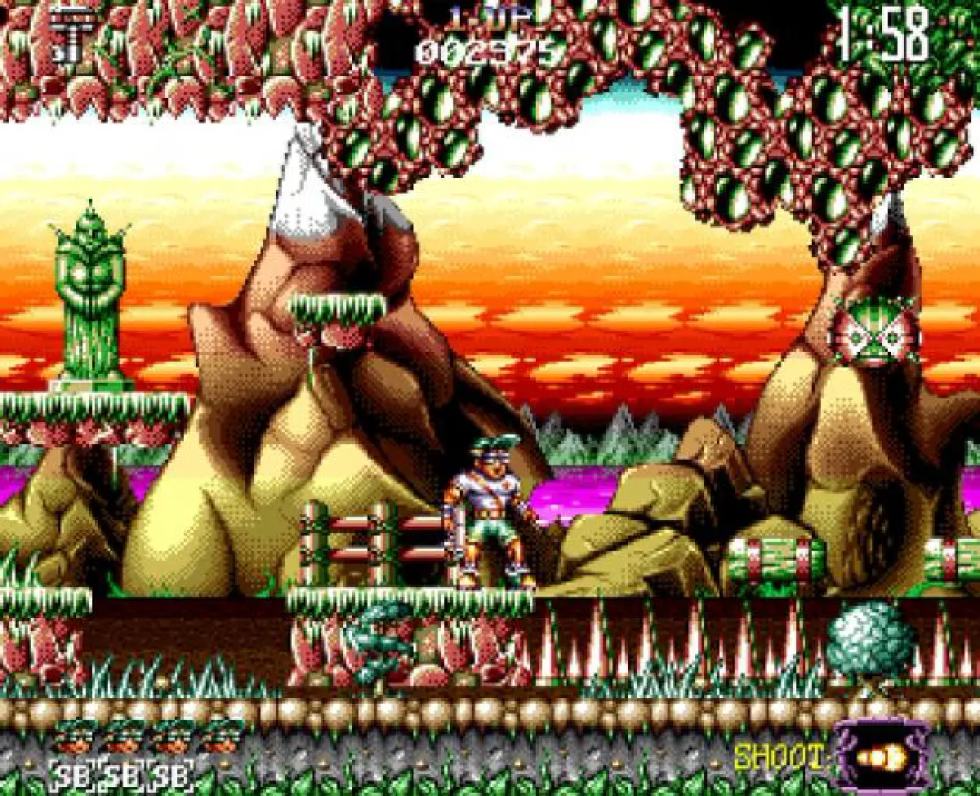
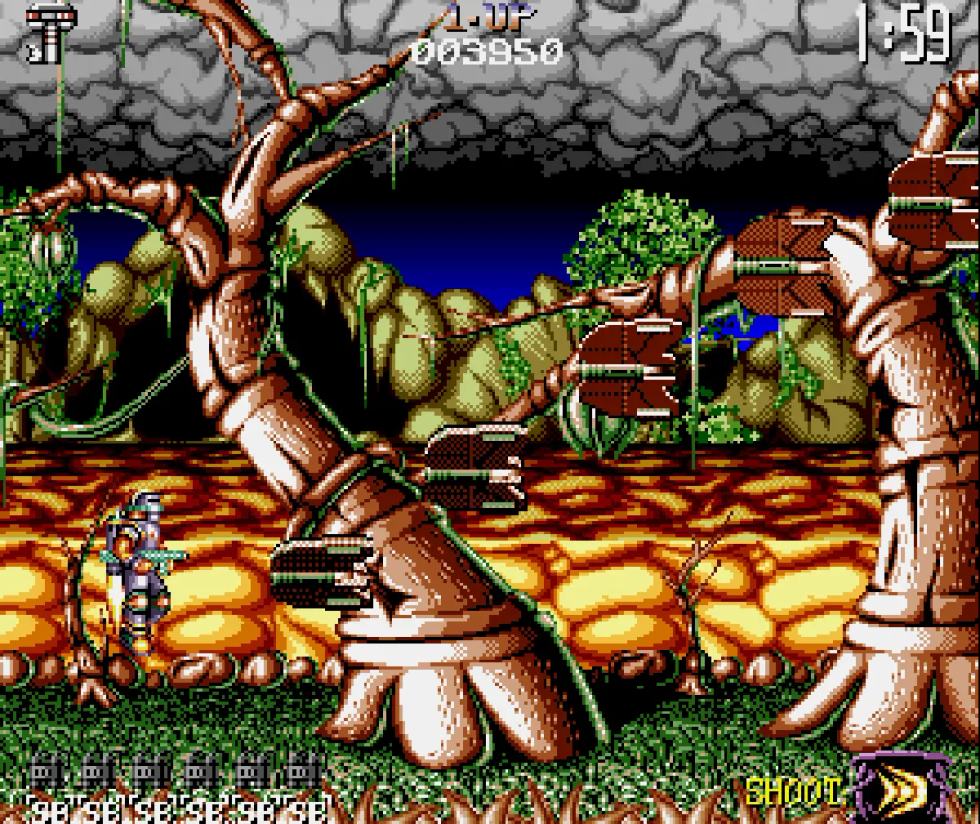
The Amiga version has a very precise identity. At first glance, it almost looks console-like: bright colours, rich backgrounds, a clearly defined character, sustained pace, constant enemies and a use of parallax designed to give depth to the scene. And yet, beneath that surface close to the console world, something deeply Amiga remains.
There is a certain European roughness, a desire for technical demonstration that sometimes matters as much as the cleanliness of the game itself. Jim Power does not seek the elegant simplicity of the best Japanese platformers. It seeks impact. It wants the screen to feel full, alive, layered. It wants the player to sense movement everywhere, even when that risks making the action less immediately readable.
And this is exactly where the game divides opinion. Visually, it is still fascinating today, but not always clear. Some backgrounds are so present that they steal space from the action. The parallax, spectacular for the time, can become almost intrusive. Colours and animations create a recognizable world, but at times the eye struggles to separate threats, platforms and decoration perfectly.
That said, the charm remains very strong. Jim Power is one of those games that, even just in motion, seem to communicate ambition. It does not have the balance of a Nintendo classic or the instinctive precision of a great SEGA title, but it has a European personality that is hard to mistake. It is dirtier, more muscular, more showy. And precisely for that reason, on Amiga, it works.
The sound of Chris Hülsbeck
If the graphics impress, the sound overwhelms. Chris Hülsbeck’s soundtrack is one of the elements that most clearly defines the identity of Jim Power. His signature is immediately recognizable: powerful melodies, epic feeling, full arrangements, and a continuous push that seems to turn every level into something larger than the game itself.
This is not just “good music for Amiga”. It is music that gives body to the action. Where the level design can feel punishing, Hülsbeck keeps the energy alive. Where the difficulty risks breaking the rhythm, the soundtrack keeps pushing forward. There is that same ability, already made famous by Turrican, to make a world built from sprites, tiles and scrolling feel enormous.
The music of Jim Power may not have the same historical weight as Hülsbeck’s most celebrated compositions, but it belongs to the same emotional school. It is European arcade adventure music: full, heroic, at times almost oversized compared to what is happening on screen. And precisely for that reason, it works so well.
In a more refined game, it might simply have been an excellent soundtrack. In Jim Power, instead, it becomes an essential part of the experience. Without Hülsbeck, the game would lose a huge part of its charisma.
Beautiful, difficult, and sometimes unfriendly
The real limit of Jim Power lies in its gameplay. Not because it controls badly in an absolute sense, but because it asks a lot and gives very little. The difficulty is high, tolerance for mistakes is low, and the placement of enemies and obstacles is often merciless. It is one of those games where memory matters almost as much as reflexes.
The protagonist responds fairly well, but the action does not always leave enough room to react naturally. In some moments, you feel punished more for not already knowing the level than for making a real mistake. It is a typical feature of much European production of the period: spectacle and difficulty before accessibility.
This does not mean that Jim Power is not fun. Once you enter its rhythm, once you accept its harshness and begin to memorize passages, enemies and patterns, the game can be satisfying. But it is not accommodating. It does not take the player by the hand. It challenges, rejects and forces you to try again.
And this is where the distance from the best console platformers of the period becomes clear. Even when those games were difficult, they often aimed for more immediate readability. Jim Power, instead, almost seems proud of its hostility. It is part of its charm, but also part of its limitation.
An Amiga looking at consoles without losing itself
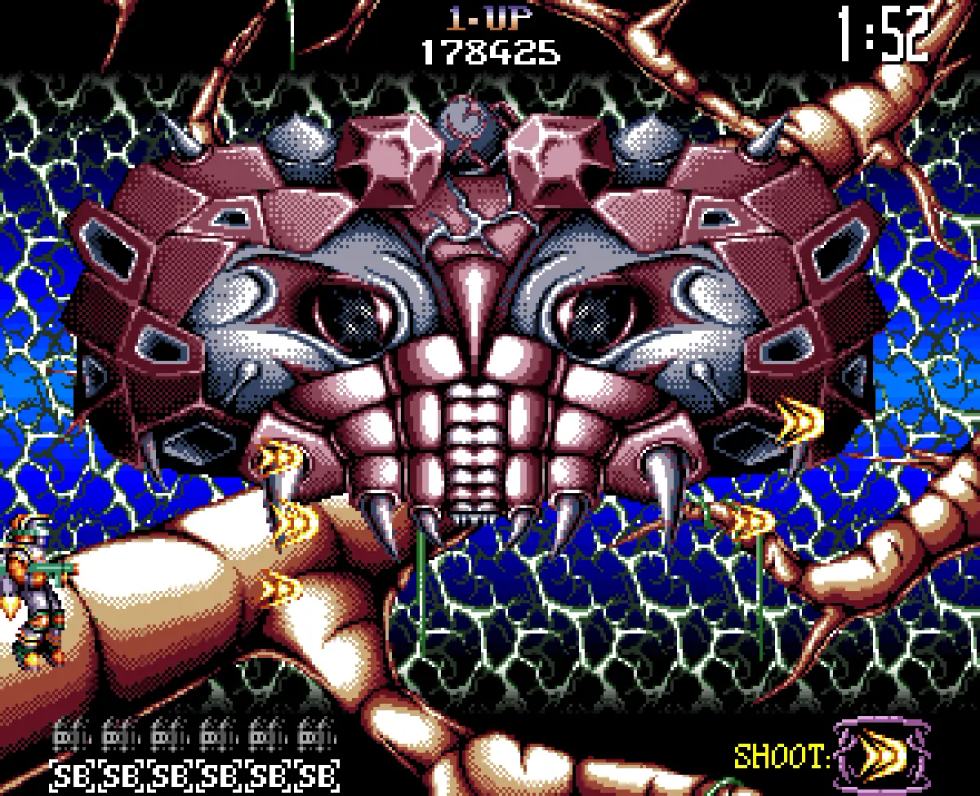
One of the most interesting aspects of the Amiga version is its relationship with console imagery. Jim Power seems to want to speak that language: arcade rhythm, strong colours, recognizable sprites, varied sections, continuous spectacle. And in many ways, it succeeds.
But it never truly becomes a “console game” in the Japanese sense of the term. It remains rougher, more technical, more unbalanced. It is an Amiga looking at Mega Drive and Super Nintendo, but doing so with its own character. It does not try to imitate them completely: it translates that language into a European sensitivity made of visual excess, severe difficulty and monumental music.
For this reason, even today, the Amiga version remains perhaps the most fascinating. Later versions on consoles and PC would take different directions: sometimes cleaner, sometimes stranger, sometimes more explicitly tied to the idea of the “3D dimension”. But the Amiga original preserves a more immediate force of impact: it is rougher, more European, more connected to that desire to impress that defined so much Amiga production in the early 1990s.
It is the most direct, dirtiest and most recognizable Jim Power. Not necessarily the most balanced, but the one with the strongest character.
An imperfect classic, but impossible to ignore
Jim Power in Mutant Planet is not one of the best Amiga platformers in an absolute sense, if by “best” we mean balance, cleanliness, precision and progression. It is too severe, too irregular, too in love with its own spectacle to be truly impeccable.
But dismissing it for that would be a mistake. Because Jim Power is also one of the titles that best expresses a certain idea of Amiga: a machine capable of chasing consoles without becoming a console, of showing technical muscle without losing the European taste for strangeness, of turning a platformer into an aggressive and memorable audiovisual showcase.
Graphically, it remains remarkable, even with its confusion. Sonically, it is powerful. As a game, it requires patience, memory and a certain tolerance for the rough edges of the period. It is not a title to recommend to someone looking for the most refined or most fair platformer. It is a title to recommend to someone who wants to understand what it could mean, in the early 1990s, to switch on an Amiga and see something that seemed to challenge the console world openly.
And above all, it is a game you remember. Perhaps not always peacefully, perhaps with a few curses along the way, but you remember it. In retrogaming, that matters too.
Reader memories
Comment on the article and join the discussion.
Comment rulesLog in or register to leave a comment.
Create your account
Loading comments...