


The return of Star Fox on Nintendo Switch 2 brings one simple question back into focus: why is this episode still the main reference point for the entire saga? Not the first Star Fox on Super Nintendo, important but inevitably tied to the technical wonder of the Super FX chip. Not Star Fox Zero, the controversial attempt to relaunch the series on Wii U.
Once again, collective memory returns there: to 1997, to the Nintendo 64, to Fox McCloud, Falco, Peppy, Slippy, Andross, and to that immortal line: “Do a barrel roll”.
In 1997, the Nintendo 64 needed games capable of showing the new generation in an immediate way. Super Mario 64 had already redefined three-dimensional platforming, Mario Kart 64 had brought local multiplayer into a new dimension, but the console still needed a title capable of expressing pure, fast, spectacular and cinematic action. Lylat Wars, known in Japan and North America as Star Fox 64, arrived with exactly that role.
The game took the idea behind Star Fox on Super Nintendo and transformed it into something far smoother, clearer and more ambitious. The first Star Fox had been a technical marvel for its time thanks to the Super FX chip, but it was also inevitably rough. Lylat Wars, by contrast, brought Fox McCloud and the Star Fox team into a much more solid kind of 3D, with more dynamic missions, stronger direction, voice acting, alternative routes and a remarkable number of memorable moments.
In Europe, the name changed for legal reasons, but for many players on the continent that cartridge was still the true entry of Star Fox into the modern imagination. It was not just “the one with the spaceships”: it was one of the most recognizable action games in the entire Nintendo 64 library.
A space war in arcade form
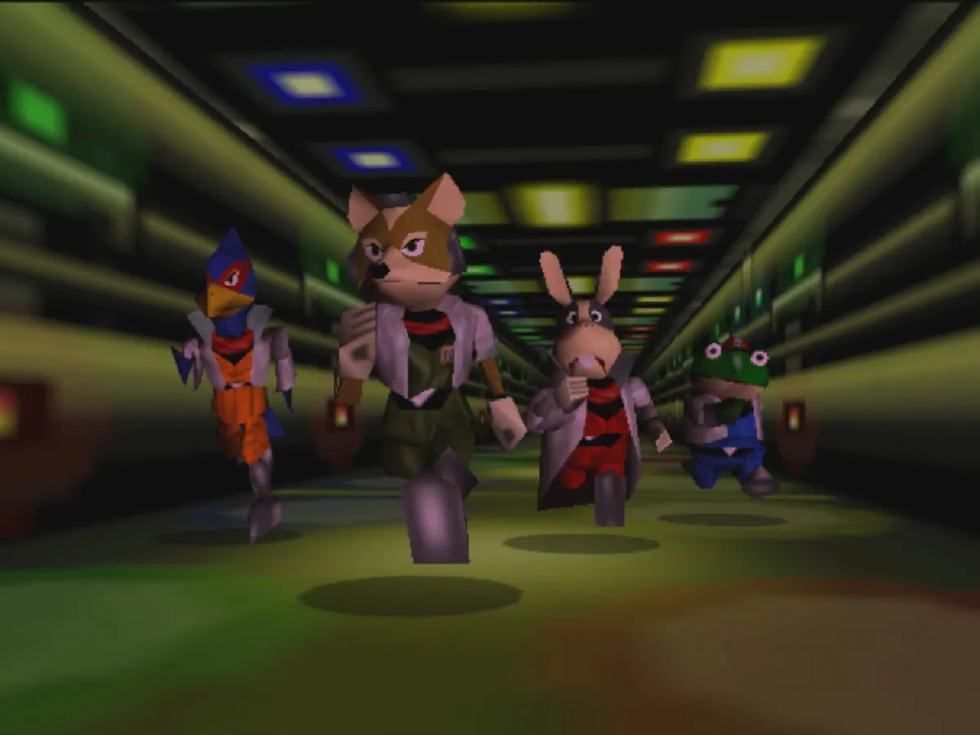
The story is simple and functional. The evil Andross, exiled to the planet Venom, threatens the Lylat system. General Pepper calls in the Star Fox team, formed by Fox McCloud, Falco Lombardi, Peppy Hare and Slippy Toad, to stop the invasion and reach the heart of the conflict. There is no long or complex plot, but there is a narrative rhythm perfectly suited to an arcade game.
Each mission is a small episode of space war. The game moves from mountain corridors to orbital battles, from enemy bases to asteroid fields, from aquatic worlds to besieged cities. It alternates between on-rails sections, closer to a classic shooter, and moments in all-range mode, where the area opens up and the player can move freely within a three-dimensional arena.
This alternation is one of the game’s greatest strengths. Lylat Wars never loses control of the scene. Even when it grants freedom, it keeps objectives clear, enemies readable and the pace tight. The feeling is that of an interactive action film built with an arcade mentality: few distractions, plenty of intensity, constant forward momentum.
The Nintendo 64 and the control of space
The heart of the game is the Arwing. Fox’s ship responds precisely, allowing acceleration, braking, sharp turns, loops, flips and the famous barrel roll. The control system makes excellent use of the Nintendo 64 controller: the analogue stick provides a smoothness that previous consoles could not easily achieve, while the buttons make lasers, bombs, lock-on and evasive manoeuvres feel natural.
Lylat Wars is immediately accessible, but it is not shallow. Finishing a mission is one thing; mastering it is another. Score, medals, teammate survival, alternative routes and secrets all encourage replay. Every level can be played better, with greater precision, by learning enemy spawns, trajectories, bomb timing and hidden conditions that change the route across the Lylat system map.
This is where the game reveals its true nature. Lylat Wars is short if treated as a linear adventure, but huge if understood for what it is: a highly replayable arcade shooter. The campaign does not last long, but every run can be different, and the branching map encourages players to discover harder paths, alternative bosses and secret missions.
Teammates are not just voices on the radio
One of the game’s smartest ideas is the role of the Star Fox team. Falco, Peppy and Slippy are not simple narrative decorations. They appear during missions, ask for help, comment on the action, signal danger, open routes and influence the rhythm of battle. Defending them is not just a moral matter: if a teammate is shot down, they will miss the next mission while their ship is repaired, depriving the player of their support.
This system brings the action to life. The radio communications, now iconic, create a sense of team play that many more ambitious games struggled to achieve. Peppy giving advice, Falco provoking, Slippy getting into trouble, General Pepper intervening, Wolf and Star Wolf entering the scene: everything contributes to making the battle more dynamic and personal.
The voice acting had a huge impact. Today, some lines may sound naive or repetitive, but they are part of the game’s identity. Lylat Wars is one of those titles where the lines stay in memory as much as the levels or bosses. “Do a barrel roll” did not become a meme by chance: it is the perfect synthesis of a game that constantly communicated with the player.
Rumble Pak: a generational shock
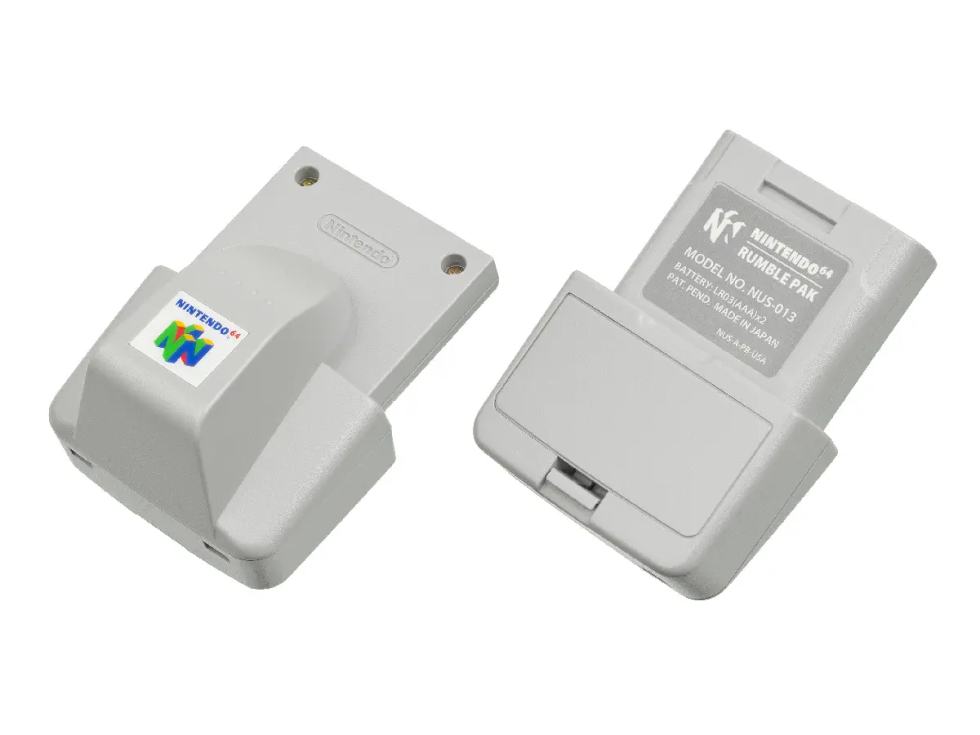
Lylat Wars was also the game that accompanied the debut of the Rumble Pak, an accessory destined to change the way controllers physically communicated with players. Vibration is taken for granted today, but in 1997, feeling the controller react to explosions, damage and impacts gave the game a new and almost surprising sensation.
It was not a minor detail. In a shooter built around speed, collisions, lasers and evasive manoeuvres, physical feedback increased immersion. The Nintendo 64 turned the action on screen into a small shock in the player’s hands, making each battle feel more concrete. Lylat Wars was not only a great game: it was also a demonstration of how the controller itself could become part of the experience.
This contributed greatly to the game’s “next gen” feel. It was not only three-dimensional graphics or spoken audio, but a combination of signals: analogue movement, direction, voice, vibration and branching structure. Everything communicated the idea of a new generation.
Simple direction, remarkable effectiveness
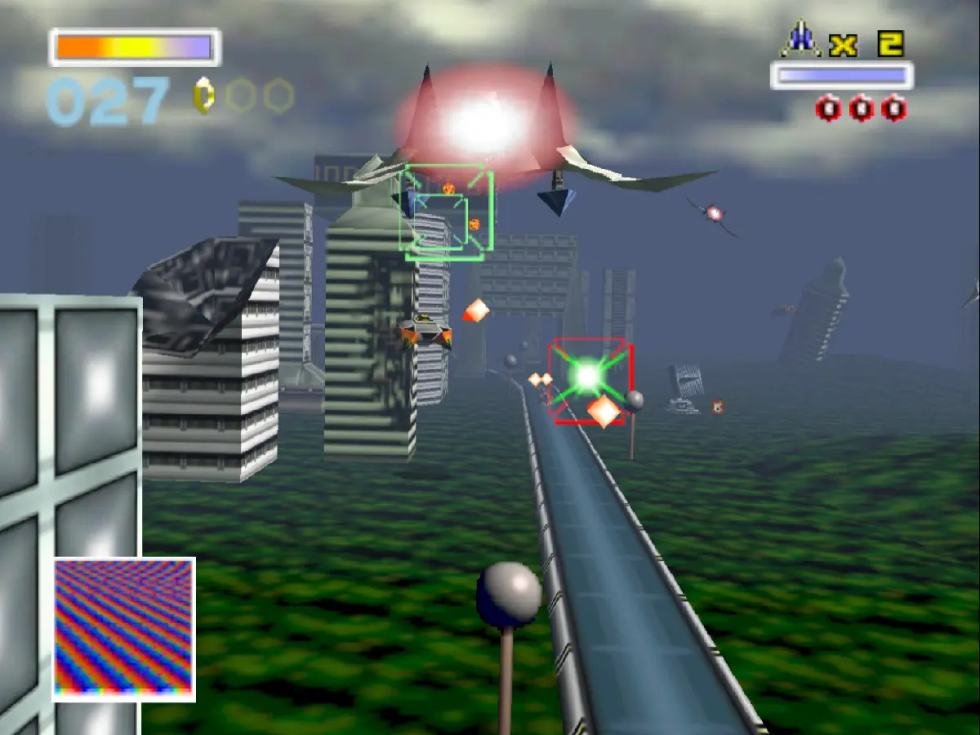
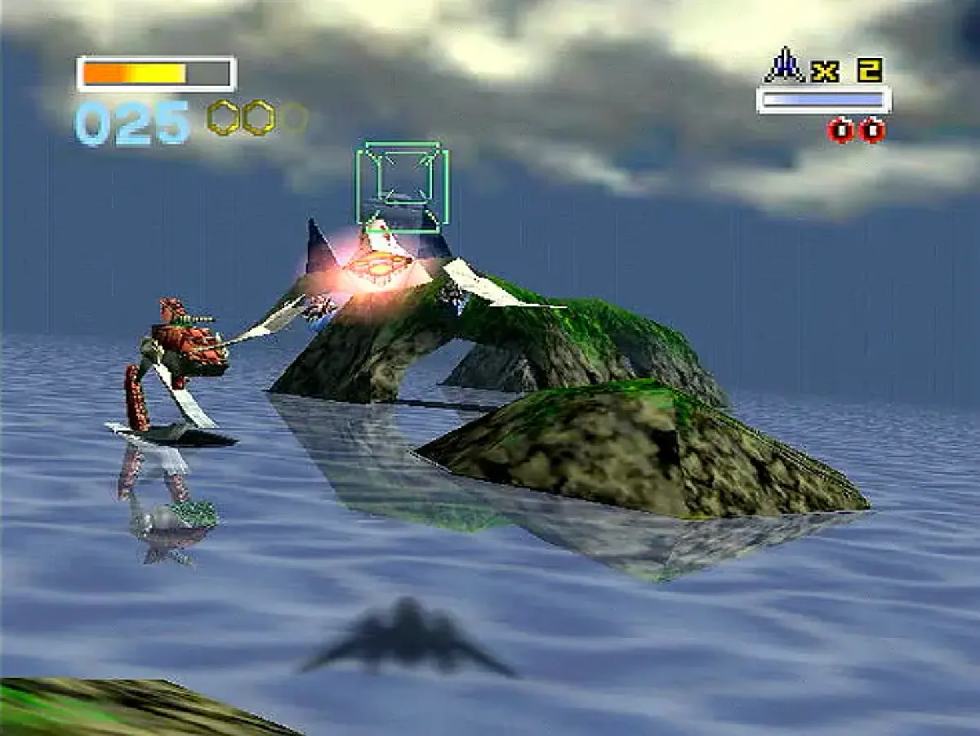
Visually, Lylat Wars does not aim for realism. The models are simple, the textures essential, the geometry clearly marked by the Nintendo 64 era. And yet the game still works because it has extremely clear direction. Enemies are readable, explosions satisfying, environments varied, bosses large and recognizable. Every mission has its own visual and mechanical identity.
Corneria introduces the war spectacularly, with the city under attack and the famous flight under the arches. Sector Y increases the scale of battle. Aquas completely changes the rhythm with the Blue-Marine. Zoness brings a dirtier, darker tone. Macbeth, Solar, Titania, Area 6, Venom: every stop adds something. Even when the game shows the technical limits of its time, the direction remains solid and dynamic.
Lylat Wars is full of small scenes built to be remembered: the first appearance of Star Wolf, the Macbeth train, all-range battles, bosses that open into successive phases, the final run toward Venom. It is not a very long game, but it is dense with moments.
Music, voices and identity
Sound plays a fundamental role. The music supports the action with synthetic orchestral themes: martial, adventurous and perfectly aligned with the idea of an arcade space opera. The soundtrack does not always have the complexity of Nintendo’s most melodic works, but it supports mission rhythm extremely well and gives the game an immediate heroic tone.
The voices, however, are the most distinctive element. Lylat Wars constantly speaks. Teammates comment, enemies threaten, bosses provoke, communications shape the action. This creates an almost cinematic flow without taking control away from the player. It is an intelligent use of speech: it does not replace gameplay, it accompanies it.
In Europe, many players also remember the game for its localized voice acting, which gave the experience additional personality. The quality may sound naive today, but at the time, hearing a Nintendo game speak so much had a notable impact. It was part of the magic of the cartridge.
Shorter than it looks, longer than it says
The easiest flaw to mention is length. A complete run can be finished in a short time. Players who expected a long space adventure in 1997 could be surprised by its compactness. But judging Lylat Wars only in those terms means misunderstanding its structure.
The game is built to be repeated. Each path across the map changes the level of challenge. Some missions require precise conditions to be reached. Medals force the player to perform well, not simply survive. Multiplayer added another element of local fun, even though it was not the heart of the experience. It was not as deep as the campaign, but it allowed Arwing, Landmaster and battles between friends to become a strong arcade extra.
Longevity, then, depends heavily on the player’s approach. Seek only the ending, and Lylat Wars is short. Seek the best route, high scores, mission mastery and every branch of the map, and it becomes a cartridge to return to often.
The classic the Nintendo 64 deserved
Lylat Wars is one of the games that best define the Nintendo 64. Not because it is the largest or the most innovative title in absolute terms, but because it concentrates many of the console’s qualities: analogue control, readable 3D action, personality, physical accessories, local multiplayer, arcade immediacy and the desire to impress.
Compared to the first Star Fox, it is an enormous leap. Compared to many shooters of its time, it has unusual clarity and synthesis. It is spectacular without being confusing, accessible without being banal, short without being poor. Above all, it has that quality typical of Nintendo’s best games: after a few minutes, everything feels natural, as if it could not work any other way.
Today, Lylat Wars remains one of the best entry points into the Nintendo 64 library. It does not require hours to come alive, it does not need complicated explanations, and it does not require nostalgia to work. All it takes is taking off from Corneria, hearing the first radio communications, avoiding enemy fire and understanding that the Lylat system is still in danger.
Fox, Falco, Peppy and Slippy never had a more balanced, iconic and immediate adventure. And for a console often remembered through a handful of absolute giants, Lylat Wars deserves to stand permanently among those names.


Reader memories
Comment on the article and join the discussion.
Comment rulesLog in or register to leave a comment.
Create your account
Loading comments...