


An action game too large for a single definition
Some sagas are born to occupy a genre. Others seem determined to push against it from the inside. Turrican belongs to the second group. At a quick glance, it could look like a European run and gun of its time: science fiction armour, huge weapons, biomechanical aliens, hostile worlds and a generous dose of metallic imagery. But reducing it to that means missing the point. Turrican was not simply a Western answer to Contra, nor a distant relative of Metroid, nor just a technical showcase for the Commodore 64 and Amiga. It was something more ambiguous and fascinating: an attempt to take arcade influences, home computer exploration, technical virtuosity and electronic music, and fuse them into an action game that did not really feel like anything else.
That was its strength. Turrican did not simply ask the player to run from left to right, nor did it lock them inside perfectly readable corridors. It placed them in large, sometimes maze-like spaces filled with platforms, enemies, secrets, climbable walls, hidden bonuses and routes to discover. It was action, certainly, but not only action. It was also about getting lost, searching, turning back, understanding where the level might still lead. At its best, it felt like an arcade game too vast to fit inside an arcade cabinet, a console-style action game filtered through the mentality of home computers, a German technical fantasy that used limitation not as an obstacle, but as material to be shaped.
Manfred Trenz and the Commodore 64 pushed beyond the possible
At the centre of it all was Manfred Trenz, an almost mythical figure in European video game history. Even before Turrican, his name was already linked to The Great Giana Sisters and Katakis, two games that say a great deal about the ambition and boldness of a certain German scene in the 1980s: looking at Japanese giants, absorbing their grammar, reinterpreting it on different machines, often at the edge of what seemed possible and sometimes beyond the border of resemblance. Trenz was a programmer, but above all he was a technical author: someone who seemed to think the game directly inside the machine, not above it. With Turrican, he took the Commodore 64 and asked it to behave like something larger, faster and more aggressive.
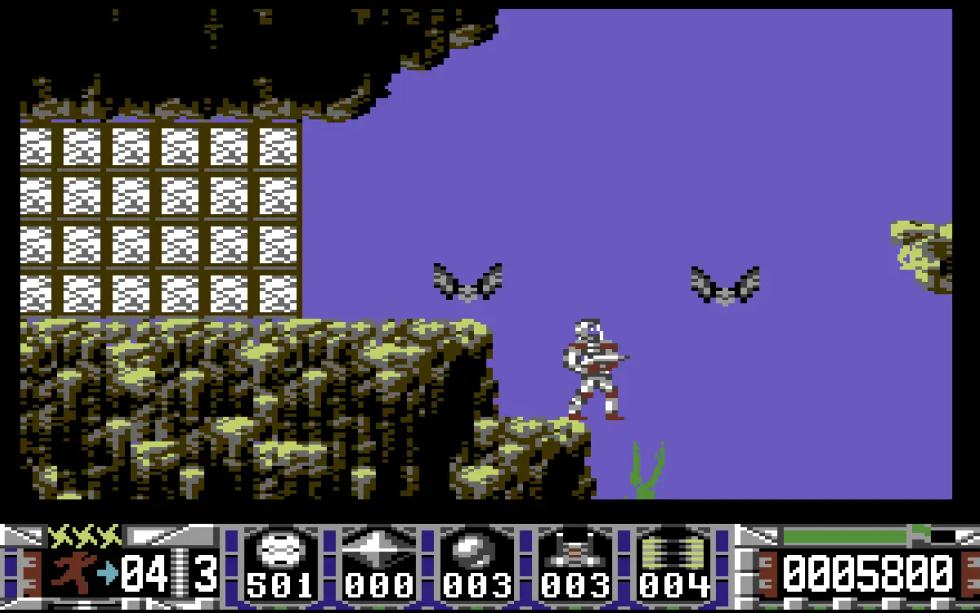
The first Turrican, published in 1990 by Rainbow Arts, was born there: on the Commodore 64. Not as a reduced version of an idea created elsewhere, but as the point of origin. This matters, because the memory of the saga is often dominated by the Amiga, by 16-bit spectacle, by Chris Hülsbeck’s music and by the audiovisual impact of the Factor 5 versions. But the creative core is 8-bit. It is on the C64 that Turrican finds its initial identity: large levels, aggressive sprites, flexible controls, multiple weapons, the gyroscope transformation, a sense of scale, and that strange mixture of freedom and pressure that made it less immediate than a pure arcade game but more magnetic than many linear shooters.
The Commodore 64 version is also where Trenz’s character becomes clearest. Turrican never seems satisfied with itself. Every screen wants to prove something: that the C64 can scroll, that it can host large worlds, that it can move a heavy armed character without losing readability, that it can suggest a universe bigger than the available memory. Not everything is elegant, and not everything is perfectly refined. That is part of its charm. It is a game built on the tension between ambition and hardware, arcade desire and computer structure, spectacle and labyrinth.
Amiga, Factor 5 and the consecration of the myth
Then came the Amiga, and with the Amiga came consecration. The conversions handled by Factor 5 did not simply move Turrican to a more powerful machine: they amplified its myth. The graphics became richer, the sound wider, the rhythm more cinematic. The Amiga was the perfect machine for this transformation, because it had exactly what the saga needed: colours, scrolling, sampled audio, and a user base accustomed to expecting technical wonders and treating every limit as a challenge. Turrican seemed to speak the language of the Amiga even though it had not been born on the Amiga. Like many European games of that period, it found in Commodore’s 16-bit machine not only a platform, but a cultural home.
The decisive step, however, was Turrican II: The Final Fight. Released in 1991, it is the chapter most often remembered as the peak of the classic formula. Here the structure becomes more confident, broader and more powerful. Action remains central, but the game breathes better. The levels feel more carefully built, the progression more varied, the sense of adventure stronger. The Amiga version in particular became, for many players, the definitive face of the series, even though the project retained a very strong bond with the Commodore 64 and with Trenz’s original vision. Turrican II is one of those rare sequels that does not truly change the nature of the first game, but makes its greatness easier to read.


Chris Hülsbeck: when music becomes identity
Talking about Turrican without talking about Chris Hülsbeck means telling only half of the story. Hülsbeck did not simply accompany the saga: he elevated it, expanded it, and made it memorable even when the game was no longer on screen. His tracks gave Turrican an emotional dimension that many action games of the time did not have. They were not only energetic shooter themes; they were epic openings, melancholic melodies, electronic progressions that turned a level into a place. With Turrican II in particular, the music became almost a manifesto for the Amiga: no longer a simple sound effect, but identity. The player did not only remember what they did. They remembered what they heard.
This is one of the reasons why Turrican has endured so well over time. Other games were cleaner, better balanced, more modern in design. But few had this fusion of image, sound and technical ambition. The saga lived in a particular space: too exploratory to be a simple run and gun, too arcade-driven to be an adventure, too European to truly resemble its Japanese models. Where Contra focused on rhythmic precision and linear intensity, Turrican preferred to open the space. Where Metroid built an interconnected and progressive world, Turrican offered huge levels that were more instinctive and less systematic. It was not necessarily better. It was different. And that difference was its mark.
Turrican 3 and Mega Turrican: the change of era
With the third chapter, the story becomes more complicated. Turrican 3: Payment Day on Amiga and Mega Turrican on Mega Drive are two faces of the same historical transition: the saga gradually leaving the home computer as its natural centre and trying to speak the language of consoles. Here Manfred Trenz is no longer the direct creative heart as he was in the first two chapters, and it shows. Not necessarily in a negative way, but it shows. Mega Turrican was born within Factor 5 with a more console-oriented logic: more compact, more spectacular, more direct. It was then brought to Amiga as Turrican 3. Curiously, the Amiga version reached the European market before the Mega Drive version, even though the project had been designed around Sega’s machine.
The comparison between the two versions tells the story of that changing era. On Mega Drive, Mega Turrican feels more coherent with its target hardware: rhythm, controller, structure and immediacy seem to communicate more naturally with the console world. On Amiga, Turrican 3 remains impressive, but it also carries the shadow of a conversion and of a market that was changing around it. It is still Turrican, but it is a different Turrican: less exploratory, more focused on direct action, with shorter levels and a new central mechanic, the grappling hook, which partially replaces the famous armed-control feeling of the first two games.
The grappling hook is an interesting choice because it tries to give the saga a new recognizable gesture. It is not just an accessory: it changes the way the player reads space, introduces vertical movement, requires timing, and pushes the game toward a more modern idea of mobility. At the same time, it marks a distance. In the first Turrican games, the protagonist felt like an organic tank capable of occupying the screen with weapons, lasers and transformations. In Mega Turrican, he becomes more acrobatic, more guided, more console-like. It is a coherent mutation, but not a painless one.
And yet it would be unfair to dismiss Turrican 3 or Mega Turrican as minor chapters. They are transition games, and for that reason they are valuable. They show Factor 5 trying to survive the commercial decline of European home computers and move its technical talent onto consoles. They show the Amiga at a moment when it is no longer the future, but not yet memory. They show the Mega Drive as a possible new home for a certain kind of European action game, harder and more metallic than the dominant cartoon platformer. Above all, they keep one question alive: how much of Turrican belonged to the character, and how much belonged to the technical and cultural environment in which it was born?
Super Turrican: the saga enters console territory
Then there are the Super Nintendo chapters, often treated as a side branch, but essential for understanding how Turrican changed when it truly entered console territory. Super Turrican, released in 1993, was developed by Factor 5 for SNES and credited as based on the character created by Manfred Trenz. It is not a simple port of the earlier games, but a reinterpretation. It has richer colours, smoother controls and a structure closer to the console audience, yet it still preserves part of the original formula: exploration, weapons, large levels and science fiction atmosphere. It is probably the most balanced attempt to translate Turrican to Super Nintendo without completely distorting it.
Super Turrican 2, released in 1995, is something else. More linear, more spectacular, more in love with effects, vehicles, Mode 7 and cinematic action. It is a technically remarkable game, at times impressive, but also the one that moves furthest away from the original idea of Turrican as a space to explore. Here the saga seems to look less toward Metroid and more toward Contra, less toward home computers and more toward the console grammar of the late 16-bit cycle. The result is powerful and often beautiful, but divisive. Some consider it one of the best action games on SNES; others feel that, by gaining spectacle, Turrican lost part of its mystery.


A saga made of versions, ports and compromises
This tension runs through the whole saga. Every time Turrican changes platform, something is gained and something is lost. On Commodore 64, there is the wonder of the impossible. On Amiga, there is audiovisual consecration. On Mega Drive, there is the console compactness of Mega Turrican. On Super Nintendo, there is the colourful and technical spectacle of the two Super Turrican games. On Game Boy, PC Engine, Atari ST, Amstrad CPC, Spectrum, DOS and other platforms, there remains the more irregular trace of a series that, like many European sagas of the time, was adapted to very different machines, often changing skin, rhythm and compromises.
The point is that Turrican has never been a “pure” saga in the modern sense. It does not have a strong narrative continuity, a perfectly ordered canon or a psychologically defined character. Bren McGuire, the armour, MORGUL, Alterra and the various science fiction frames exist, but they are not what truly remains. What remains is a sensation. The idea of being thrown into a hostile world with oversized weapons, huge music and the possibility of discovering something beyond the edge of the screen. Turrican is less a character than a way of inhabiting the action game.
Perhaps this is also why the saga has continued to live in the memory of European players more strongly than its commercial numbers or mainstream presence might suggest. It did not become a global icon like Mario, Sonic, Mega Man or Metroid. It did not have a long modern lineage, nor a fully accomplished rebirth. But for those who grew up with Commodore 64, Amiga and the European home computer scene, Turrican represents something very specific: the proof that, far from Japan and the United States, it was possible to build a powerful, recognizable, technically ambitious and musically unforgettable action imaginary.
The modern Turrican Anthology brought this history back to the surface, but it also showed how difficult it is to contain it inside a neat product. Turrican is not just a series of ROMs to emulate: it is a path made of versions, ports, compromises, different machines, changing markets, authors entering and leaving, and music that outlived the games themselves. The collections have the merit of making many chapters accessible again, but the myth lives elsewhere: in memories, forums, remixes, endless debates about which version is best, comparisons between Turrican 3 and Mega Turrican, soundtracks listened to again decades later, and the name of Manfred Trenz, which still seems to belong more to legend than chronology.
The sound of a European video game culture that wanted to matter
In the end, perhaps the value of Turrican lies precisely in its refusal to be reduced to a single formula. It is not only the first chapter on C64, not only Turrican II on Amiga, not only Mega Turrican, not only the SNES branch. It is a constellation. A saga born in an era when European developers often worked with limited resources but enormous ambition, looked at arcades and Japanese games without merely copying them, and turned technical constraints into identity.
Turrican is metal and chip music, solitude and power, exploration and fire, Commodore 64 and Amiga, Mega Drive and Super Nintendo, Manfred Trenz and Chris Hülsbeck, Rainbow Arts and Factor 5. It is an imperfect, discontinuous, sometimes confused saga, but for that very reason it is alive. It never needed to be ordered like a modern franchise, because it belongs to a time when video games were still strange hybrid objects, halfway between software, toy, technical demonstration and personal dream.
And if we still talk about it today, it is not only because it was difficult, spectacular or technically impressive. We talk about it because Turrican represents a precise promise: that of a European action game capable of asking no permission, of not fully imitating anyone, of taking a home computer and making it feel larger than it was. A promise that the saga did not always keep with the same strength, but that at its best — especially between the first game and Turrican II — burned with rare intensity.
It was not only “shoot or die”. It was the sound of a European video game culture that, for a few years, truly believed it could build its own action imaginary.
Reader memories
Comment on the article and join the discussion.
Comment rulesLog in or register to leave a comment.
Create your account
Loading comments...