




After Tramiel: a vacuum and an uncertain direction
When Jack Tramiel left Commodore in 1984, he did not simply leave a company behind: he left a vacuum that was difficult to fill. For years he had embodied a clear vision, built on pragmatism, commercial aggression and total control of production. Without him, Commodore suddenly found itself without an equally clear direction, precisely at the moment when the market was evolving faster than ever.
And yet, while this uncertainty was visible from the outside, something completely different was taking shape within the company: a project born far from Commodore’s traditional logic.
A project called Hi-Toro.
Hi-Toro: the hidden origin of the Amiga
At first, Hi-Toro was a small company with an ambitious idea: to create an advanced machine capable of overcoming the limits of existing home computers. It was not simply a new product, but a completely different approach to hardware, where graphics, audio and multitasking were conceived as central elements, not later additions.
When Commodore acquired Hi-Toro, it brought in not only a technology, but a vision. It was a decision that marked a change of paradigm: for the first time, the company was not merely trying to make technology accessible, but to push its limits.
The Amiga: a machine out of its time
When the Amiga reached the market, it did not seem to belong to the same generation as its competitors. In an era increasingly shaped by competition with Atari, its graphic and audio capabilities, combined with an advanced multitasking system, made it something profoundly different from what the public was used to seeing. It was not simply a step forward from the Commodore 64 or the other home computers of the time: it was a leap, clear and almost disorienting.
That leap became even more evident in the direct comparison with the Atari ST, created under the leadership of Jack Tramiel after his departure from Commodore. The two machines inevitably came to represent two opposing philosophies: on one side the more linear and essential approach of the ST, on the other the more ambitious and multimedia-driven vision of the Amiga. It was a rivalry born not only from the market, but from a personal and industrial fracture rooted in the previous years.
In fact, the story of the Amiga also carries an almost invisible but fundamental tension. The project was born inside Amiga Corporation, the evolution of Hi-Toro, but to survive it needed immediate funding. At first, it was Atari that intervened with a loan, securing an option on the technology. It was a move that could have completely changed history.
When Commodore entered the scene and acquired Amiga, repaying the debt, it did not simply buy a project: it literally took a key technology away from a direct competitor.
From that moment on, the rivalry between Commodore and Atari stopped being purely commercial.
It became personal.
At a time when many systems were still limited to text interfaces or rudimentary graphics, the Amiga introduced a fluid visual environment, rich colors, believable animations and audio that, for the first time, could come close to real instruments. All of this while the system was able to handle multiple operations at once, making natural something that on other machines remained complex or simply impossible.
In this context, one of the most revolutionary elements was Workbench. It was not simply a graphical interface, but an environment that anticipated in surprising ways what would later become standard. Overlapping windows, visual file management, the ability to work with multiple applications at the same time: none of this was an extra, but an integral part of the experience.
While many systems still worked sequentially, often through command lines or limited interfaces, the Amiga introduced the idea of real multitasking, where switching from one activity to another became immediate. It is a vision that feels normal today, but in the mid-1980s it was simply ahead of its time. In a way, Workbench was a concrete precursor of the modern way of using a computer.
The Amiga was not just a computer for work or play, because reducing it to those two functions means missing its deeper nature. It was a creative machine, designed — perhaps for the first time so clearly — for those who wanted to produce content, not only consume it.
Graphic artists, musicians, programmers and enthusiasts found in this platform a space where they could express themselves freely. Demos appeared that were not simple technical demonstrations, but true audiovisual works; digital music became accessible thanks to software that allowed users to compose and sample sounds with a level of freedom that had previously been unthinkable; graphics entered a new dimension, made of pixel art, animation and early forms of digital art.
This approach inevitably influenced the world of video games as well, where the so-called “computer war” between Amiga and Atari ST became one of the central themes of the second half of the 1980s. Many titles were released on both platforms, but the Amiga versions often stood out for their audiovisual quality, thanks to a wider palette, more advanced graphic effects and, above all, a far superior sound system.
These were not only technical differences, but differences in perception. The Amiga was seen as the machine capable of astonishing people, while the Atari ST appeared more rational and essential. Two different philosophies, born also from a rivalry rooted in the initial battle for the project.
It was precisely this difference in approach that emerged most strongly in the world of software and video games, where the Amiga began to define a new language made of image, sound and interaction.
And yet, alongside its official success, there was also a less visible but decisive element in the spread of the platform: piracy. A constant presence, one that helped create an extremely active community and made access to software broader and more immediate.
It is this combination — technical innovation, creative impact and “informal” distribution — that made the Amiga something unique. Not just a more powerful computer, but a true change of perspective.
Video games, software and the generational leap
If the Commodore 64 had defined a generation, the Amiga represented a clear, almost brutal leap toward something completely new. Video games stopped being merely functional experiences and began to focus on atmosphere, presentation and visual impact, becoming something closer to an expressive language than a simple pastime.
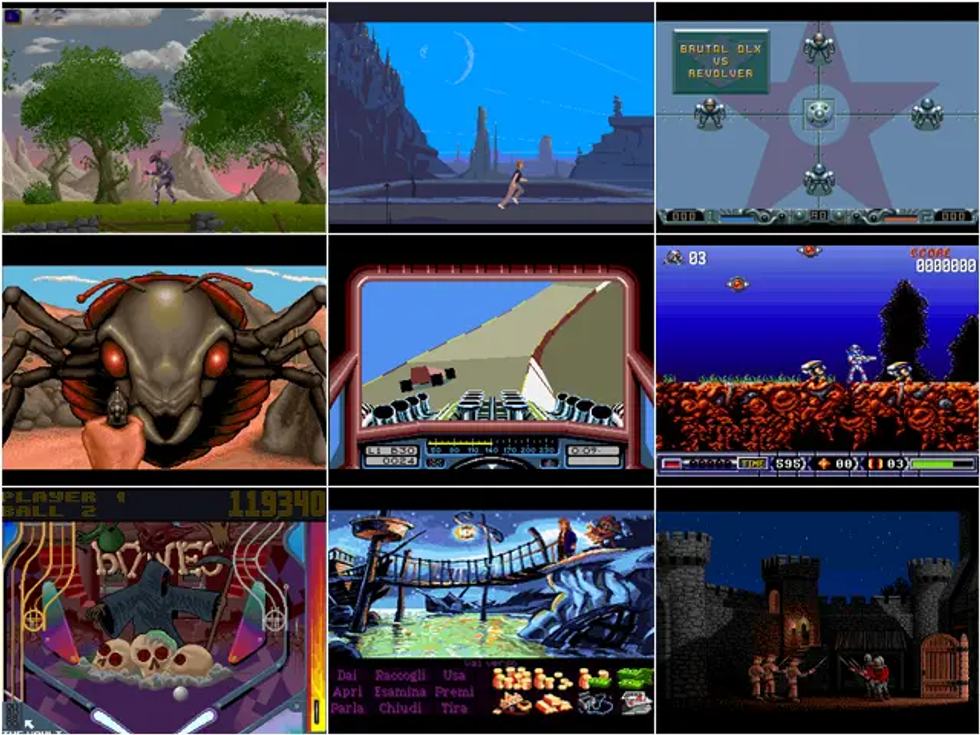
Software houses such as Psygnosis, Team17, The Bitmap Brothers, Thalion Software and Cinemaware pushed this evolution forward with an increasingly clear vision: a video game should not only entertain, but involve, surprise and leave something behind.
It is in this context that titles destined to become iconic emerged. Shadow of the Beast was not just a game, but a technical showcase that redefined visual expectations; Another World introduced a minimalist but powerful cinematic form of storytelling; Speedball 2: Brutal Deluxe transformed a simple idea into an intense and instantly recognizable experience; while It Came from the Desert brought a deliberately cinema-inspired aesthetic to the computer.
At the same time, the work of Geoff Crammond marked another kind of evolution. With Stunt Car Racer, he showed how simulation could coexist with spectacle, while with Formula One Grand Prix he brought realism to a level that influenced an entire generation of racing games.
But it was perhaps on the audiovisual level that the Amiga truly managed to distinguish itself.
Its audio chipset became one of the most recognizable elements of the platform, capable of turning soundtracks into a central part of the experience.
Composers such as Chris Huelsbeck helped create pieces that went far beyond simple accompaniment, becoming true symbols of an era. Series such as Turrican II: The Final Fight are a perfect example: music, action and rhythm merged into an experience that is still remembered today with particular intensity.
This attention to sound also appeared in other iconic titles, such as Pinball Dreams and Pinball Fantasies by Digital Illusions, where physics, graphics and music worked together to create a surprising sense of realism and involvement.
Piracy: a hidden but decisive factor
Unlike what had happened with the Commodore 64, in the case of the Amiga piracy took on an even more central role, becoming one of the factors that contributed to the spread of the hardware.
The floppy disk format, much faster and more practical than cassette tapes, made copying games extremely easy. Exchange networks multiplied, organized groups appeared, along with intros, cracktros and digital signatures: a true subculture developed in parallel with the official market.
Many users bought an Amiga precisely because they knew they could easily access an enormous software library, often impossible to sustain economically through official channels. It was an ambiguous dynamic, but a real one, and it significantly contributed to the spread of the machine.
At the same time, this parallel scene also gave life to the demoscene, one of the most fascinating phenomena of the era, where programmers, graphic artists and musicians collaborated to show how far the hardware could be pushed.
And it was precisely while the Amiga was reaching its highest point, between technological innovation and creative ferment, that Commodore’s structural weaknesses began to emerge — weaknesses that would, over time, turn an extraordinary advantage into a missed opportunity.
Reader memories
Comments, memories and points of view stay here, beside the article.
Comment rulesLog in or register to leave a comment.
Leave a comment
Create your account
Loading comments...