


When even an advertising mascot could have character
In the 1990s, almost any mascot could become the star of a video game. Some were pure marketing exercises, some had a good visual idea, and only a few managed to turn a brand into a credible platformer. Cool Spot, released in 1993 and developed by Virgin Games, belongs to that last group. It was based on the 7 Up mascot, but it was not just an interactive advert. It was a real platform game, lively, polished and more competent than many licensed titles of the period.
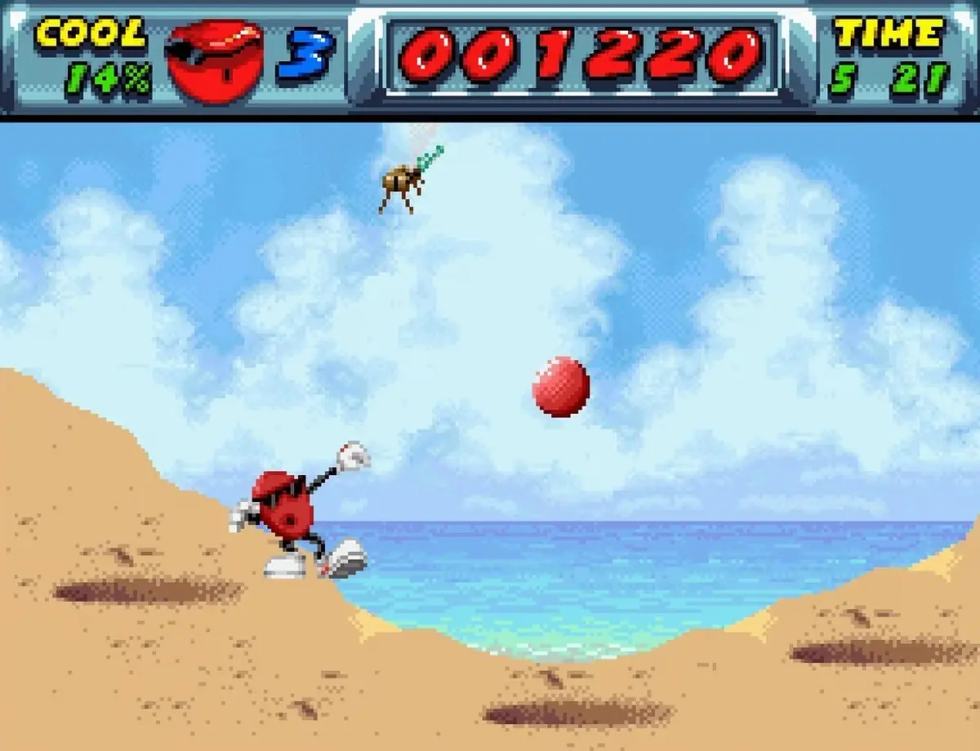
The Super Nintendo version is one of the most enjoyable versions of the game. It is colorful, clean, full of small animations and light in tone, without taking its commercial origin too seriously. Spot does not have the narrative background or cultural weight of a traditional video game mascot, but he moves with surprising confidence. He jumps, shoots bubbles, climbs, rescues other trapped Spots and crosses everyday locations turned into oversized platform stages.
Simple, but not empty
The structure is clear. You explore each level, collect a required percentage of spots and free a caged companion to complete the stage. Spot can attack by throwing bubbles in several directions, jump, climb certain parts of the scenery and use checkpoint flags. The game also includes a time limit and a continue system linked to collecting the letters of “UNCOLA”, 7 Up’s famous slogan.
This makes Cool Spot more interesting than a simple left-to-right platformer. The levels are open enough to encourage exploration, but not so wide that the pace collapses. The controls are generally good, the directional attack works well, and Spot has a funny, elastic physicality that gives even basic actions some personality.
The limitation is depth. Cool Spot does not have the constant invention of Nintendo’s best platformers or the speed and spectacle of Sonic. It is made with craft rather than genius. Some sections require trial and error, a few enemies are placed in annoying spots, and the need to collect enough spots can slow things down when you simply want to move forward. Still, the core loop remains enjoyable, and on SNES the game has a clean feel that helps a lot.
Virgin’s animation style
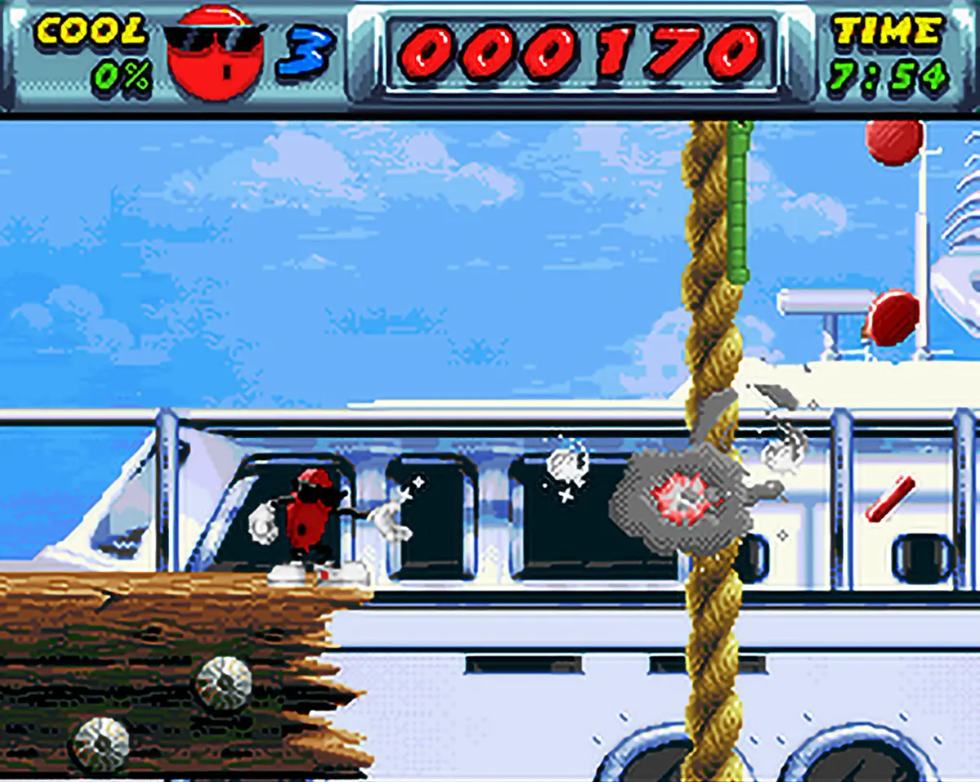
The real strength is presentation. Cool Spot comes from the early 1990s Virgin school, where animation and character personality mattered a great deal. The 7 Up mascot was not a deep hero, but in the game he becomes surprisingly expressive. He walks with attitude, reacts, bends, attacks, climbs and fills the screen with a presence far beyond his advertising origin.
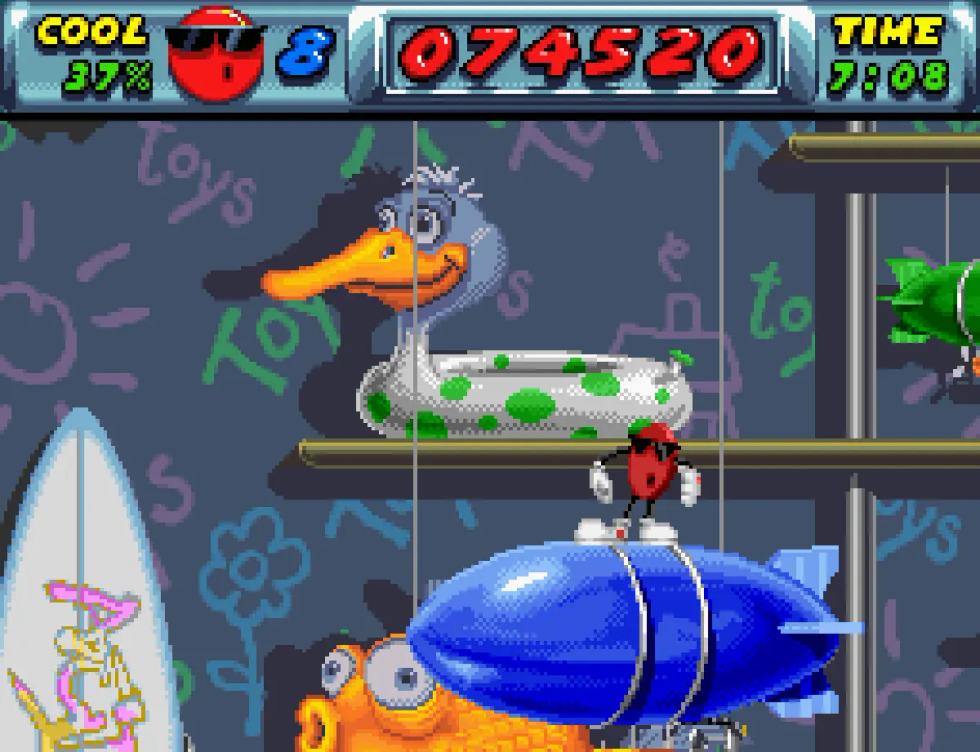
On Super Nintendo, the graphics are lively, defined and often very pleasant. The colors give warmth to the stages, sprites are readable, and many backgrounds have that American 1990s platform look, less elegant than Japanese design but full of energy. The result is a game that still looks charming today.
Compared to the Mega Drive version, the most natural point of comparison, the SNES edition leans more on color and visual softness. It does not always feel quite as sharp in motion, but the overall picture is very pleasing. It is one of those cases where Nintendo’s console gives the game a rounder, richer image, even if not every element is automatically better.
Music, bubbles and 90s identity
The sound also does its job well. The soundtrack is upbeat, catchy and perfectly matched to the game’s carefree tone. It does not aim for depth or big emotional moments, but it supports the action and helps make Cool Spot immediately recognizable. The effects are simple but clean, with bubbles and small character reactions giving rhythm to the action.
It is an audio package that works mainly because it is coherent. This is not one of the most memorable SNES soundtracks, but Cool Spot did not need that. It needed a fresh, light and commercial identity in the best sense, and from that point of view it succeeds.
Advertising, but with craft
What stands out today is how well Cool Spot moves beyond its advertising roots. Of course, it comes from 7 Up, and the character is literally a logo with sunglasses, arms and legs. But the game does not survive only because of product placement. It has solid controls, good pace, strong presentation and a level of care that many tie-ins of the era simply did not have.
In Europe, the 7 Up branding was toned down in some versions because of issues linked to the mascot’s use, making the game feel almost more neutral than its American origin. That makes it even easier to see it as a platformer in its own right, not only as playable advertising.
It does not compete with the absolute giants of the SNES catalogue, but it remains one of the more enjoyable Western platformers on the system. It does not revolutionize anything and it does not leave behind a deep mythology, but it proves that even a commercial idea could become a well-made video game.
Reader memories
Comment on the article and join the discussion.
Comment rulesLog in or register to leave a comment.
Create your account
Loading comments...