


There was a time when starting a videogame did not mean pressing a button immediately. Sometimes it began earlier: on the bus ride home, in the back seat of a car, on the floor of a bedroom, with a box opened carefully and a manual already in your hands. Before the disk had loaded, before the cartridge had clicked into place, before the title screen had appeared, the game had already begun on paper.
The manual was not just an instruction booklet. At its best, it was a threshold. It explained commands, of course, but it also built expectation. It told you what kind of world you were about to enter, who you were supposed to be, what the rules were, what dangers waited ahead. Sometimes it was practical, sometimes poetic, sometimes badly translated, sometimes far more ambitious than the game itself. But it belonged to the experience.
Today, most games teach us while we play. They highlight objects, pause the action, open tutorial windows, place icons over everything and explain every system step by step. That can be useful, especially in complex modern games. But something was lost when the manual disappeared: the quiet moment before play, the idea that reading, imagining and preparing could be part of the adventure.
The first level was paper
For many players, especially in the eighties and nineties, the manual was the first contact with a game’s identity. A boxed PC or Amiga title could feel almost like a small archive: disks, registration cards, maps, reference sheets, catalogues, warnings, sometimes even novellas or fake documents created to support the fiction.
Big-box computer games understood this very well. A role-playing game might include tables, spells, bestiaries and keyboard commands. A flight simulator could arrive with a manual thicker than a short novel. A strategy game might ask the player to study units, resources, terrain and hotkeys before even touching the keyboard. In those cases, the manual was not optional decoration. It was part of the interface.
Console manuals were usually smaller, but they had their own charm. NES, Mega Drive, Super Nintendo and later PlayStation booklets often condensed an entire world into a few pages: story, controls, items, enemies, warranty information and little illustrations that sometimes became more memorable than expected. They were practical objects, but also souvenirs.
There was a specific pleasure in reading them before playing. You looked at screenshots and tried to imagine how the game would move. You studied power-ups before knowing how they felt. You read enemy descriptions like clues from a place you had not visited yet. The manual created anticipation, and anticipation is one of the most underrated parts of videogame memory.
Lore before cutscenes
Manuals often carried story material that the game itself could not easily contain. Limited memory, simple graphics and short intros meant that a lot of context had to live outside the screen. The manual gave names to places, motives to enemies and history to worlds that, inside the game, might only appear as a few pixels and a line of text.
This was especially important in genres where imagination filled the gaps. Early RPGs, adventures, strategy games and simulations often depended on external reading. The screen showed you symbols, icons, rooms or maps, but the manual explained why they mattered. It made the world larger than the software could physically show.
Sometimes this created a strange imbalance. The manual promised empires, wars, ancient prophecies and dramatic stakes, while the game itself showed a tiny sprite moving through a few repeating backgrounds. But that gap was not always a weakness. In the mind of the player, the paper and the pixels merged. The manual did not merely explain the game; it expanded it.
There were also manuals written with real personality. Some used humor, fake bureaucracy, in-universe notes, military briefings, explorer diaries or fictional advertisements. They did not just tell the player which key opened the inventory. They invited the player to inhabit a role. Before “worldbuilding” became a common word in games discussion, manuals were already doing it quietly.
Comics, maps and worlds beyond the screen
Some games went even further. They did not simply include a manual; they surrounded the software with other forms of storytelling. Comics, maps, reference cards, driving guides, fictional documents and illustrated inserts could turn a videogame box into a small multimedia package.
Beneath a Steel Sky is one of the clearest examples. The original release included a comic created by Dave Gibbons, the artist of Watchmen, which introduced the world, tone and atmosphere of Revolution Software’s cyberpunk adventure before the player even reached the first screen. It was not a disposable extra. It was part of the fiction, a bridge between comics and videogames at a time when both languages were still learning how to speak to each other.
Italian players had their own special relationship with this idea through Simulmondo, a Bologna-based studio that adapted popular Italian comic-book characters such as Dylan Dog, Tex and Diabolik into episodic computer games. For international readers, those names may not have the same immediate weight, but in Italy they belonged to a strong newsstand culture, where comics, serial publishing and videogames briefly crossed paths.
Those games carried a different kind of physical memory: not just the box on a shelf, but the rhythm of monthly releases, paper covers and familiar characters moving from one medium to another.
Maps were another powerful extension of the game world. The Legend of Zelda is almost impossible to separate from the idea of exploration on paper: overworld maps, hand-drawn notes, secrets marked by players, routes imagined before being tested. A map could make the game feel larger than the screen, giving geography a physical presence outside the cartridge.


Even more unexpected examples existed. Gran Turismo, for instance, did not use its manual only to explain menus and buttons. It also introduced driving techniques, braking, cornering and the basic logic of sport driving. The booklet became almost a small guide to understanding cars, not just a list of controls. In cases like this, the manual did not merely teach the game. It taught a way of looking at the subject behind the game.
These objects remind us that older videogames often lived beyond the software itself. The screen was central, but it was not alone. Around it there was paper: sometimes functional, sometimes beautiful, sometimes strange, sometimes excessive. And that paper helped transform a game from a file or cartridge into a world.
Controls, commands and beautiful confusion
Of course, manuals were also useful because many older games were not exactly self-explanatory. A modern player can often learn by following prompts. Older games frequently assumed that the player had read something first. The keyboard could be full of commands. The joystick might do different things depending on context. Some games used function keys, typed commands, save-disk procedures or configuration steps that were almost impossible to guess.
This was part of the charm, but also part of the barrier. Manuals could be essential, and losing one could turn a game into a mystery. What key opens the map? How do you save? Why does this icon flash? What does this symbol mean? Without the booklet, even starting properly could become an adventure of its own.
There was also a particular kind of old-school confusion caused by translation. European players knew it well. Manuals could be multilingual, compressed into tiny columns, or translated with a confidence that did not always match accuracy. Sometimes the Italian, French, German or Spanish text was charmingly strange. Sometimes it made things worse. But even those awkward pages became part of the memory.
The manual represented a different relationship between player and game. It assumed a certain patience. It expected you to read, understand, remember and sometimes return to specific pages. It trusted that you would do a little work before demanding that the software explain everything again.
Copy protection and the strange poetry of page numbers
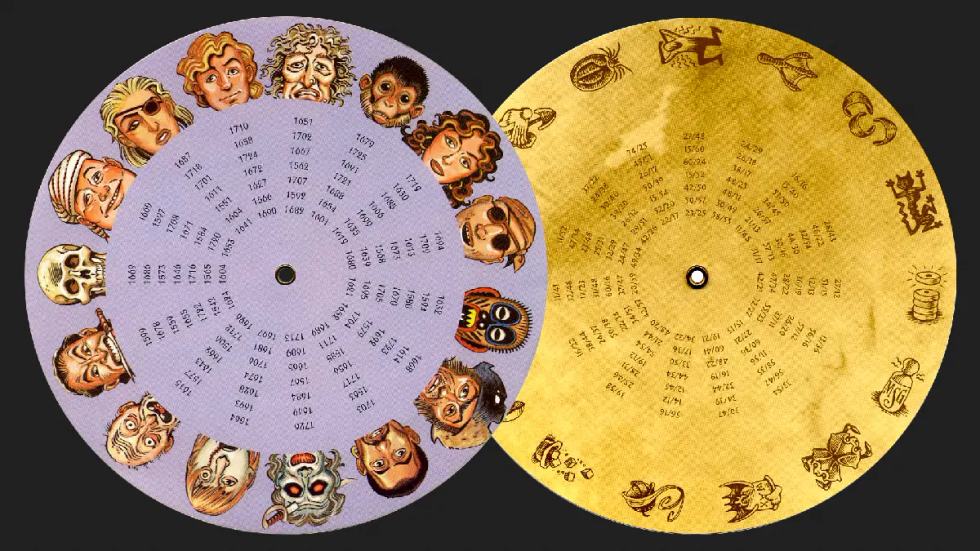
For many players, manuals also meant copy protection. Before online accounts and digital activation, games often asked players to prove they owned the original box by checking the printed material. “Enter the word on page 12, line 4.” “What is the code printed next to this symbol?” “Use the wheel.” “Find the coordinate on the map.”
It was annoying, but also oddly memorable. Some protections were simple word checks. Others became physical objects: code wheels, lens filters, maps, cardboard devices, reference cards. They were designed to fight piracy, but in retrospect they also became part of the mythology of boxed games.
There was a peculiar tension in those moments. You were ready to play, the game was loaded, the screen was waiting, and suddenly you had to search through a booklet for a word that might be printed in tiny type. If the manual was missing, damaged or in another room, the adventure stopped before it began.
And yet, compared with later forms of digital restriction, those paper checks feel almost charming now. They belonged to a world where ownership had weight. The box, the disk, the manual, the map and the code sheet were all part of the same object. You did not simply have access to a game. You possessed its pieces.
The smell of cardboard, ink and possibility
It is impossible to talk about manuals without talking about the physical object. The paper mattered. The cover mattered. The smell of ink and cardboard mattered. These details may sound sentimental, but memory is made of them. A manual could be folded, marked, damaged, annotated, borrowed, lost, rescued from a box in the attic years later.
Some players wrote passwords inside them. Others underlined commands, circled maps, added notes, or used them as bookmarks for the game itself. A manual aged together with the player. It carried traces of use in a way that a digital tutorial never can.
Big-box computer games were especially powerful in this sense. They did not feel like disposable media. They felt like packages from another world. The manual helped create that illusion. It suggested that the game had a history before you arrived and rules that existed beyond the screen. Opening the box was not just opening software. It was opening a small universe.
Console games created a different but equally strong feeling. Many players remember reading manuals repeatedly when they had only a few games and a lot of time. A child might know every enemy, every item and every illustration before reaching the second level. The booklet extended the life of the game beyond play sessions.
What we gained, what we lost
It would be too easy to say that everything was better before. It was not. Many manuals were confusing, incomplete or poorly printed. Some games used them to hide information that should have been explained better in the software itself. Others were simply dry lists of commands with little personality. Modern tutorials, accessibility options and in-game explanations have made games easier to understand for many more players.
But progress always changes the ritual. When games learned to teach everything on screen, the manual slowly lost its function. Digital distribution finished the process. The box became smaller, then disappeared. The booklet became a PDF, then a menu, then a few tooltips and onboarding screens.
What disappeared was not only paper. It was a different rhythm. The manual allowed a pause between desire and action. You could want to play and still spend time reading. You could imagine the game before touching it. You could enter the world slowly.
Modern games often fear silence. They fear that the player might be confused for a second, might miss a system, might not notice a mechanic. So they explain, mark, highlight and guide. Again, this can be useful. But older manuals remind us that discovery also needs space. Sometimes not knowing everything immediately is part of the pleasure.
A small art form worth preserving
Today, old manuals are part of game preservation. Scans, archives and fan communities keep them alive because they contain information that the software alone cannot preserve. They show how games were sold, explained, imagined and understood in their own time. They are design documents, marketing objects, historical sources and emotional triggers all at once.
Reading an old manual today can change the way we approach an old game. It restores context. It reveals intended controls, backstory, terminology and assumptions. It also reminds us that videogames were never only code. They were boxes, pages, illustrations, promises, rituals and habits.
Some modern physical editions and indie releases have rediscovered this pleasure, including printed manuals, maps and art cards as deliberate acts of nostalgia. These objects are no longer always necessary, but that may be exactly why they feel special. They are not required by function; they are chosen for feeling.
The manual belonged to a slower videogame culture. A culture of loading times, borrowed cartridges, copied passwords, bedroom shelves, computer desks and boxes that took up real space. It was not perfect, and sometimes it was frustrating. But it gave the game a beginning before the beginning.
For a generation of players, the adventure did not start with “Press Start”. It started with a booklet in hand, a page full of commands, a map to unfold, a strange paragraph of lore, and the feeling that somewhere inside those pages, the game was already waiting.
Reader memories
Comment on the article and join the discussion.
Comment rulesLog in or register to leave a comment.
Create your account
Loading comments...