




Swords, magic and coins
In 1989, arcades were a fierce battlefield. Cabinets had to catch the eye in seconds, promise spectacle, explain themselves almost instantly and convince players to insert a coin before they had even fully understood the rules. In that context, Golden Axe had everything it needed to stand out: a powerful title, a barbarian fantasy look, three selectable characters, devastating magic, rideable monsters and a very clear promise: move forward, strike, survive.
SEGA was already one of the strongest names in the arcade world, and with Golden Axe it found a formula that immediately separated itself from much of the beat ’em up landscape. If Double Dragon had helped define urban street fighting as the dominant language of the genre, Golden Axe changed the scenery completely. No city streets, criminal gangs or neon signs. Here there were warriors, dwarves, amazons, skeletons, knights, dragons, burning villages and the evil Death Adder threatening the kingdom of Yuria.
Its imagery came from the fantasy cinema, comics and illustration of the 1980s: Conan, heavy metal covers, muscular heroes and primitive worlds filled with magic and violence. Golden Axe did not explain that world through long introductions. It placed it directly in the player’s hands.
Three heroes against Death Adder
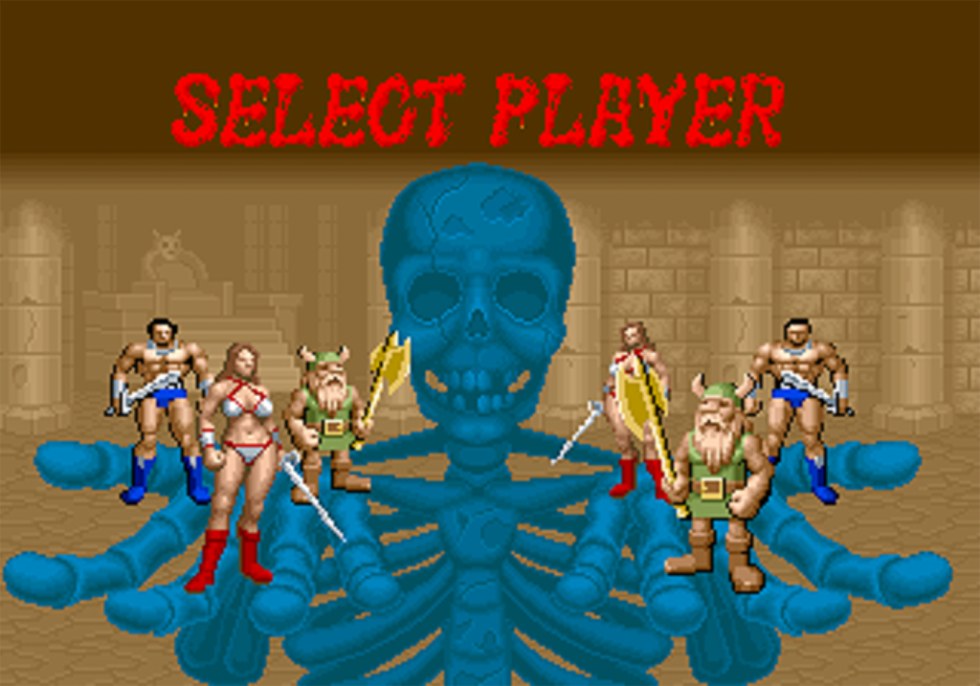
The structure is simple and perfectly suited to the arcade. Three heroes, each with a personal reason to seek revenge against Death Adder, set out to reclaim the kingdom. Ax Battler, the sword-wielding barbarian, offers a balance between strength and magic. Tyris Flare, a fast amazon with powerful magic, is the most spectacular character once enough magic pots have been collected. Gilius Thunderhead, the dwarf warrior, has weaker magic but strong close-range effectiveness.
These differences do not turn Golden Axe into a deeply technical game, but they are enough to give each run a different flavor. Each character feels slightly distinct, and the opening choice changes the way resources are handled. Magic, in particular, is one of the game’s most memorable features. By collecting pots from the little thieves that appear between sections, players can unleash increasingly destructive attacks.
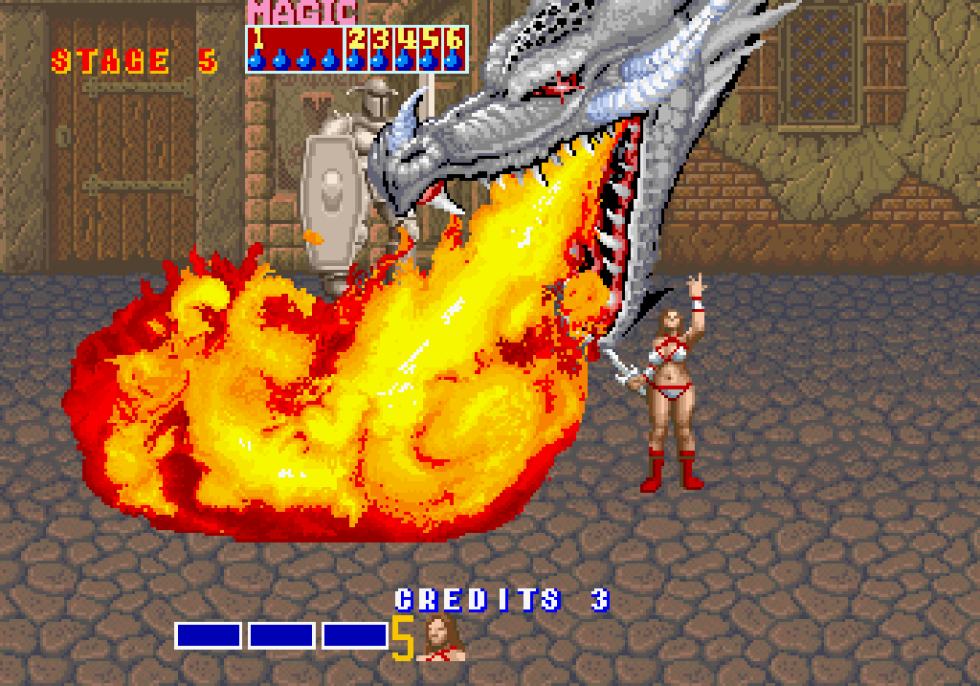
Tyris’s magic, with the huge dragon sweeping across the screen, is one of those scenes that stayed in the memory even of people who were only watching in the arcade. Golden Axe understood the value of spectacle perfectly. It was not enough to hit enemies. The game had to create images strong enough to stop people in their tracks.
A beat ’em up built more on impact than refinement
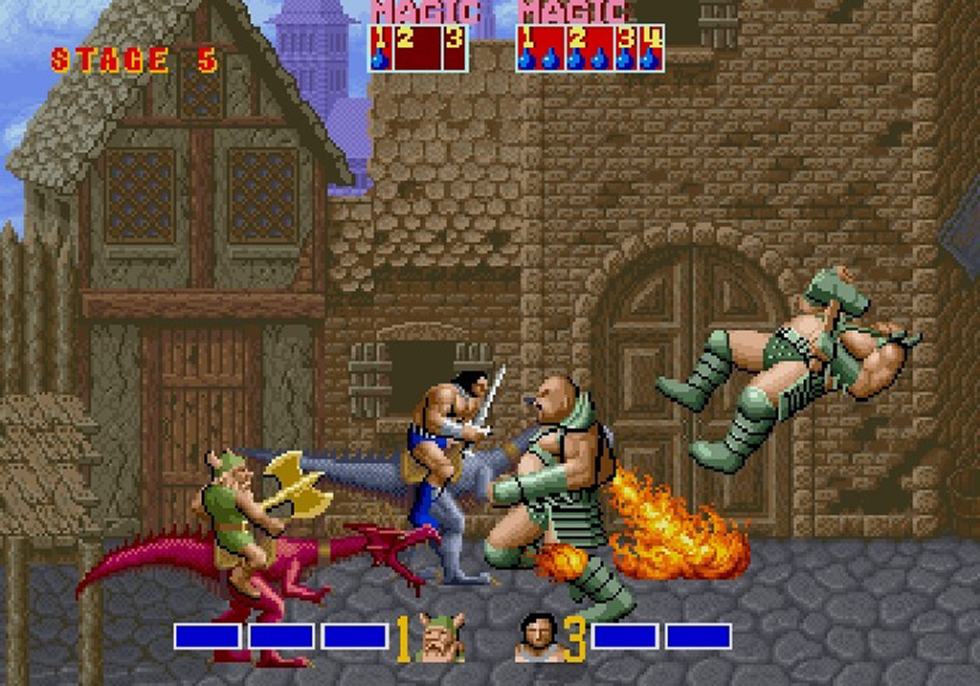
The gameplay is immediate. The player moves from left to right, fights groups of enemies, avoids side attacks, uses jumps, charges, close attacks and magic in the most dangerous moments. Compared with later beat ’em ups, the system feels fairly simple today, but in 1989 it had real strength. The game was readable, fast and just brutal enough.
Combat depends heavily on positioning. Enemies try to surround the player, attack from different directions and often force movement along the vertical axis to find the right line. Collision detection is not always perfect, and some hits can feel less clean than they should, but the action keeps a solid rhythm. Golden Axe is not about surgical precision. It is about the feeling of impact.
The running charge is essential, as are jumps and close-range attacks. In two-player mode, the game becomes much stronger. Coordinating movement, splitting enemies, deciding when to use magic and trying not to get in each other’s way become part of the fun. Like many coin-ops of its time, Golden Axe was built to be shared. Alone it is good. With another player, it becomes memorable.
Riding the fantasy
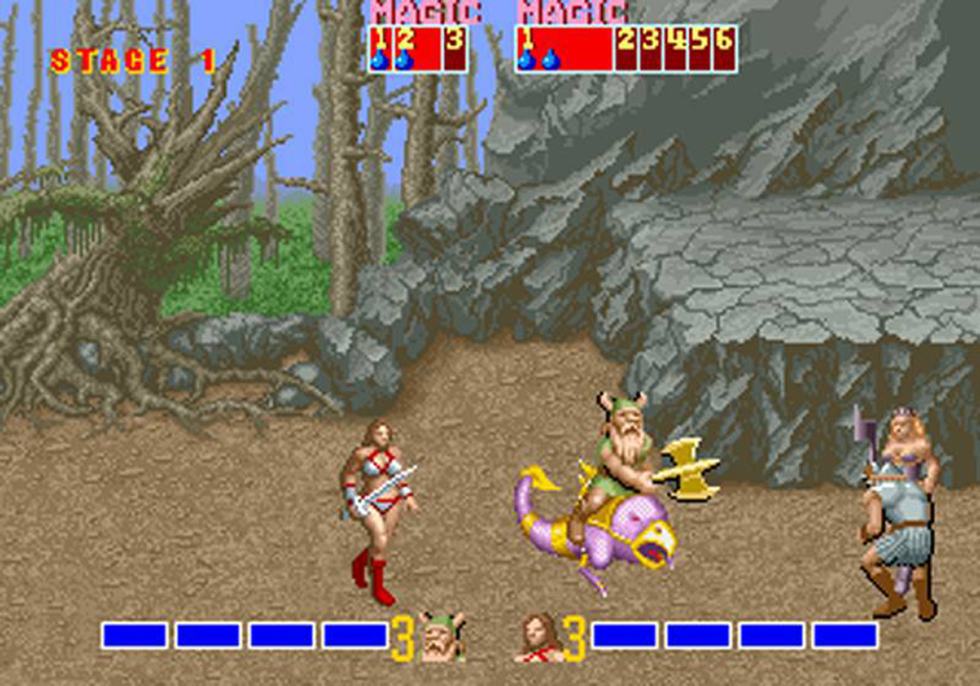
One of its most iconic elements is the rideable beasts. In some stages, players can knock enemies off creatures and take control of them, including the Chicken Leg, already part of SEGA’s wider universe, or dragons capable of breathing fire. It is a simple but very effective idea, because it breaks repetition and gives the player a temporary sense of superiority.
The beasts are powerful, but not absolute. Players have to keep them, avoid being knocked off, use their range well and try not to lose them at the worst possible moment. In the arcade, stealing a dragon from an enemy and using it against the next group was an immediate little victory. Golden Axe lives on moments like this: not complex, but extremely clear and satisfying.
The setting helps a great deal. The journey moves through ruined villages, forests, enemy territories, giant creatures used almost like living roads, fortresses and battlefields. The game has the rhythm of a fantasy journey, almost a small adventure compressed into a handful of stages. There is no exploration and no deep storytelling, but there is a clear visual progression, with the feeling of moving closer and closer to the heart of evil.
SEGA System 16 and arcade identity
Technically, Golden Axe runs on SEGA System 16 hardware, a platform that had already shown great versatility and allowed SEGA to build some of its most recognizable coin-ops. Golden Axe is not the smoothest or most advanced title on the board, but it has a very strong artistic direction.
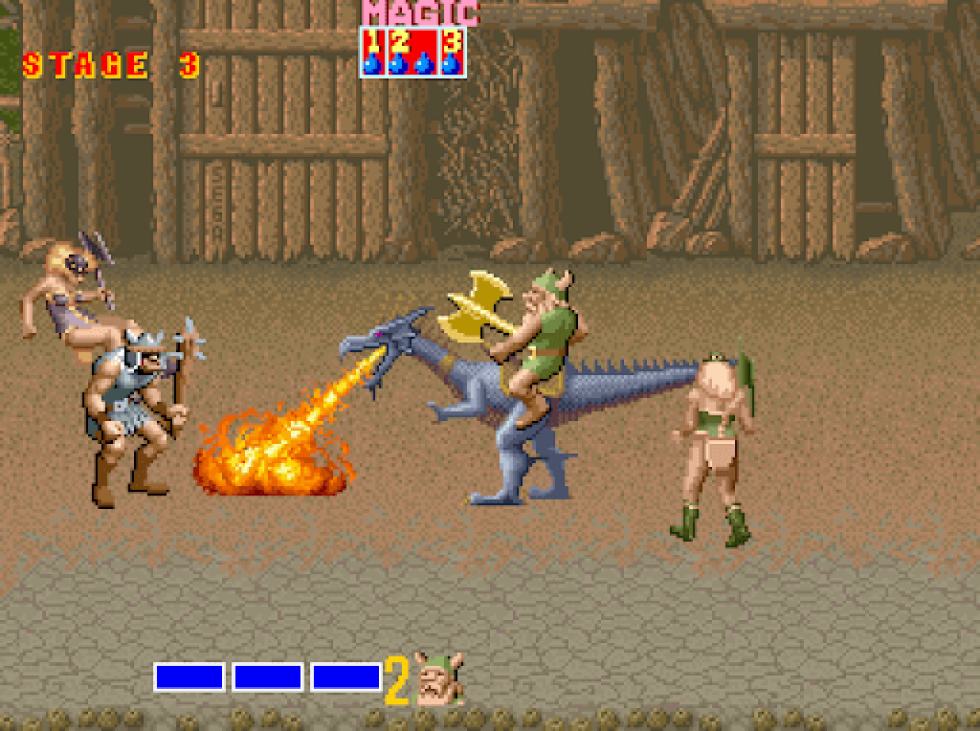
The sprites are large, colorful and easy to read. The main characters have clear silhouettes, the enemies are instantly recognizable and the backgrounds capture the barbarian tone of the adventure well. The animation can look limited today, especially compared with the Capcom beat ’em ups that would follow in the early 1990s, but the visual impact remains strong. Golden Axe looked different because it was not trying to be another urban action game. It brought a physical, rough and theatrical kind of fantasy to the screen.
The sound also plays an important role. The music has an epic, adventurous tone, with melodies that support the journey and give the game an immediate personality. The sound effects are sharp, arcade-like and functional: hits, screams, magic and short jingles keep the action moving without leaving much empty space. In a cabinet, with the volume high and the noise of the arcade around it, Golden Axe had a very strong presence.
A short game, built to be remembered
Like many arcade games of its time, Golden Axe is not long. Once learned, it can be completed fairly quickly, and its structure does not offer the variety or complexity that the genre would reach in later years. Some enemies repeat, some situations return with only small changes, and the difficulty often comes more from numerical pressure than from refined design.
But judging it only by modern standards would be unfair. Golden Axe was born for the arcade, for the coin, for immediate impact and for the desire to try again. Its longevity came from co-op play, from better magic management, from clearing a section with less damage, from trying a different character and from experiencing that concentrated fantasy journey once more.
It is also one of those games where imagery matters as much as mechanics. Many beat ’em ups of the period were good, but few had such a strong identity. The logo, the music, Tyris unleashing magic, Gilius with his axe or a stolen dragon are enough to make Golden Axe instantly recognizable.
From cabinet to home legend
Part of the game’s fame also comes from its home conversions, especially the Mega Drive version, which brought Golden Axe into many living rooms and turned it into one of the symbols of the relationship between SEGA’s arcade heritage and its console identity. But the heart of the game remains the coin-op. That is where Golden Axe showed its real strength: color, sound, sprite size, immediacy and the atmosphere of the arcade.
Golden Axe helped define a fantasy arcade style that SEGA would continue to explore, though rarely with the same impact. Sequels and spin-offs would expand the universe, but the first game remains the purest. It is not perfect, and it is not the deepest beat ’em up ever made, but it fixed a very precise image in memory: three heroes against a dark tyrant, in a world where every coin could become a small barbarian epic.
Played today, Golden Axe still has a primitive force. It is simple, direct, sometimes rough, but full of character. It does not ask to be studied for hours. It asks to be picked up, played with a friend and enjoyed for what it is: a compact, spectacular arcade adventure that can still evoke the sound and atmosphere of late 1980s arcades.
To tell the story of SEGA in the arcade, Golden Axe remains an essential name. Not only for what it did technically, but for what it represented: the ability to turn the muscular fantasy of the 1980s into a coin-op that was immediate, memorable and still loved today.


Reader memories
Comment on the article and join the discussion.
Comment rulesLog in or register to leave a comment.
Create your account
Loading comments...