


A sequel bigger than the machine that hosted it
When God of War II arrived on PlayStation 2 in 2007, the next generation had already begun. PlayStation 3 was on the market, Xbox 360 had opened the race toward high definition, and many were already looking at the old PS2 as a console slowly approaching the end of its cycle.
Then Kratos returned, once again, and proved that the machine still had something to say.
Developed by Santa Monica Studio and directed by Cory Barlog, God of War II did not simply repeat the success of the first game. It expanded it, made it more spectacular, more fluid and more ambitious. It was one of those sequels that felt almost impossible on the hardware that hosted it: bigger, richer and more confident.
Kratos before the modern myth
Today, Kratos is often associated with his second life, the Norse one, more mature, melancholic and introspective. But in God of War II we are still at the heart of his original incarnation: pure rage, revenge, brutality and Greek mythology turned into a theatre of destruction.
The game begins after the events of the first God of War, with Kratos now the new god of war. But his thirst for power and his inability to stop bring him into conflict with Zeus and Olympus itself. From there begins a furious journey built around fate, betrayal and the desire to rewrite his own story.
It is not subtle storytelling, and it does not want to be. God of War II works through excess: screams, blood, gods, titans, monsters, chains, temples, giant statues and impossible revenge. It is mythological melodrama turned into an action game.
Action as brutal choreography
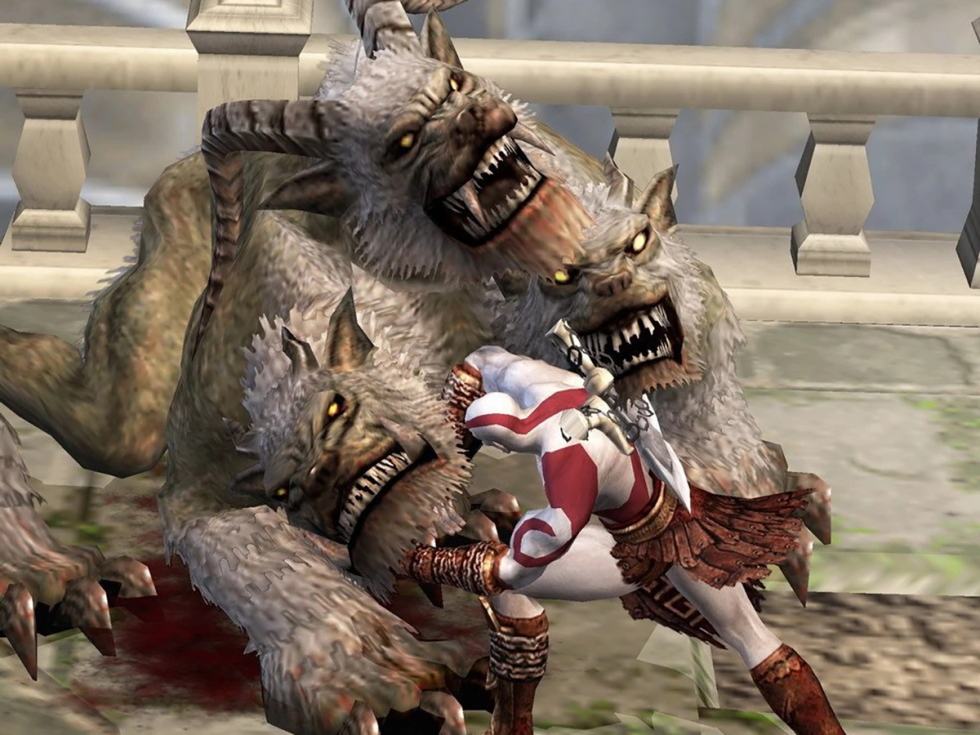
The heart of the game is still combat. The Blades of Chaos, later replaced by the Blades of Athena, once again define Kratos’ body: wide, violent, readable, perfect for striking groups of enemies and moving naturally from one target to another.
God of War II is not a technical action game in the Devil May Cry sense, nor does it seek the same systemic depth. Its goal is different: making the player feel powerful, aggressive and constantly at the centre of a brutal choreography. Combos, grabs, magic, dodges, blocks and quick time events create an immediate, physical and spectacular rhythm.
The game works because every impact has weight. Every enemy seems to exist only to be crushed by Kratos’ fury, but the system remains solid enough not to become simple button mashing. At higher difficulty levels, dodging, controlling space and choosing the right moment to attack become essential.
Giants, temples and impossible set pieces
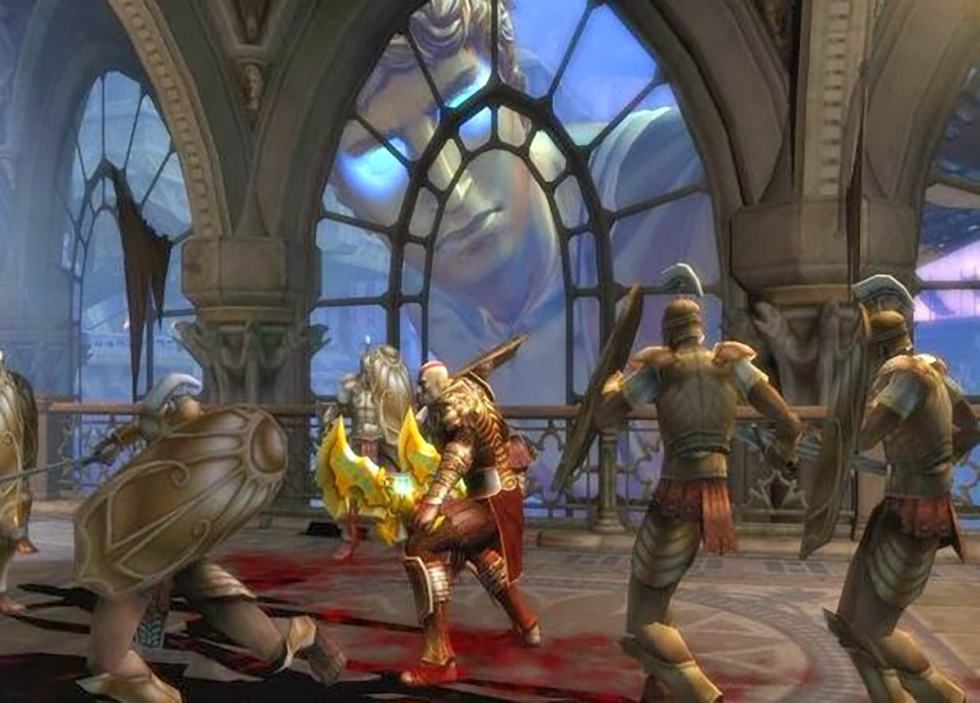
One of the reasons God of War II made such a strong impression is its ability to constantly feel bigger than the PS2. The game alternates combat, environmental puzzles, climbing sections, sequences on colossal creatures and boss fights that use scale as a visual language.
The opening with the Colossus of Rhodes is still a powerful statement of intent. It is not just a boss fight: it is a way of telling the player that the sequel wants to exceed expectations immediately. From that moment on, God of War II keeps raising the stakes: enormous temples, ancient mechanisms, mythological creatures and environments that feel like theatrical backdrops moved by aggressive direction.
The PlayStation 2 is pushed to its limit. Textures, animations, effects, level streaming and fixed camera work together to hide the hardware’s limits and build an almost cinematic flow. Not everything is perfect, but the overall impact remains remarkable.
Puzzles and rhythm
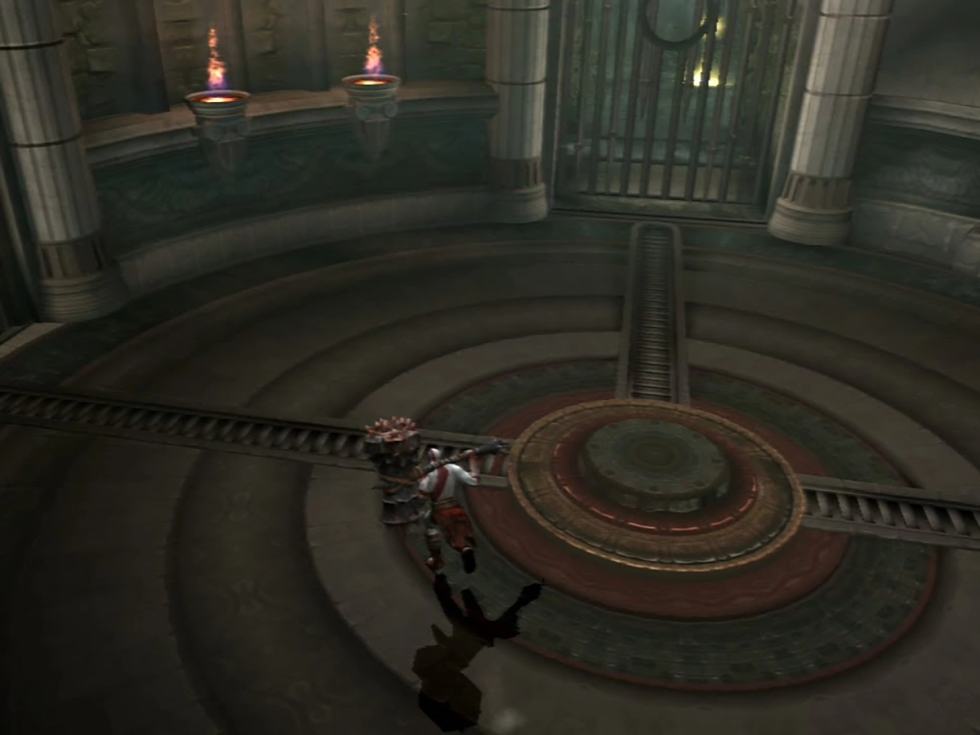
God of War II is not only about combat. Like the first game, it alternates action with environmental puzzles, levers, blocks to move, mechanisms and platforming sections. These moments are designed to break the fury of combat and give the adventure room to breathe.
Some puzzles are simple, others more elaborate, but they usually work because they remain integrated into the world. They do not feel like separate minigames, but like obstacles built inside temples, statues and mythological environments. The rhythm benefits from this: God of War II knows when to accelerate and when to slow down, when to put the player in front of a room to understand and when to overwhelm them with an action scene.
The platforming sections, on the other hand, show a few more rigidities. Walking on beams, jumps, rotating blades and suspended passages can still feel less elegant than combat today. But they are part of the game’s identity and help give variety to the experience.
Direction built on power
God of War II uses its fixed camera as a directing tool. The player does not freely control the view, but is guided through angles, environments and battles designed with almost cinematic precision.
Today this choice may feel limiting, especially after years of third-person action games with free cameras. But in the PS2 context it was extremely effective: it enhanced the environments, controlled the spectacle and guaranteed constant readability. Every room feels composed to show Kratos in the most dramatic position possible.
The soundtrack plays a decisive role. Choirs, percussion, brass and epic themes turn every battle into an event. God of War II never looks for restraint. It wants to be enormous, solemn, violent, almost operatic. And it is exactly this lack of modesty that makes it so recognizable.
The limits of excess
Played today, God of War II also shows some limits. The writing is powerful but monolithic: Kratos is almost always rage, and the game rarely tries to dig beneath that surface. Quick time events, spectacular at the time, may feel more intrusive to players used to more modern action design. Some platforming sections and environmental trials are less fluid than memory might suggest.
But these limits do not erase the strength of the work. If anything, they help place it in its time. God of War II belongs to an era when action games were trying to become more cinematic, more muscular and more immediate, without completely abandoning the classic structure of rooms, puzzles, bosses and linear progression.
It is a game that does not apologize for what it is. It wants to overwhelm, exaggerate and close the PS2 era with a hammer blow.
PlayStation 2’s swan song
God of War II is often remembered as one of the last great PlayStation 2 games, and rightly so. It arrived when many developers were already looking elsewhere, yet it still managed to stand as one of the console’s highest points.
It was not just a great sequel. It was a demonstration of technical, artistic and production control. Santa Monica Studio knew the machine, knew the character and knew the language it had created. The result was a more compact, more spectacular and more confident game than the first episode.
With hindsight, God of War II is also the perfect closing act for the first phase of Kratos. Before doubt, fatherhood, snow and Norse silence, there was this: a warrior consumed by rage, thrown against gods, titans and fate.
Playing it today
Playing God of War II today means finding an action game that is still surprisingly solid. The controls respond well, the rhythm remains engaging and many scenes retain an impact that goes beyond simple nostalgia.
Of course, it is deeply tied to its era. It does not have the emotional complexity of the modern chapters, nor the freedom of movement of contemporary action games. But it has rare clarity: it knows exactly what it wants to be, and it does it with impressive confidence.
It is pure spectacle, but built with craft. It is violent, theatrical, sometimes naive, but hard to forget.
Conclusion
God of War II is one of PlayStation 2’s greatest action games and one of the most successful sequels of its generation. It does not reinvent the formula of the first episode, but it expands it in every direction: scale, rhythm, variety, spectacle and technical control.
Today some elements show their age, but the whole remains extremely powerful. It is Greek-era Kratos in his fiercest and most monumental form. A game that belongs to the end of a generation, but still reminds us how great the PlayStation 2 could be when pushed to its limits.
Not only a memorable sequel. A farewell in grand style.


Reader memories
Comment on the article and join the discussion.
Comment rulesLog in or register to leave a comment.
Create your account
Loading comments...