



Sharp
- Manufacturer
Sharp is a historic Japanese electronics company, important to retro gaming through computers such as the X1 and X68000 and hardware like the Twin Famicom.
History
Sharp was founded in Japan in 1912 by Tokuji Hayakawa. The company’s name comes from the “Ever-Sharp Pencil”, a mechanical pencil invented by Hayakawa himself and one of the firm’s first commercial successes. After the Great Kantō Earthquake of 1923, the company gradually moved toward Osaka and rebuilt its business around electronics, first with radios and household devices, then with televisions, calculators, semiconductors, LCD displays and computer products. In the postwar period, Sharp became one of the major names in Japanese electronics, alongside Sony, Panasonic, Toshiba, NEC and Hitachi.
In video game history, Sharp should not be read as a software house, but as a hardware and technology manufacturer. Its importance comes mainly through Japanese home computers. The MZ series, launched in the late 1970s, was one of the early attempts to bring personal computing into Japanese homes and schools. In the early 1980s came the X1 line, based on the Zilog Z80 CPU and designed to compete in the Japanese home computer market against the NEC PC-8801, Fujitsu FM-7 and MSX. The X1 had an interesting software scene and hosted many games, conversions and productions aimed at the Japanese audience.
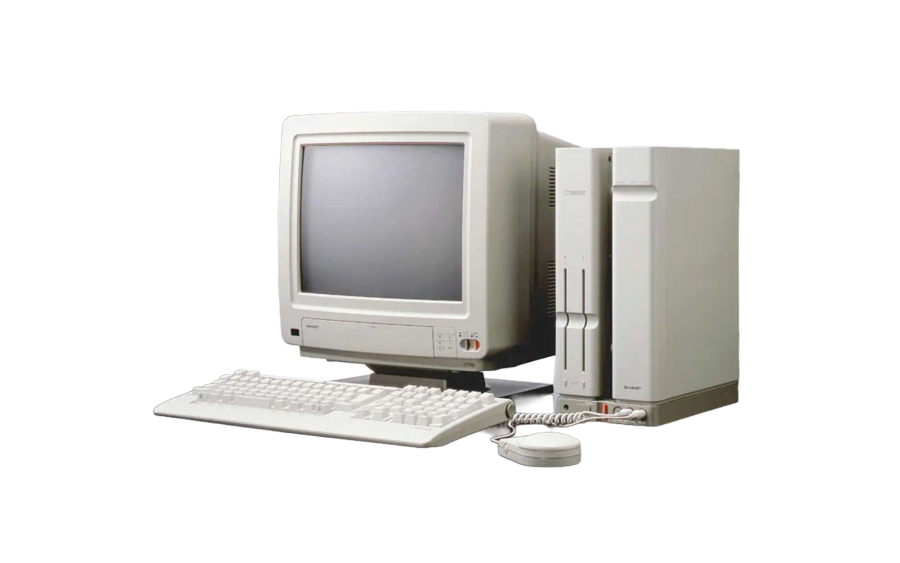
Sharp’s strongest gaming association, however, is the X68000, launched in 1987. Based on the Motorola 68000, equipped with very advanced graphics and sound capabilities for the home market, and sold in an iconic twin-tower vertical case, the X68000 became one of the most desired machines among Japanese enthusiasts. It was not cheap and it was not designed for the international mass market, but it offered an environment remarkably close to arcade culture. Conversions of games from Capcom, Konami, Namco, Taito, SEGA and other publishers helped build its legend: Gradius, Final Fight, Street Fighter II, Daimakaimura, Akumajō Dracula, Parodius Da!, R-Type and many other titles showed a level of fidelity rarely seen in home versions.
Sharp also had a distinctive relationship with Nintendo. The Twin Famicom, released in 1986, combined the Famicom and Famicom Disk System in a single unit, offering a more elegant and compact solution for the Japanese market. Later, Sharp also produced televisions with integrated Nintendo hardware, such as the C1 NES TV and the SF1 Super Famicom TV, objects that are now highly sought after by collectors. These products show Sharp’s position well: not the owner of Nintendo’s major series, but a hardware partner able to turn consoles and computers into unusual, often more refined objects compared with standard models.
In the 1990s and 2000s, Sharp remained above all a consumer electronics and display giant rather than a direct video game protagonist. Its retro-gaming memory, however, remains very strong in Japan and among more attentive international enthusiasts. The X1 and especially the X68000 represent a different side of video game history: not the mass-market console, not the European bedroom computer, but an expensive, powerful Japanese machine close to arcades and local technical culture. For Retro-Gamers, Sharp is exactly this: the manufacturer that brought a piece of the Japanese arcade dream into the home.