



Apex Computer Productions
- Developer
- Publisher
Apex Computer Productions was the small British studio led by brothers John and Steve Rowlands, best known for some of the Commodore 64’s most technically impressive platform games.
History
Apex Computer Productions was formed in the United Kingdom in the late 1980s around brothers John and Steve Rowlands. Most sources place its foundation around 1988, at a time when the Commodore 64 was still central to the British games market, even as Amiga, Atari ST and 16-bit consoles were starting to change expectations. Apex was not a large studio in the usual sense. It was closer to a small family authorial unit: John mainly handled programming, while Steve worked on graphics, animation and music, with external collaborators joining when needed. Their work relied on assembly language and on a deep understanding of the C64 hardware.
The first commercial game associated with Apex was Cyberdyne Warrior, published by Hewson in 1989. The same year brought Retrograde, published by Thalamus, the label linked to Newsfield and the world of Zzap!64. Even in these early titles, the Rowlands brothers showed technical ambition: large sprites, polished scrolling, strong arcade pacing and a recognizable visual style. But it was Creatures, released for the Commodore 64 in 1990, that gave Apex its real identity. The game combined platforming, action puzzles and the famous “torture screens”, grotesque animated sequences in which the player had to save the little Fuzzy Wuzzies from cruel and absurd traps. It was a very C64 idea: constrained by memory and format, but full of personality, dark humour and clever technical solutions.
Creatures II: Torture Trouble, released in 1992, pushed those sequences even further and made them the core of the experience. Around this period Apex also had a distinctive relationship with the British games press. Commodore Format followed the Rowlands brothers closely and helped build anticipation around their work. It was typical of the C64’s final major years in the UK, when magazines, cover tapes, demos and small development teams often felt like part of the same ecosystem. Thalamus, however, ran into financial trouble and eventually folded, leaving Apex more exposed just as the Commodore 64 market was shrinking quickly.
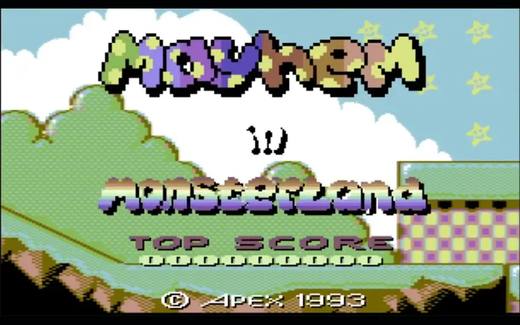
The Rowlands brothers answered with Mayhem in Monsterland, published directly by Apex in 1993. The game arrived when the C64 was already widely seen as yesterday’s machine, but it felt designed to challenge that idea. It offered very fast scrolling, bright visuals, fluid animation and a platform structure influenced by the console language of Sonic and Mario, while still remaining rooted in Commodore design. The project also involved Andy Roberts in design and programming, while Steve Rowlands handled graphics and music. Reception was extremely strong, with very high review scores in the specialist press, although the close relationship between Apex and Commodore Format, which had documented the game’s development, later generated some debate.
After Mayhem, the Apex name remained almost entirely tied to the Commodore 64. The Rowlands brothers later returned with other projects and through Infinite Lives, but Apex’s legacy is concentrated in a small number of games with a very clear identity. It was not a global publisher, nor a studio that crossed many hardware generations. It was one of the purest examples of British technical craft on the Commodore 64: a few creators, one machine pushed close to its limits, and a sequence of games that made the C64 feel younger than it really was.