





Sinclair Research
- Manufacturer
- Developer
- Publisher
Sinclair Research was one of Britain’s most important home computer companies, central to the rise of affordable computing through the ZX80, ZX81 and ZX Spectrum.
History
Sinclair Research officially began in 1973 as Sinclair Radionics, founded by Clive Sinclair, although the path that led to its home computers also passed through Science of Cambridge and then Sinclair Research Ltd. Clive Sinclair was already known for a very clear philosophy: compact, inexpensive electronics, often sold by mail order and designed to bring costly technology to a wider public. Before computers came radios, calculators, digital instruments and some less successful products, such as the Black Watch, which put the company under severe pressure. But that same tension between ambition, low cost and industrial risk would also define Sinclair’s computing story.
The first major step was the ZX80, launched in 1980. It was a very minimal machine, with a Zilog Z80 processor, 1 KB of RAM and an aggressive price: £99.95 assembled or £79.95 as a kit. It was not refined, comfortable or as powerful as more expensive systems, but it made personal computing reachable for many British users. The ZX81, released in 1981, expanded that audience even further. It was cheap, connected to a television, loaded programs from cassette and invited ordinary users to write BASIC code. Around these machines grew an early culture of type-in listings, magazines, mail-order games and young programmers teaching themselves how to create software.
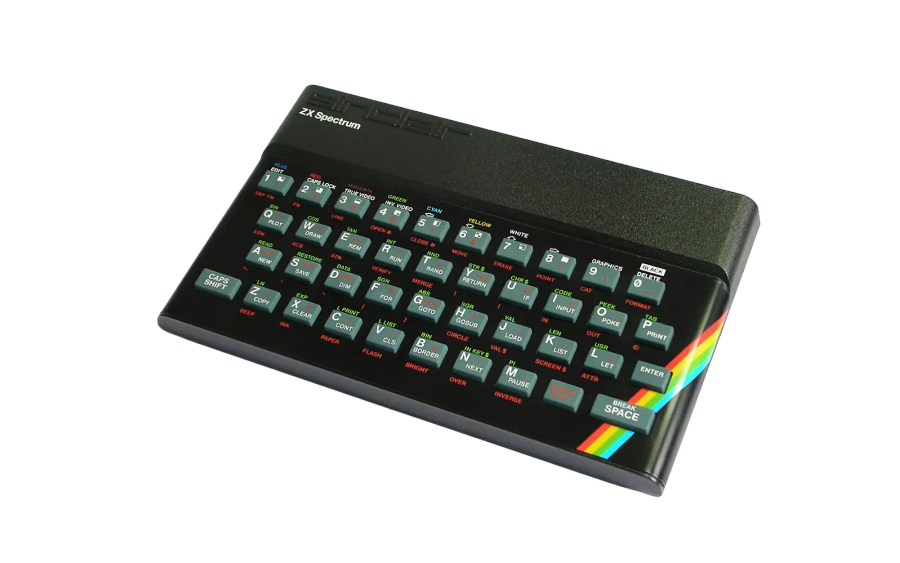
The decisive moment came on April 23, 1982 with the ZX Spectrum, an 8-bit home computer developed and marketed by Sinclair Research. Initially available with 16 KB or 48 KB of RAM, the Spectrum kept the low price while adding colour, quickly becoming the defining home computer of the United Kingdom. Its rubber keyboard, rainbow logo, cassette loading and very recognizable graphic limitations created an imperfect but deeply loved machine. Sinclair did not win only through technical power. It won through price, distribution and imagination. In many British and European homes, the first contact with programming and video games came through a Spectrum.
Its impact on games was enormous. The Spectrum helped create the British video game industry by giving a generation of authors an affordable platform on which to make and sell software. Manic Miner, Jet Set Willy, The Hobbit, Football Manager, Knight Lore, Sabre Wulf, Ant Attack, Skool Daze, Chuckie Egg, Head over Heels and many other titles describe a creative scene that was often surreal, ironic, experimental and very different from Japanese or American models. Companies such as Ultimate Play the Game, Imagine, Ocean, Mikro-Gen, Gremlin and Bug-Byte grew within that ecosystem. The Spectrum was not only a computer. It was a shared training ground for programmers, musicians, artists and players.
Sinclair then tried to expand its vision with the QL, launched in 1984 as a more professional machine based on the Motorola 68008 processor and proprietary Microdrive storage. The project was ambitious but troubled, marked by delays, questionable technical choices and an increasingly competitive market. Commodore, Amstrad, Acorn and later IBM PC compatibles made it harder to sustain the strategy of an inexpensive but proprietary computer. In 1986, Amstrad acquired the rights to Sinclair’s computer products, including the Spectrum line, and continued with models such as the ZX Spectrum +2 and +3.
Sinclair Research’s legacy is especially strong in Europe. It was not a perfect company, and it did not always turn ideas into solid products, but it made the computer a domestic, affordable and desirable object. Its historical importance lies in lowering the barrier to entry. Without Sinclair, a large part of the British game scene of the 1980s would have looked very different. For Retro-Gamers, Sinclair stands for an era when a television, a cassette recorder, a few kilobytes and a lot of stubborn curiosity were enough to enter the world of computing and video games.