





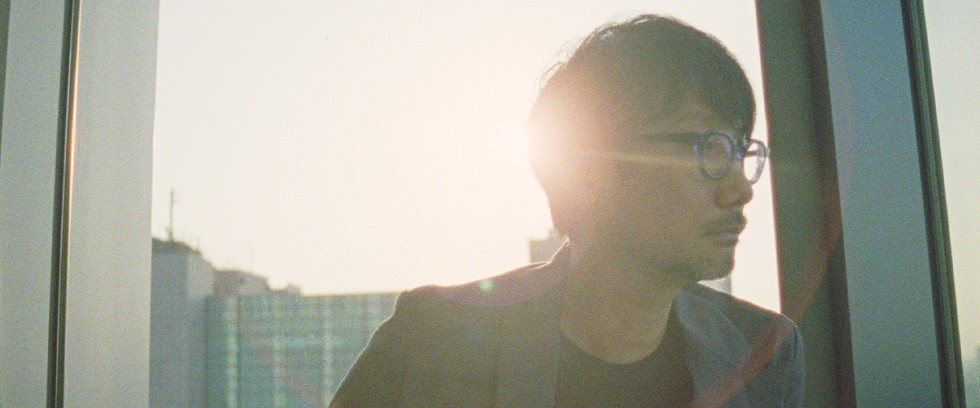
Some authors belong to video game history because they created an important series, an iconic character, or a recognizable mechanic. Hideo Kojima belongs to a rarer category: those authors who turned their own name into a grammar. You recognize a Kojima game before you fully understand it. You recognize it in the long conversations, in the impossible names, in the shots that seem to reach for cinema only to bend toward something else, in tired soldiers, artificial bodies, endless wars, political trauma, broken bonds, and technologies that promise freedom but almost always become systems of control.
Today, Kojima is a figure who exists beyond video games. We see him next to actors, directors, musicians and photographers; we follow him through event-like trailers, presentations built like short films, trips, festivals and international collaborations. He has become a brand, of course, but also one of the few personalities in the medium recognizable beyond the strictly technical gaming audience. And yet, to really understand Kojima, we need to strip away the contemporary myth for a moment and go back much further, before Norman Reedus, Léa Seydoux, Guillermo del Toro, Mads Mikkelsen or Elle Fanning. There was Konami, there was Japan in the 1980s, there was the MSX2, and there was a young author who wanted to tell stories larger than the machines he was working on.
That is where Kojima becomes Kojima. Not when video games finally become able to imitate cinema, but when they still have to suggest it. Not when he has digital actors, motion capture and open worlds at his disposal, but when he has to create tension, atmosphere and identity within severe technical limits. From the very beginning, his greatness lies in this: turning an obstacle into language.
Konami, the MSX and invention through subtraction
Hideo Kojima joined Konami in the mid-1980s, at a time when the Japanese video game industry was already a formidable machine, but not yet a place where authors were recognized in the way we understand today. Companies mattered more than names. Teams were often invisible. Creators worked inside industrial structures that produced games at a fast pace, under very strong corporate identities. Kojima did not emerge as a pure programmer. He brought with him a narrative, cinematic, almost literary imagination. He was drawn to the way cinema builds rhythm, tension, characters and anticipation. But video games, at that moment, did not yet seem like the ideal place for all that.
The first major turning point came with Metal Gear, released on MSX2 in 1987. Looking back today, after decades of stealth design, it may seem like an inevitable starting point. In reality, it was an almost sideways intuition. The MSX2 was not the perfect machine to stage a spectacular military action game full of enemies, bullets, chaos and destruction. So Kojima moved the center of the experience elsewhere: not eliminating everyone, but avoiding confrontation. Not power, but vulnerability. Not advancing while shooting, but observing, waiting, infiltrating.
It is one of the most important ideas in the history of modern video games, and it was born partly from a limitation. Metal Gear did not simply invent a genre; it introduced a different psychology of action. The player was no longer just a force moving across the screen, but a fragile body inside a hostile space. You had to understand guard routes, avoid alarms, use the environment, survive with very little. In Kojima’s work, war is never just scenery. It is already a system, a pressure, a machine that crushes the individual.
This is one of the keys to reading his entire career. Kojima has never truly loved action as pure muscular display. Even when his games became more spectacular, even when technology allowed him to stage increasingly elaborate scenes, at the center there is almost always a character forced to move inside a mechanism larger than himself. Solid Snake is not born as a superhero, but as an infiltrator. He is a man sent into a structure that precedes him, manipulates him and uses him.


Metal Gear 2: Solid Snake, also on MSX2, in 1990, made everything more mature. Enemy intelligence, noise, radar, narrative structure, the rhythm of infiltration: many of the elements that the wider public would later associate with the series already find a surprisingly modern form here. It is a fundamental chapter because it shows a more aware Kojima, already capable of thinking not only in terms of levels and obstacles, but in terms of atmosphere, world and narrative tension. The video game was beginning to become direction.


Snatcher and Policenauts: cinema before global fame
Before Metal Gear Solid turned Kojima into a global name, there were two works that perhaps better than any others reveal his hunger for cinema: Snatcher and Policenauts. They are not mere side paths in his career. They are the laboratory where Kojima focused his idea of interactive storytelling, the place where his passion for genre cinema, science fiction, noir and artificial bodies emerged with almost shameless clarity.
Snatcher is cyberpunk, noir, detective story, an obvious tribute to Blade Runner and 1980s science-fiction cinema. But reducing it to its references would be unfair. In Snatcher, Kojima is not merely borrowing beloved images; he is trying to understand how to make a world breathe inside a video game. Synthetic bodies, unstable identities, night cities, memory, paranoia, technology invading the human. It is closer to a visual novel and narrative adventure than to action, but precisely for this reason it reveals an essential side of the author: Kojima does not only want to design mechanics. He wants to build atmosphere.
In Snatcher, cinema is not yet expensive spectacle. It is not motion capture. It is not an international cast. It is rhythm. It is framing. It is dialogue. It is pause. It is that very Japanese, and very Kojima-like, way of absorbing Western imagery and returning it filtered through another sensibility: more melodramatic, more technological, more restless. Japanese video games of the 1980s and 1990s often performed this miracle: taking fragments of American cinema, comics, animation and global pop culture, then transforming them into something that no longer truly resembled the original. Kojima is one of the strongest examples of this alchemy.


Policenauts pushed this trajectory even further. It is a science-fiction buddy movie, an investigation in space, a work that carries echoes of Lethal Weapon, space opera and investigative thrillers, but also a broader reflection on the relationship between bodies, technology, colonies and humanity. Once again, Kojima works on the border: between cinema and video game, between quotation and reinvention, between popular storytelling and authorial obsession.
In Policenauts, his passion for cinema is now openly declared, but not yet trapped in the public myth of “Kojima the director.” It is almost an artisanal passion, made of rhythm, faces, dialogue, small gestures and suspended moments. Before Western audiences truly learned how to pronounce his name, Kojima was already trying to bend the video game toward a more personal, slower, more atmospheric narrative form. Not always perfect, not always balanced, but unmistakable.


Metal Gear Solid: the PlayStation leap
For many Western players, Hideo Kojima was born in 1998 with Metal Gear Solid. Of course, that is not true. But it is understandable. Metal Gear Solid did not create Kojima; it finally made him legible to the world.
The PlayStation was the right machine at the right time. 3D, CD-ROM, voice acting, cutscenes, Sony’s global reach: everything helped turn a language already present in his earlier works into something immediately perceptible. Metal Gear Solid is not just a sequel, nor simply the three-dimensional translation of Metal Gear. It is a manifesto. It is the moment when Kojima brought the idea of video game as direction into the mainstream.
The game begins with an infiltration, but within minutes it becomes much more. Codec conversations, voice acting, camera work, cinematic rhythm, briefings, war memory, genetics, nuclear deterrence, identity, betrayal, manipulation. Metal Gear Solid constantly seems to exceed its own container. It wants to be stealth, political thriller, military melodrama, anime, action cinema, a reflection on the soldier and even a game about the player.
The famous Psycho Mantis sequence, with the memory card reading and the breaking of the fourth wall, remains iconic not because it is a simple trick, but because it perfectly summarizes Kojima’s idea: technology is never neutral. The medium, the controller, the screen, memory, saving, everything can become part of the story. Metal Gear Solid does not merely use the PlayStation; it stages it.
This is where Kojima became, for the wider public, the game director as auteur. Not because he was the first developer with a strong vision, but because he managed to make that vision recognizable within a product of enormous commercial impact. Metal Gear Solid is accessible and bizarre, spectacular and verbose, elegant and naive, adult and adolescent. It is full of contradictions. But those contradictions are alive. Above all, they are his.


MGS2, MGS3, MGS4: control, memory and identity
After Metal Gear Solid, Kojima could have simply expanded the formula. More Snake, more stealth, more cinema, more spectacle. Instead, Metal Gear Solid 2: Sons of Liberty did something far more interesting and far riskier: it betrayed expectations.
The audience expected Solid Snake and found Raiden. It expected the confirmation of a myth and received a game about simulation, manipulation, information, digital identity and control of context. MGS2 is a strange, courageous work, almost hostile to the fan. For years, it was discussed as much for what it took away as for what it offered. Today, it perhaps appears as one of Kojima’s most prophetic works, a game obsessed with the way information is selected, filtered, organized and used to construct perceived reality.
It is one of the moments in which Kojima seems to see something before others. Not in an orderly way, not with the coldness of a theoretical essay, but with the chaotic intuition of a pop author. MGS2 speaks of digital control before the world fully becomes the world of social networks, algorithms and fragmented online identities. It does so inside an espionage video game, with absurd names, military melodrama and endless conversations. That is precisely why it works: because it is theory disguised as a deranged blockbuster.
Metal Gear Solid 3: Snake Eater changed direction again. It went back in time, abandoned part of the digital coldness of the second chapter and rediscovered the body, the jungle, hunger, wounds and survival. It is perhaps Kojima at his most classical and emotionally compact. The Cold War becomes personal tragedy, the myth of Big Boss is born inside a story of loyalty, betrayal and sacrifice. If MGS2 is the game of information, MGS3 is the game of flesh. The body suffers, eats, bleeds, camouflages itself. Politics passes through the skin.
Metal Gear Solid 4: Guns of the Patriots, on the other hand, is a terminal work. Huge, melancholic, overloaded. It wants to close everything, explain everything, connect everything. Perhaps too much. It is one of the games where Kojima’s flaws emerge most clearly: verbosity, the need for control, the inability to leave certain mysteries truly open. But it is also coherent precisely in its heaviness. A game about old age, legacy, war as permanent economy, and the body consumed by the system.
By that point, the Metal Gear saga was much more than a stealth series. It was a gigantic discourse on control: control of the soldier, control of memory, control of information, control of the body, control of the player. Each chapter changes mask, but always returns there. To the question of who is really moving whom. Does the soldier move history, or does history move the soldier? Does the player control Snake, or does the game control the player? Does technology liberate, or does it train?


Peace Walker, Metal Gear Solid V and the Konami wound
Before the great fracture, there is an often underestimated passage: Peace Walker. Born on PSP, designed for a different, more portable and fragmented kind of play, Peace Walker anticipated many ideas that would return in Metal Gear Solid V: the base to build, recruitment, management, war as organizational system. It may not have the same symbolic weight as the main home console chapters, but it is an important turning point because it shows Kojima interested not only in the mission, but in the infrastructure that makes the mission possible.
Metal Gear Solid V: The Phantom Pain is an open wound. On one hand, it is probably one of the best stealth-action systems ever built: fluid, free, elegant, capable of generating endlessly different situations. Moving Big Boss through its open world is an almost physical pleasure. Every outpost becomes a problem to solve, every infiltration a small emergent story. Character control, freedom of approach and mechanical clarity reach an extremely high level.
On the other hand, MGSV carries the mark of incompleteness. Not because what it contains is little, but because the presence of what is missing can constantly be felt. It is an enormous and yet broken game, lucid in gameplay and ghostly in narrative structure. It is as if the title itself, The Phantom Pain, ended up describing the player’s experience too: the pain of the missing limb, the perception of an absent part, the void left by something that could have been there.
The relationship with Konami, by then worn down, turned MGSV into something more than a controversial chapter. It became the symbol of the end of an era. Kojima, for decades an internal author within a major Japanese company, found himself separated from the series that made him immortal. Metal Gear continued to exist as an industrial property, but without him it lost its spiritual center. Not because a saga must necessarily belong to one man, but because Metal Gear, for better or worse, had become inseparable from his obsessions.
MGSV is perhaps the greatest paradox of Kojima’s career: his freest game in terms of player control, but one of the least free in terms of its own industrial existence. The player can approach missions in countless different ways; the author, meanwhile, seems trapped inside a production fracture that had become impossible to repair.
There is, however, another ghost that belongs to that same season, and perhaps tells its symbolic power even better: P.T. Officially, it was only a “playable teaser,” a free demo released on PlayStation 4 to announce Silent Hills, the horror project by Kojima together with Guillermo del Toro and starring Norman Reedus as its lead face. In reality, within a very short time, P.T. became something much larger: a small domestic nightmare, a corridor repeated endlessly, a house that changed almost imperceptibly with every passage, an experiment in fear built more on anticipation than explosion.
P.T. proved that Kojima could enter horror without simply imitating its most codified forms. There were no vast scenarios, no fully explained mythology, not even a real game in the traditional sense. There was a closed, obsessive, almost ritual space, where the player was forced to observe, listen and doubt every detail. It was Kojima in his most concentrated form: direction, mystery, the language of the medium, and a community forced to decipher an enigmatic object together.
The cancellation of Silent Hills and the removal of P.T. from the PlayStation Store turned that demo into a relic. Even today, some people still keep a PlayStation 4 with P.T. installed, as if preserving an artifact from an interrupted timeline. It is one of the strangest and most fascinating cases in recent video game history: an unfinished work that left a deeper mark than many complete games. A corridor that never truly left the imagination of players.
In this sense, P.T. may be the perfect ghost of the end of the relationship between Kojima and Konami. Not only because it anticipated a Silent Hill we would never play, but because it showed an author still capable of shifting the attention of the entire industry with just a few meters of space, a closed door, a ringing telephone and a promise. Even before his official rebirth, Kojima was already somewhere else.


Kojima Productions, Sony and freedom after the fall
After Konami, Kojima could have chosen a safe path. He could have built a spiritual stealth game, a Metal Gear without Metal Gear, a product designed to reassure fans wounded by the separation. Instead, he did the riskiest thing: he founded a new Kojima Productions and, thanks to a decisive partnership with Sony, chose to start again from an idea almost impossible to sell.
Death Stranding is not the project of an author simply trying to prove he can survive without his historical saga. It is the project of an author trying to redefine himself. After years of soldiers, conspiracies, military bases, private armies and systems of control, Kojima imagined a world devastated not by a traditional war, but by a fracture in existence itself. The living and the dead, cities and emptiness, individuals and the network, body and territory: everything is separated, everything must be stitched back together.
The partnership with Sony was decisive because it gave Kojima space, resources and visibility. But what is truly interesting is that Kojima did not use that freedom to make the most obvious game. Death Stranding is a work of walking, weight and connection. A game where the central gesture is not shooting, conquering or destroying, but carrying. Taking something from one place to another. Crossing a hostile world with a load on your back. Falling. Getting up. Leaving a ladder, a rope, a road, a bridge for someone you will never see.
It is an almost anti-commercial idea, and for that reason profoundly Kojima-like. Because once again, Kojima starts from a fragile, even unspectacular gesture and charges it with meaning. Delivery becomes relationship. Weight becomes memory. The journey becomes care. Connection is not an online menu, but a responsibility.
Death Stranding: walking on the ruins of the world
Death Stranding is one of the most beautiful and strangest games of its generation precisely because it accepts being divisive. It does not always chase easy rhythm. It is not afraid of slowness, repetition or silence. It asks the player to inhabit distance, not simply overcome it. The world is not there to be consumed quickly; it is there to be crossed, measured with the body, understood through fatigue.
Sam Porter Bridges is a perfectly Kojima-like protagonist. He is not a classical hero, not a luminous savior, not a legendary soldier. He is a closed, wounded man, allergic to contact, forced to carry on his shoulders the largest task imaginable: reconnecting a scattered humanity. In this sense, Death Stranding may be Kojima’s most autobiographical game, even when it speaks of America, apocalypse, mothers, beaches and ghosts. After the break with Konami, Kojima too had to rebuild bridges. He had to reconnect with an audience, with an industry, with a new creative identity.
The game is full of moments that can seem excessive, even ridiculous, when isolated from their context: symbolic names, complicated explanations, over-the-top dialogue, metaphors declared without shame. But Kojima is also this. He is not a minimalist author. He does not seek invisible elegance. He would rather risk too much than settle for correctness. And in Death Stranding, that excess becomes part of the experience. It is a game that constantly speaks of connection, but does so through solitude. It speaks of community, but almost always without showing it directly. It speaks of life, death and rebirth with a seriousness that few other authors would dare to sustain to the end.
And then there is that Japanese dimension that runs through all of his work, even when the surface appears Western. The melancholy for a world that disappears. The attention to repeated gestures. The relationship between technology and spirituality. The presence of the dead beside the living. The idea that a journey is not only movement, but inner discipline. Death Stranding may look American in its landscapes, international in its cast, global in its visual language, but its heart remains deeply tied to a Japanese sensibility: one able to find the sacred even inside a machine, a bridge, a road, or an object left by a stranger.


Death Stranding 2 and the question of connection
With Death Stranding 2: On the Beach, Kojima returns to the world he built after his industrial liberation. But he does not seem interested in merely offering a bigger, richer, more spectacular continuation. The question running through the project is more uneasy: was connection really the answer? Did we do the right thing by stitching the world back together? Or does every network, every bond, every infrastructure carry within it a new form of dependence, control and fragility?
It is a perfectly Kojima-like question, because it ideally closes a circle opened decades earlier. Metal Gear spoke of military systems, MGS2 of information systems, MGS4 of automated war systems, Death Stranding of social and emotional systems. Kojima has never told stories only about characters, but about networks: networks of power, memory, blood, data, trauma and affection. In his games, the individual is always crossed by something larger.
Death Stranding 2 continues this reflection in an even more unstable world, where connection is no longer only hope but also doubt. It is a fascinating position for an author who, after Konami, was celebrated precisely as a symbol of creative freedom and rebirth. Kojima does not simply say, “let us connect.” He asks what being connected really means. What price the network has. What we lose when every distance is erased.
In this sense, the two Death Stranding games are among the most personal works of his career. Not because they lack collaborators, influences or production strategies, but because they seem to emerge from an intimate urgency. Kojima is no longer only telling stories about soldiers manipulated by governments, armies and artificial intelligences. He is telling stories about men and women trying to remain human in a world where the bond itself has become a problem.


Cinema, Japan, Italy
To speak of Kojima inevitably means speaking of cinema. Not as a simple archive of references, but as sentimental education. Kojima loves cinema in a total way, almost childlike in the most beautiful sense of the word: with enthusiasm, gratitude and hunger for images. He brings it everywhere. In trailers, in actors’ faces, in posture, in dialogue, in titles, in editing, in silence, in genre. Sometimes he does it with subtlety, sometimes with disarming directness. But there is never cynicism in his relationship with cinema. There is devotion.
This is also why Kojima has always held a special fascination for those who love Japanese video games. Because he embodies one of the most powerful traits of Japanese pop culture: the ability to absorb distant worlds and return them transformed. Hollywood, noir, cyberpunk, anime, manga, European science fiction, Western music, military design, global pop culture: everything enters his imagination and comes out distorted, melodramatic, technological, deeply personal.
Kojima’s Japan is never only geographical. It is a method. It is the way his work holds together restraint and melodrama, technological rigor and feeling, high culture and popular entertainment, war and poetry, embarrassment and greatness. Those who love Japanese video games know this mixture well: the ability to be deadly serious and absurd at the same time, to move from a reflection on nuclear deterrence to an improbable name, from a tragic scene to an almost comic detail, from a philosophical speech to a perfectly concrete game mechanic.
And then there is Italy, which returns more than once in Kojima’s relationship with the world as a loved, imagined and crossed place. It is not just social media folklore or tourist fascination. For an author like him, Italy is cinema, architecture, memory, faces, light, stratified history. It is a country that seems almost made for his obsessions: ruins and beauty, past and present, the cult of the image, theatricality, melancholy. Perhaps that is also why his gaze toward Italy touches us. Because it does not feel like the distracted gaze of someone consuming a place, but that of someone immediately turning it into imagination.
An imperfect author, and therefore a necessary one
Kojima divides people because he cannot be reduced to a comfortable measure. He is a brilliant author, but not always a balanced one. He is visionary, but often verbose. He is capable of dazzling intuitions, but also of explaining too much. He can build extremely powerful images, but he does not fear kitsch. He can move like few others and irritate like few others. In the end, he is the opposite of the invisible, perfectly disciplined author.
But precisely for this reason, he is necessary. In an industry increasingly attracted to polished, interchangeable products optimized to please everyone and disturb no one, Kojima remains one of the last great popular authors recognizable at first glance. A game of his can be criticized, discussed, even rejected, but it rarely feels anonymous. It carries a voice, a body, a personal history, a set of obsessions that no creative algorithm could truly replicate.
From the MSX2 to Death Stranding, his career also tells the transformation of the video game itself. At the beginning there is an industry that hides its authors behind corporate brands and technical limits. Then comes the age in which the game director becomes a public figure, the video game openly dialogues with cinema, narrative expands, and the medium seeks cultural legitimacy. Finally there is the present, where the author himself becomes brand, face, promise and risk.
Kojima has crossed all these phases without ever becoming normal. He started from a machine unable to sustain the kind of action he perhaps had in mind and invented a language based on infiltration. He took genre cinema and transformed it into cyberpunk adventure, political thriller, military melodrama, post-apocalyptic walking. He told stories about war to speak of identity, about technology to speak of control, about connection to speak of solitude.
Perhaps this is the point: Kojima did not simply bring cinema into video games. That would be too small a definition. He brought into video games the desire to exceed, to blur boundaries, to make the author’s hand visible even at the risk of making mistakes. He turned limits, passions, flaws and obsessions into language.
And that is why we still follow him. Not because he is perfect. Not because every choice works. But because every time he gives us that rare feeling of standing before someone who is truly searching for something. Something larger than format, larger than genre, larger even than video games as we thought we knew them.
Reader memories
Comments, memories and points of view stay here, beside the article.
Comment rulesLog in or register to leave a comment.
Leave a comment
Create your account
Loading comments...