


The 272 bus and the bar at the terminus
I went to middle school at Ugo Foscolo, in Piazza Pallavicini, Genoa. To get home, I took the 272 bus, and at the terminus there was a bar that, for us, was never just a bar. It was called Bar Acquario, and even the name said something about Giorgio, the owner: a moustache, a passion for fish, a real aquarium to watch and look after, and around it the whole adult world of the 1990s.
The counter, the coffee cups, the espresso machine, the television left on, the regular customers. And then, at the back, the machines. Coin-ops, pinball tables, lights, screens, buttons, tokens. A small arcade hidden inside an ordinary neighbourhood bar.
There was also that constant haze that now seems almost impossible to imagine, but back then was simply part of the atmosphere. Arcade cabinets and pinball glass were not collector’s items: they were lived-in machines, marked by use, carrying a thin layer of nicotine. Adults played with cigarettes in their hands, leaving them on the glass or in the recesses of the coin-ops, as if it were the most natural thing in the world.
After school, we often ended up there. I do not always remember whether we were waiting for the bus, wasting time or simply being pulled in by the place. I only know that, at some point, Bar Acquario became an obligatory stop. Before going home, before homework, before everything else: one game, or at least a few minutes watching someone else play.
The pinball machine that seemed alive
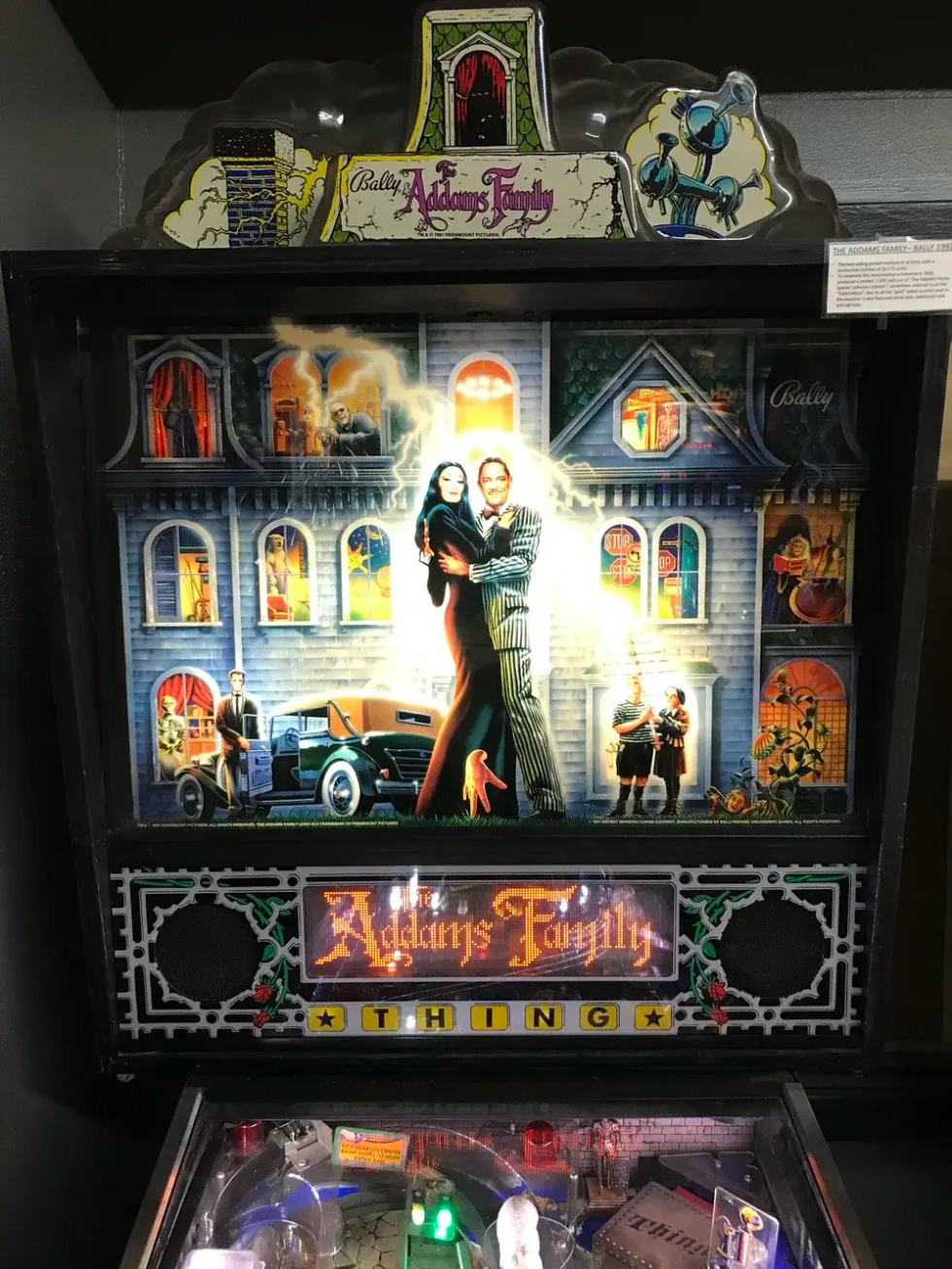
Among those machines, one had a different kind of presence: The Addams Family.
It was not just a colourful or instantly recognisable pinball table because of the film. It seemed alive. It had lights, metallic sounds, sudden kicks, digitised voices, theatrical pauses and violent restarts. You only had to hear it from a distance to know that someone was playing.
I remember Fester’s screams, Morticia saying “Gomez”, Cousin Itt announcing or accompanying the multiball, and that wonderful confusion in which every sound seemed designed to grab the attention of the whole bar. The Addams Family was never really silent: it commented, called, provoked and rewarded.
To be honest, I did not play it that much. Or at least that is how I remember it. More than a player, I was a spectator. I liked watching. I stayed close to the glass, following other people’s games, the movement of the ball, the reflexes of those who knew exactly when to strike, the hands moving almost without thought.
Good players seemed to speak directly to the machine. They nudged the cabinet with incredible naturalness, saved balls that looked already lost to me, hit ramps and targets as if they knew in advance where everything would go. I may not have truly understood the rules, but I understood when a game was becoming important.
Franco, the Guzzi and the aquarium
There were older kids, adults, regular customers. And then there was Franco.
Franco was the father of my best friend, but at Bar Acquario he was also something more: one of those people who belonged to the place. He played with us, talked to everyone, knew how to do a bit of everything. He also helped take care of the aquarium, as if that detail made the name of the bar even more meaningful.
You recognised him before you even saw him. He arrived on his Moto Guzzi California, car radio on, with that exhaust rumble you could not mistake for anything else. First the crackle, then the music, then him. Today it almost sounds like a scene written on purpose, but back then it was simply the way certain people entered your memories.
The motorcycle outside, the bar inside, the smoke, the pinball machine, us kids with our schoolbags and the adults standing in front of the same machines. Looking back now, the strangest thing is exactly that: in front of that pinball table, ages mixed together. It was not like school, where adults were teachers, parents, janitors, separate figures. There they were opponents, playing companions, spectators, people to beat or people to observe.
There could be a kid with a schoolbag still on his shoulders and, next to him, a man with a cigarette between his fingers, both focused on the same silver ball.
The “stock” of a won game
The challenges could last a very long time.
The Addams Family had this ability: it could turn a game into a small event. When someone was good, you understood it even without really knowing all the rules. The ball stayed alive longer than usual, ramps lit up, voices came in at the right moment, the score climbed, and around the table a silent tension formed among those watching and waiting for the mistake. Or the perfect shot.
By standing there so often, I had learned the language of the machine. Not as a player, but as a spectator. I knew when something was going well, when the table was entering an important phase, when the player had just saved a ball that seemed destined to disappear. Every sound had a meaning, even if I could not have explained it.
And then there was that moment.
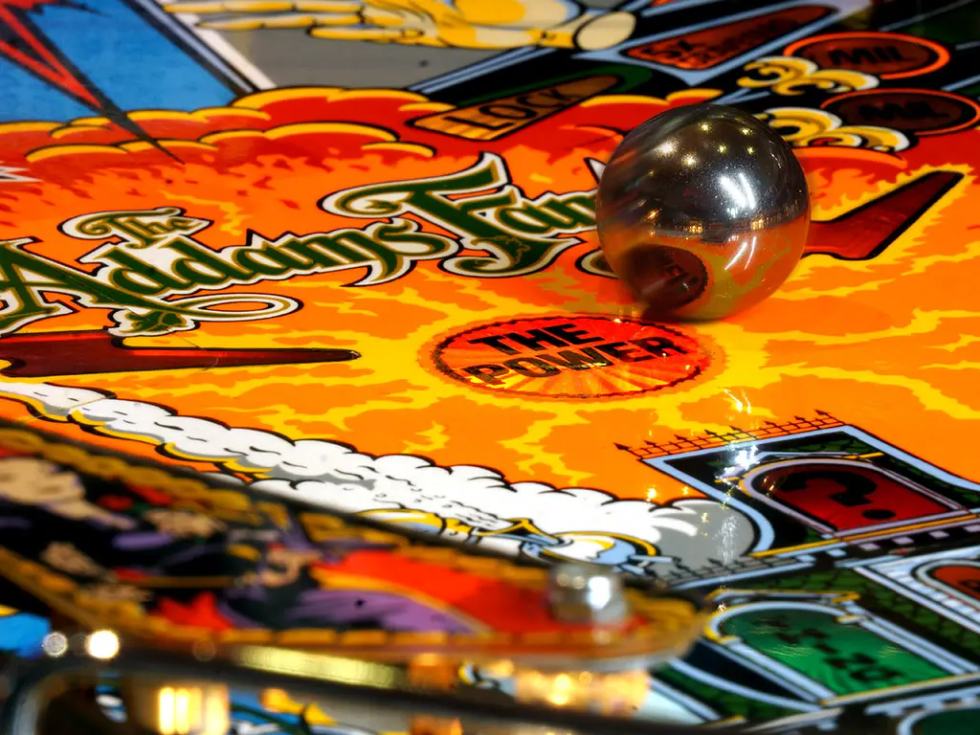
When someone beat the record, or reached an important threshold, there came the “stock”: the sharp knock of the knocker. A dry, clear, unmistakable sound that meant only one thing: game won. Credit earned. Another chance.
For us it was a kind of mechanical applause. Nobody had to say anything. You heard it and understood. The pinball machine had recognised the player and granted him more time. In a bar where everything was constantly moving — coffees, cigarettes, buses, customers coming and going — that knock stopped the afternoon for an instant. As if it were saying: stay a little longer.
Before collecting, everyday life
The Addams Family, produced by Bally in 1992 and inspired by the film released the previous year, would become one of the most famous and widespread pinball machines ever made. But that is something I understood later.
At the time, I did not care about production numbers, collector value or historical importance. For me, it was simply the pinball machine at Bar Acquario. The one you heard as soon as you walked in. The one that always had someone around it. The one that seemed bigger than the place that hosted it.
Today, pinball machines are photographed, restored and collected. You see them clean, perfectly lit, with flawless glass and polished plastics. It is beautiful, of course. But in my memory, The Addams Family is not like that.
It is slightly dirty, smoky, full of fingerprints. Its light is filtered through cigarette smoke, with the sound of coffee behind it, the bar door opening, the Guzzi engine outside, us with our schoolbags and adults playing as if they were kids too.
It was not an exhibition piece. It was a piece of everyday life.
What remains
Maybe that is what is missing the most today. Not the smoke, no. Not the nicotine stains on the cabinets, not the cigarettes left on the glass, not that heavy air that stayed on your clothes. We can safely leave all of that to the 1990s.
What is missing is everything else: the idea that a game could live in a public place and bring different people together. Kids and adults, experts and curious onlookers, players and spectators, someone stopping for a coffee and ending up commenting on a game.
Pinball was physical, noisy, social. You did not own it. You found it. You had to leave the house, reach the bar, have a few coins, wait your turn. Even when you did not play, you were part of it. You watched, learned, cheered, joked, stayed there. The game belonged to the person pressing the buttons, but somehow also to everyone standing around it.
When I think of The Addams Family, then, I do not immediately think of a technical sheet. I think of Ugo Foscolo, the 272 bus, Bar Acquario. I think of Giorgio, his moustache, the aquarium. I think of Franco arriving on his Moto Guzzi California with the stereo on. I think of the digitised voices, the endless after-school challenges, Fester screaming, Morticia calling Gomez, Cousin Itt and the multiball.
And above all, I think of that sudden dry sound, that unexpected knock, giving away another game.
A small metallic noise, almost ordinary. But for a kid standing at the bus terminus, in a bar full of smoke and lights, it could feel like the promise that the afternoon was not over yet.
Reader memories
Comments, memories and points of view stay here, beside the article.
Comment rulesLog in or register to leave a comment.
Leave a comment
Create your account
Loading comments...