






Nintendo 64
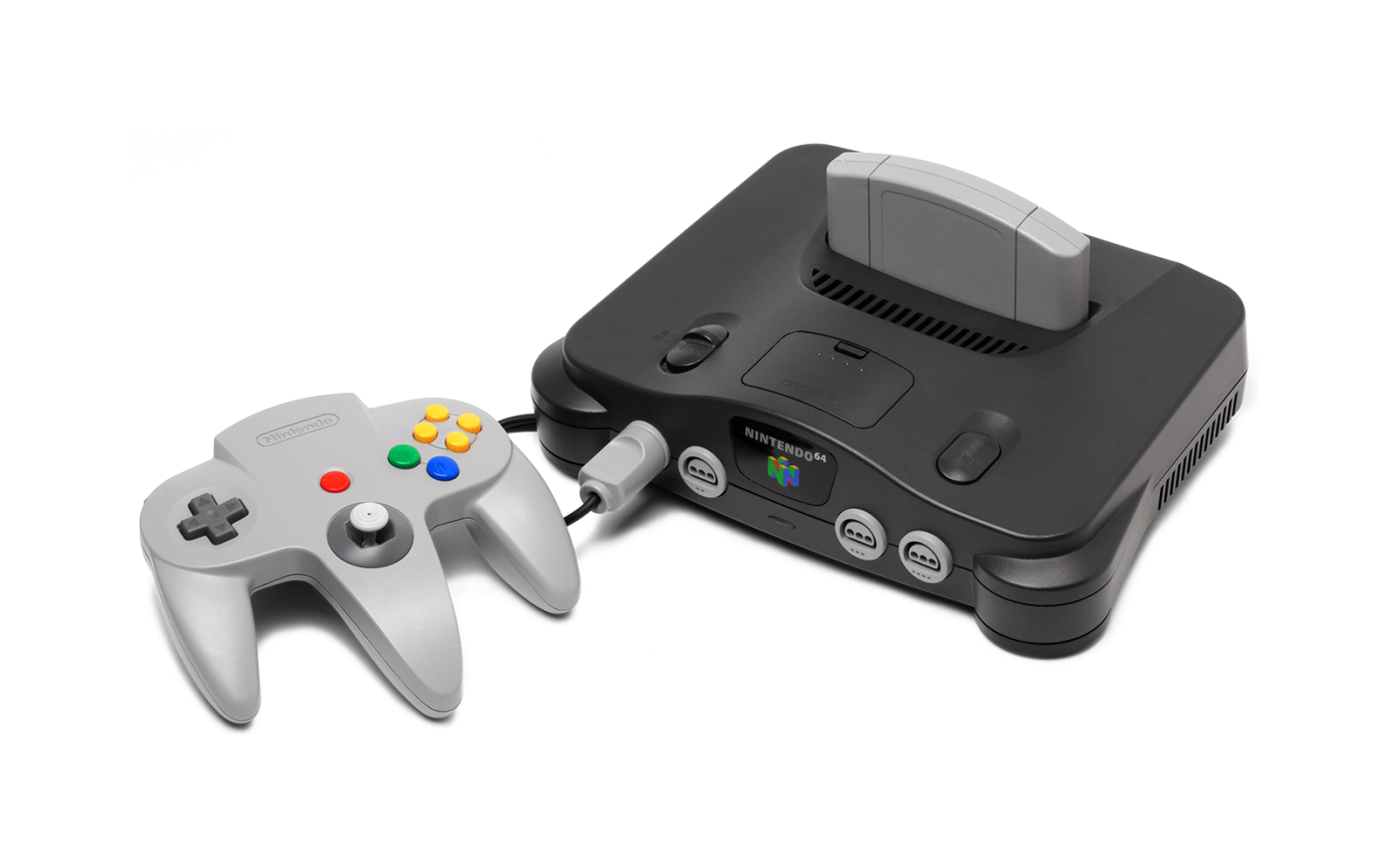
Launched by Nintendo in Japan and North America in 1996, and in Europe in 1997, the Nintendo 64 arrived in the middle of the transition to 3D. The console competed mainly with the Sony PlayStation and Sega Saturn, but chose a different path: powerful hardware, analogue control and cartridge-based software, while the rest of the market was rapidly moving toward CD-ROM.
The machine used a 64-bit NEC VR4300 CPU, based on the MIPS architecture, running at around 93.75 MHz, supported by the Reality Co-Processor developed with Silicon Graphics. It featured 4 MB of RDRAM, expandable to 8 MB with the Expansion Pak. Its graphics focused on textured polygons, bilinear filtering, anti-aliasing and z-buffering, with variable resolutions often around 320×240 pixels. The cartridge format ensured almost non-existent loading times, but limited storage capacity, raised costs and reduced third-party support compared with CD-based systems.
Worldwide sales are generally reported at around 32-33 million units. The Nintendo 64 did not dominate its generation, but it defined many of the rules of 3D gaming on consoles, from analogue movement to camera control and four-player local multiplayer. Its legacy lives through Super Mario 64, The Legend of Zelda: Ocarina of Time, GoldenEye 007, Mario Kart 64, Banjo-Kazooie, Star Fox 64, Perfect Dark and Wave Race 64.