






Squaresoft
- Developer
- Publisher
SquareSoft was one of the most important Japanese game companies of the 8-bit, 16-bit and 32-bit eras, best known for the creation and evolution of Final Fantasy.
History
SquareSoft began as the video game brand of Square, a company founded in Japan in 1983 by Masafumi Miyamoto as the software division of Den-Yu-Sha, a family-owned electrical construction business. In its early years Square published games for Japanese computers such as the NEC PC-8801 and Fujitsu FM-7, in a market where small teams could still experiment freely and the line between personal computers and consoles was not yet fixed. In 1986 Square became independent as Square Co., Ltd. and began to focus more clearly on the Famicom, looking for an identity in a field dominated by Nintendo, Namco, Hudson and the first major Japanese software houses.
The decisive moment came in 1987 with Final Fantasy, directed by Hironobu Sakaguchi and developed for the Famicom. The game was created during a difficult period for Square and has often been described as a last chance, although the “final game” story has been simplified over time. What matters is the result. Final Fantasy gave Square a clear direction built around fantasy worlds, parties of characters, statistical growth, long journeys, melodrama and increasingly ambitious audiovisual design. Around Sakaguchi, several key figures emerged: Nobuo Uematsu for music, Yoshitaka Amano for visual identity, Nasir Gebelli for the programming of the early games and, later, Kazuko Shibuya, Hiroyuki Ito, Akitoshi Kawazu and other creators who would define different sides of Square’s RPG language.
During the Super Famicom years, Square reached extraordinary maturity. Final Fantasy IV, V and VI expanded the narrative range of Japanese role-playing games, while Secret of Mana, Romancing SaGa, Live A Live, Front Mission, Bahamut Lagoon and especially Chrono Trigger showed a company able to work across very different systems, rhythms and tones. Its relationship with Nintendo was extremely strong, but creatively Square was never just a supplier. It became a laboratory for the JRPG, where design, music, pixel art and storytelling were constantly searching for more expressive forms. This period also involved creators such as Tetsuya Takahashi, Yasunori Mitsuda, Tetsuya Nomura and Yoshinori Kitase, who would become central to the next phase.
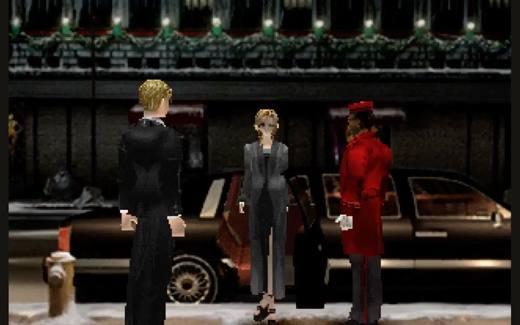
The symbolic break came with the move to PlayStation. Square chose Sony’s CD-ROM format for Final Fantasy VII, released in 1997, leaving Nintendo 64 and its cartridges behind. It was a huge turning point: computer-generated cutscenes, cyberpunk settings, global marketing and a protagonist like Cloud Strife brought the JRPG to a much wider international audience. From that moment, SquareSoft became one of the key names of the PlayStation era, with Final Fantasy VIII, Final Fantasy IX, Final Fantasy Tactics, Xenogears, Parasite Eve, Brave Fencer Musashi, Vagrant Story, Chrono Cross and Threads of Fate. Not every project achieved the same commercial success, but the period remains one of the most creative in Japanese video game history.
At the beginning of the 2000s, Square entered a more fragile phase. Final Fantasy: The Spirits Within, released in 2001, was a huge investment and a major commercial failure, weakening the company. At the same time, Square released Final Fantasy X, the first main entry on PlayStation 2, Final Fantasy XI as an MMORPG, and Kingdom Hearts, created in collaboration with Disney and directed by Tetsuya Nomura. In 2003 Square merged with Enix, its historic RPG rival and the company behind Dragon Quest, forming Square Enix. The end of SquareSoft as an independent identity closed a unique era: the story of a studio that turned the JRPG from a Japanese niche into a global language, combining technology, music, melodrama and visual ambition with rare force.